
Copper-tailed Ctenotus

Copper-tailed Ctenotus

Ctenotus taeniolatus

Silhouette: David Orr · PhyloPic

LCLeast ConcernNTVUENCR Endemic
Daily sighting probability ~20% · Possible
at Blue Mountains National Park

In 3 days ~60% in a week ~90%

93 Verified sightings at Blue Mountains National Park From 2019 to 2026
181 In all 3 parks
January Best month
☀️ Diurnal When it's spotted

About the Copper-tailed Ctenotus

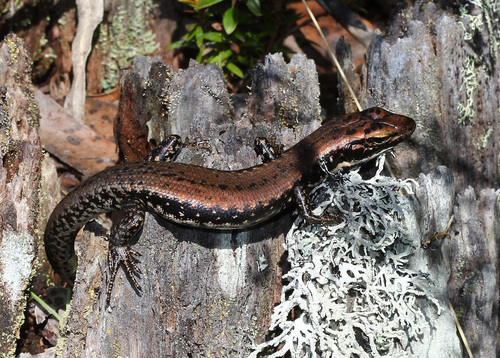
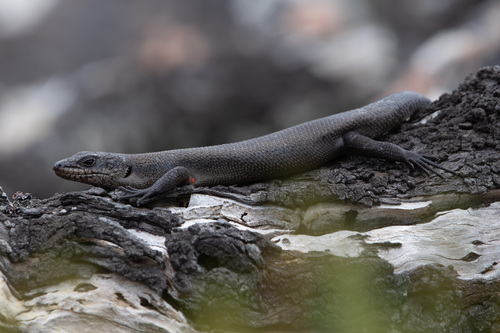
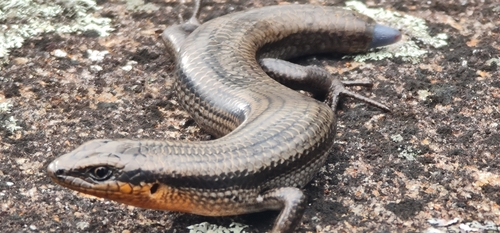
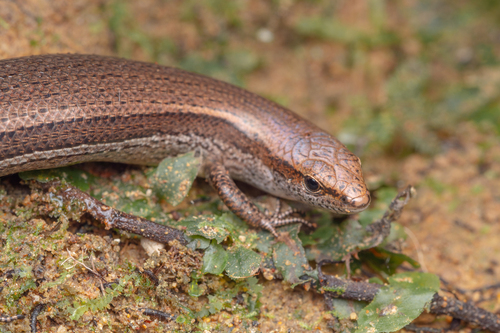
Ctenotus taeniolatus, the copper-tailed ctenotus or copper-tailed skink, is a species of medium-sized skink found commonly along the eastern seaboard of Australia and throughout the country generally. Striped skinks are found in open bushland and heathland. They can grow to be 30 cm long.

Striped skinks are olive brown on top with stripes of dark brown and white running from head to tail. They have a black, white-edged vertebral band and a white dorsolateral band edged in black. The sides are dark brown and spotted with white.

Like most skinks, they eat mainly small invertebrates like insects and worms. They live in rocky and sandy areas, seeking sunny basking spots with cover nearby so they can dart away from predators. photo of Ctenotus taeniolatus, Townsville Reptiles

photo of Ctenotus taeniolatus, Museum Victoria photo of Ctenotus taeniolatus, Museum Victoria Wikipedia →

Global Distribution

Parks Where Found

# Park Country Daily sighting probability
1 Royal National Park 🇦🇺 Australia
~30%
2 Blue Mountains National Park 🇦🇺 Australia
~20%
3 Noosa National Park 🇦🇺 Australia
~10%

Cities Where Found

# City Country Daily sighting probability
1 Sydney 🇦🇺 Australia
~10%
2 Brisbane 🇦🇺 Australia
<5%

Closest Relatives at Blue Mountains National Park

Before you go

What are the chances of seeing a Copper-tailed Ctenotus in Blue Mountains National Park?

Possible

About 20% of wildlife watchers report a Copper-tailed Ctenotus sighting in Blue Mountains National Park on a given day, based on 93 verified sightings from GBIF citizen-science data from 2019 to 2026. It is the 14th most-seen of the 44 reptiles we can rate there. Over three days the chance rises to about 60%, and over a week to about 90%, if each day is a fresh chance.

When is the best time to see a Copper-tailed Ctenotus in Blue Mountains National Park?

January–February and October

In those months about 30% of wildlife watchers report a Copper-tailed Ctenotus in Blue Mountains National Park on a given day, against under 5% in May and June, the lowest months.

What time of day is best to see a Copper-tailed Ctenotus?

Between 10 am and 1 pm

Across all the parks we cover, that three-hour window holds the most Copper-tailed Ctenotus sightings with a recorded time, and nearly all of them come between 6 am and 6 pm: it is a daytime animal.

Is Blue Mountains National Park the best place to see a Copper-tailed Ctenotus?

2nd of 3

Of the 3 parks where we can rate Copper-tailed Ctenotus sightings, Blue Mountains National Park ranks 2nd at about 20%. The best odds are in Royal National Park (Australia, about 30%).

Which relatives of the Copper-tailed Ctenotus live in Blue Mountains National Park?

Same family: Scincidae

The closest relatives of the Copper-tailed Ctenotus that you can see in Blue Mountains National Park (family Scincidae, Skinks) are Southern Water Skink (about 40%), Eastern Water Skink (about 40%) and Blotched Bluetongue (about 30%), with each one's daily chance of a sighting.

Where does the Copper-tailed Ctenotus sighting chance come from?

GBIF citizen-science records

It is estimated from how often the Copper-tailed Ctenotus is recorded against all the reptiles logged in Blue Mountains National Park (93 verified sightings from 2019 to 2026), calibrated against known sighting rates. Figures are rounded to the nearest 10% because citizen-science data supports honest approximations, not decimals, and months with records from fewer than five people show "—". How it works.

← Back to Blue Mountains National Park