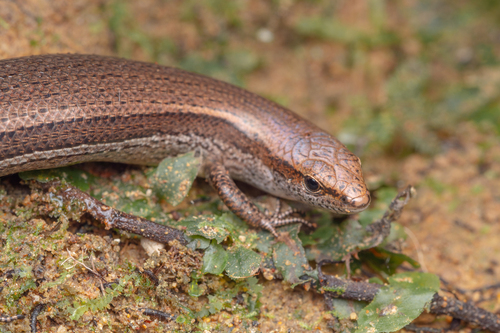
Eastern Water Skink

Eastern Water Skink

Eulamprus quoyii

Silhouette: David Orr · PhyloPic

LCLeast ConcernNTVUENCR Endemic
Daily sighting probability ~40% · Likely
at Blue Mountains National Park

In 3 days ~70% in a week >90%

210 Verified sightings at Blue Mountains National Park From 2019 to 2026
621 In all 5 parks
December Best month
☀️ Diurnal When it's spotted

About the Eastern Water Skink

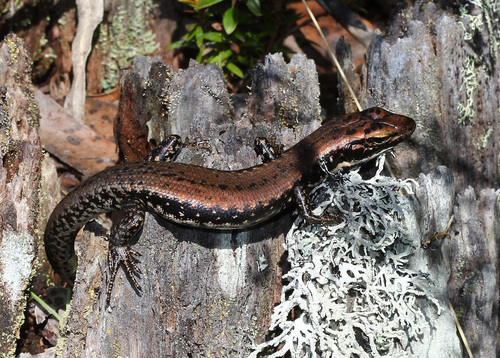
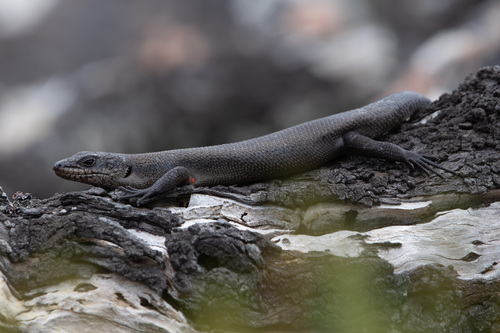
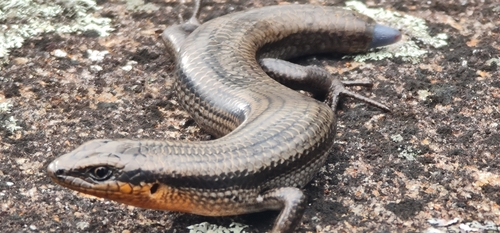
Eulamprus quoyii, more commonly known as the eastern water skink, eastern water-skink, or golden water skink, is a viviparous species of diurnal skink. Eulamprus quoyii belongs to the family Scincidae and is considered a common garden animal in Australia. The skink is endemic to Australia and found only along the east coast of the country. It makes its home in creekside habitats along the east coast of Australia and in urban garden areas with high amounts of moisture. The species can be identified by the twin, long yellow stripes that run along its body from the top of the eye, as well as by several more specific character derived states. The pale yellow dorsolateral stripes are most likely where its common name, the golden water skink, is derived. Like other ectotherms, the skink can often be seen basking in the sun on rocky outcroppings in order to regulate its body temperature. Its diet mainly consists of both aquatic and terrestrial insects, tadpoles and small amounts of plant matter. The skink both hunts for food and scavenges when necessary and is considered an opportunistic feeder. It is prey to larger lizards, snakes, cats and birds and so will often be seen moving quickly into hiding when other organisms are present. Wikipedia →

Global Distribution

Parks Where Found

# Park Country Daily sighting probability
1 Royal National Park 🇦🇺 Australia
~50%
2 Lamington National Park 🇦🇺 Australia
~50%
3 Blue Mountains National Park 🇦🇺 Australia
~40%
4 Booderee National Park 🇦🇺 Australia
~30%
5 Springbrook National Park 🇦🇺 Australia
~20%

Cities Where Found

# City Country Daily sighting probability
1 Sydney 🇦🇺 Australia
~40%
2 Brisbane 🇦🇺 Australia
~30%

Zoos & Centres Where Found

# Zoo / Centre Country
1 Australia Zoo 🇦🇺 Australia In captivity
2 Adelaide Zoo 🇦🇺 Australia In captivity
3 Vivarium Darmstadt 🇩🇪 Germany In captivity
4 Featherdale Sydney Wildlife Park 🇦🇺 Australia In captivity

Closest Relatives at Blue Mountains National Park

Before you go

What are the chances of seeing an Eastern Water Skink in Blue Mountains National Park?

Likely

About 40% of wildlife watchers report an Eastern Water Skink sighting in Blue Mountains National Park on a given day, based on 210 verified sightings from GBIF citizen-science data from 2019 to 2026. It is the 4th most-seen of the 44 reptiles we can rate there. Over three days the chance rises to about 70%, and over a week to over 90%, if each day is a fresh chance.

When is the best time to see an Eastern Water Skink in Blue Mountains National Park?

December

In that month about 60% of wildlife watchers report an Eastern Water Skink in Blue Mountains National Park on a given day, against under 5% in May and June, the lowest months.

What time of day is best to see an Eastern Water Skink?

Between noon and 3 pm

Across all the parks we cover, that three-hour window holds the most Eastern Water Skink sightings with a recorded time, and nearly all of them come between 6 am and 6 pm: it is a daytime animal.

Is Blue Mountains National Park the best place to see an Eastern Water Skink?

3rd of 5

Of the 5 parks where we can rate Eastern Water Skink sightings, Blue Mountains National Park ranks 3rd at about 40%. The best odds are in Royal National Park (Australia, about 50%) and Lamington National Park (Australia, about 50%). All parks ranked.

Where does the Eastern Water Skink sighting chance come from?

GBIF citizen-science records

It is estimated from how often the Eastern Water Skink is recorded against all the reptiles logged in Blue Mountains National Park (210 verified sightings from 2019 to 2026), calibrated against known sighting rates. Figures are rounded to the nearest 10% because citizen-science data supports honest approximations, not decimals, and months with records from fewer than five people show "—". How it works.

← Back to Blue Mountains National Park