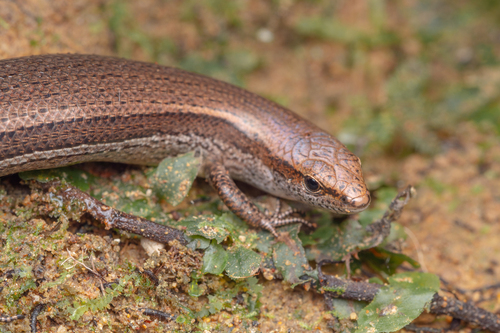
Common Bluetongue

Common Bluetongue

Tiliqua scincoides

Silhouette: David Orr · PhyloPic

LCLeast ConcernNTVUENCR Endemic
Daily sighting probability ~30% · Possible
at Blue Mountains National Park

In 3 days ~60% in a week ~90%

105 Verified sightings at Blue Mountains National Park From 2019 to 2026
217 In all 7 parks
November Best month
☀️ Diurnal When it's spotted

About the Common Bluetongue

Tiliqua scincoides is a species of lizard in the subfamily Egerniinae of the family Scincidae (skinks). The species is native to Australia as well Tanimbar Island (Maluku Province, Indonesia). There are three recognized subspecies.

Common names for Tiliqua scincoides include common blue-tongued lizard, common blue-tongued skink, blue-tongued lizard, and common bluetongue. Three subspecies of Tiliqua scincoides are recognized as being valid, including the nominotypical subspecies (listed in chronological order).

Tiliqua scincoides scincoides (White, 1790) – eastern blue-tongued skink (southern/eastern Australia) Tiliqua scincoides intermedia Mitchell, 1955 – northern blue-tongued skink (northern Australia) Tiliqua scincoides chimaera Shea, 2000 – Tanimbar blue-tongued skink (Maluku Province, Indonesia)

Nota bene: A trinomial authority in parentheses indicates that the subspecies was originally described in a genus other than Tiliqua. Tiliqua scincoides is a large species of terrestrial blue-tongue measuring upwards of 60 cm (24 in) in total length (tail included), and over 1 kg (2.2 lb) in mass. It has a stout body and short legs... Wikipedia →

Global Distribution

Parks Where Found

# Park Country Daily sighting probability
1 Noosa National Park 🇦🇺 Australia
~40%
2 Blue Mountains National Park 🇦🇺 Australia
~30%
3 Royal National Park 🇦🇺 Australia
~30%
4 Booderee National Park 🇦🇺 Australia
~20%
5 Kakadu National Park 🇦🇺 Australia
~10%
6 Grampians National Park 🇦🇺 Australia
~10%
7 Great Otway National Park 🇦🇺 Australia
~10%

Cities Where Found

# City Country Daily sighting probability
1 Sydney 🇦🇺 Australia
~30%
2 Brisbane 🇦🇺 Australia
~30%
3 Melbourne 🇦🇺 Australia
~20%

Zoos & Centres Where Found

# Zoo / Centre Country
1 Disney's Animal Kingdom 🇺🇸 United States In captivity
2 Moscow Zoo 🇷🇺 Russia In captivity
3 National Zoological Park 🇺🇸 United States In captivity
4 Shedd Aquarium 🇺🇸 United States In captivity
5 ZooParc de Beauval 🇫🇷 France In captivity
6 Denver Zoo 🇺🇸 United States In captivity
7 Cincinnati Zoo and Botanical Garden 🇺🇸 United States In captivity
8 North Carolina Zoo 🇺🇸 United States In captivity
9 Australia Zoo 🇦🇺 Australia In captivity
10 Jihlava Zoo 🇨🇿 Czechia In captivity
11 Greensboro Science Center 🇺🇸 United States In captivity
12 Kaliningrad Zoo 🇷🇺 Russia In captivity
13 Binder Park Zoo 🇺🇸 United States In captivity
14 Taipei Zoo 🇹🇼 Taiwan In captivity
15 Living Desert Zoo and Gardens 🇺🇸 United States In captivity
16 Planète Sauvage 🇫🇷 France In captivity
17 Beijing Zoo 🇨🇳 China In captivity
18 Cheyenne Mountain Zoo 🇺🇸 United States In captivity
19 Oakland Zoo 🇺🇸 United States In captivity
20 National Zoological Garden of South Africa 🇿🇦 South Africa In captivity
21 São Paulo Zoo 🇧🇷 Brazil In captivity
22 Birmingham Zoo 🇺🇸 United States In captivity
23 Louisville Zoo 🇺🇸 United States In captivity
24 Out of Africa Wildlife Park 🇺🇸 United States In captivity
25 Guadalajara Zoo 🇲🇽 Mexico In captivity
26 Kyiv Zoo 🇺🇦 Ukraine In captivity
27 Colchester Zoo 🇬🇧 United Kingdom In captivity
28 Berlin Zoological Garden 🇩🇪 Germany In captivity
29 Caldwell Zoo 🇺🇸 United States In captivity
30 San Francisco Zoo 🇺🇸 United States In captivity
31 Franklin Park Zoo 🇺🇸 United States In captivity
32 Memphis Zoo 🇺🇸 United States In captivity
33 Taronga Zoo 🇦🇺 Australia In captivity
34 Zoo Opole 🇵🇱 Poland In captivity
35 Lone Pine Koala Sanctuary 🇦🇺 Australia In captivity
36 Perth Zoo 🇦🇺 Australia In captivity
37 Edmonton Valley Zoo 🇨🇦 Canada In captivity
38 Hanover Zoo 🇩🇪 Germany In captivity
39 Philadelphia Zoo 🇺🇸 United States In captivity
40 Honolulu Zoo 🇺🇸 United States In captivity
41 Schönbrunn Zoo 🇦🇹 Austria In captivity
42 Budapest Zoo & Botanical Garden 🇭🇺 Hungary In captivity
43 Forestry Farm Park and Zoo 🇨🇦 Canada In captivity
44 Zoo d'Amnéville 🇫🇷 France In captivity
45 Auckland Zoo 🇳🇿 New Zealand In captivity
46 Riverbanks Zoo 🇺🇸 United States In captivity
47 Lincoln Park Zoo 🇺🇸 United States In captivity
48 Hartley’s Crocodile Adventures 🇦🇺 Australia In captivity
49 Lahore Zoo 🇵🇰 Pakistan In captivity
50 Reserva Zoológica Oasys MiniHollywood 🇪🇸 Spain In captivity

Closest Relatives at Blue Mountains National Park

Before you go

What are the chances of seeing a Common Bluetongue in Blue Mountains National Park?

Possible

About 30% of wildlife watchers report a Common Bluetongue sighting in Blue Mountains National Park on a given day, based on 105 verified sightings from GBIF citizen-science data from 2019 to 2026. It is the 10th most-seen of the 44 reptiles we can rate there. Over three days the chance rises to about 60%, and over a week to about 90%, if each day is a fresh chance.

When is the best time to see a Common Bluetongue in Blue Mountains National Park?

September and November

In those months about 40% of wildlife watchers report a Common Bluetongue in Blue Mountains National Park on a given day, against under 5% in June, the lowest month.

What time of day is best to see a Common Bluetongue?

Between 10 am and 1 pm

Across all the parks we cover, that three-hour window holds the most Common Bluetongue sightings with a recorded time, and nearly all of them come between 6 am and 6 pm: it is a daytime animal.

Is Blue Mountains National Park the best place to see a Common Bluetongue?

2nd of 7

Of the 7 parks where we can rate Common Bluetongue sightings, Blue Mountains National Park ranks 2nd at about 30%. The best odds are in Noosa National Park (Australia, about 40%).

Where does the Common Bluetongue sighting chance come from?

GBIF citizen-science records

It is estimated from how often the Common Bluetongue is recorded against all the reptiles logged in Blue Mountains National Park (105 verified sightings from 2019 to 2026), calibrated against known sighting rates. Figures are rounded to the nearest 10% because citizen-science data supports honest approximations, not decimals, and months with records from fewer than five people show "—". How it works.

← Back to Blue Mountains National Park