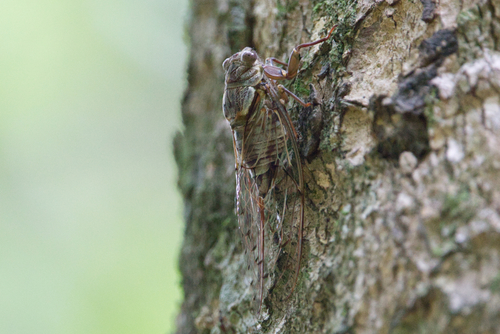
Razor Grinder

Razor Grinder

Henicopsaltria eydouxii

Daily sighting probability ~20% · Possible
at Booderee National Park

In 3 days ~40% in a week ~70%

10 Verified sightings at Booderee National Park From 2019 to 2026
269 In all 5 parks
January Best month
☀️ Diurnal When it's spotted

About the Razor Grinder

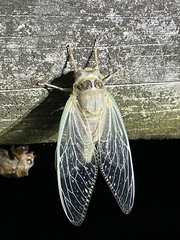
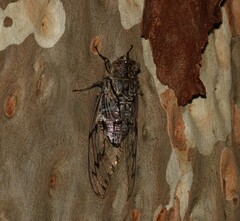
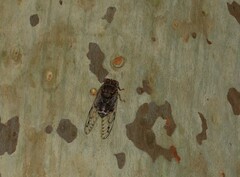
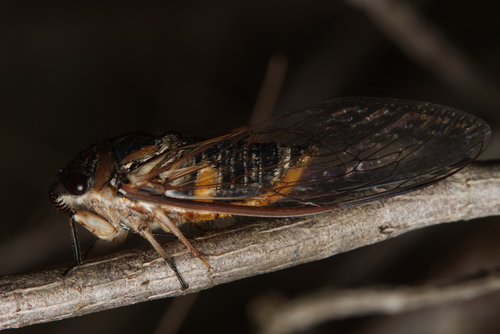
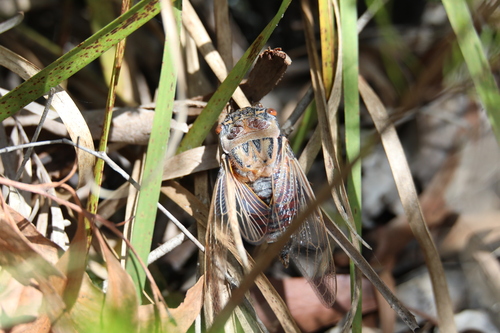
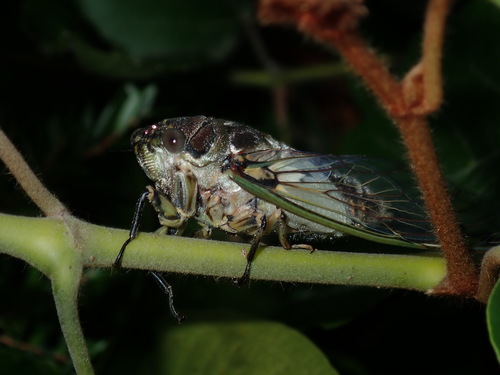
Henicopsaltria eydouxii, commonly known as the razor grinder, is a large species of cicada native to eastern Australia. Predominantly brown in colour, it is found in dry and wet sclerophyll forest in December and January and is quite common in Brisbane.

The razor grinder was first described in 1838 by Félix Édouard Guérin-Méneville as Cicada eydouxii before being moved to the new genus Henicopsaltria in 1866. It is the type species. Its common name refers to its harsh call, which has been likened to the noise of a metal grinder.

The razor grinder is a large cicada with a forewing measuring 50–55 mm (2.0–2.2 in). Males and females are similar in color and markings. The head and thorax is red-brown with black markings. The wings are transparent with some brown discoloration.

The male's call lasts for a few seconds, increases in volume, suddenly stops, and then suddenly starts again. They usually silently feed throughout the afternoon, and then groups call at maximum volume around dusk. There is a secondary population, referred to as the laughing razor grinder, which is only observed in rainforest and wet sclerophyll forest, and has a distinct call.

Razor... Wikipedia →
Global Distribution

Parks Where Found

# Park Country Daily sighting probability
1 Royal National Park 🇦🇺 Australia
~30%
2 Lamington National Park 🇦🇺 Australia
~20%
3 Blue Mountains National Park 🇦🇺 Australia
~20%
4 Booderee National Park 🇦🇺 Australia
~20%
5 Springbrook National Park 🇦🇺 Australia
~10%

Cities Where Found

# City Country Daily sighting probability
1 Brisbane 🇦🇺 Australia
<5%
2 Sydney 🇦🇺 Australia
<5%

Before you go

What are the chances of seeing a Razor Grinder in Booderee National Park?

Possible

About 20% of wildlife watchers report a Razor Grinder sighting in Booderee National Park on a given day, based on 10 verified sightings from GBIF citizen-science data from 2019 to 2026. It is the 13th most-seen of the 59 insects we can rate there. Over three days the chance rises to about 40%, and over a week to about 70%, if each day is a fresh chance.

When is the best time to see a Razor Grinder in Booderee National Park?

January

In that month about 40% of wildlife watchers report a Razor Grinder in Booderee National Park on a given day, against under 5% in March to November, the lowest months.

What time of day is best to see a Razor Grinder?

Between 9 am and noon

Across all the parks we cover, that three-hour window holds the most Razor Grinder sightings with a recorded time, and about 8 in 10 of them come between 6 am and 6 pm: it is a daytime animal.

Which relatives of the Razor Grinder live in Booderee National Park?

Same family: Cicadidae

The closest relatives of the Razor Grinder that you can see in Booderee National Park (family Cicadidae, Typical Cicadas) are Yellowbelly (about 20%), Eastern Double Drummer (about 20%) and White Drummer (about 10%), with each one's daily chance of a sighting.

Where does the Razor Grinder sighting chance come from?

GBIF citizen-science records

It is estimated from how often the Razor Grinder is recorded against all the insects logged in Booderee National Park (10 verified sightings from 2019 to 2026), calibrated against known sighting rates. Figures are rounded to the nearest 10% because citizen-science data supports honest approximations, not decimals, and months with records from fewer than five people show "—". How it works.

← Back to Booderee National Park