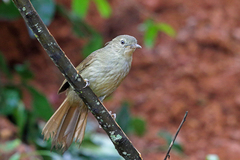
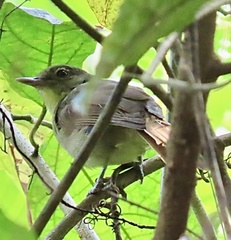
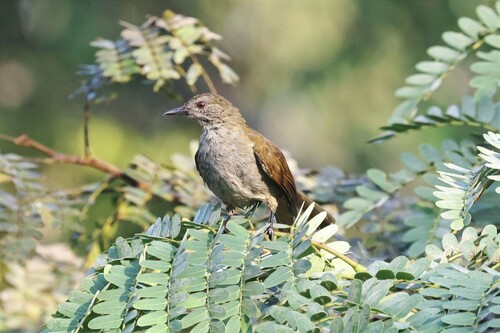
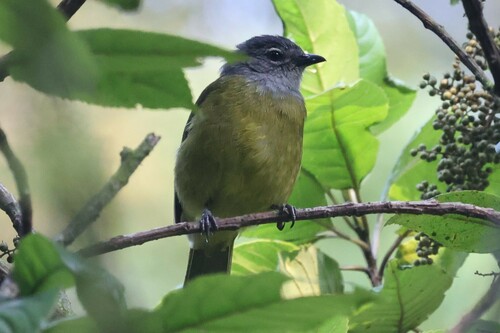
Cabanis's Greenbul

Cabanis's Greenbul

Phyllastrephus cabanisi

Silhouette: PhyloPic

LCLeast ConcernNTVUENCR
Daily sighting probability ~10% · With luck
at Bwindi Impenetrable National Park

In 3 days ~30% in a week ~60%

237 Verified sightings at Bwindi Impenetrable National Park From 2019 to 2026
523 In all 6 parks
December Best month
☀️ Diurnal When it's spotted

About the Cabanis's Greenbul

Cabanis's greenbul (Phyllastrephus cabanisi), also known as Cabanis's bulbul, is a species of songbird in the bulbul family, Pycnonotidae. It is found in east-central and south-central Africa. Its natural habitats are subtropical or tropical dry forest, subtropical or tropical moist lowland forest, subtropical or tropical moist montane forest, and subtropical or tropical moist shrubland.

Cabanis's greenbul was formally described in 1880 by the German ornithologist Jean Cabanis under the binomial name Trichophorus flaveolus based on a specimen that had been collected in Angola. Unfortunately, the scientific name was pre-occupied by Trichophorus flaveolus that had been introduced by John Gould in 1836 for the white-throated bulbul, now Alophoixus flaveolus. In 1882 the English ornithologist Richard Bowdler Sharpe proposed the replacement name, Criniger cabanisi, with the specific epithet chosen to honour Cabanis who had first described the species. Cabanis's greenbul is now one of 20 greenbuls placed in the genus Phyllastrephus that was introduced in 1832 by William Swainson. The genus name combines the Ancient Greek φυλλον/phullon meaning "leaf" with στρεφω/strephō meaning... Wikipedia →

Sounds

Song and call0:34

Kenya · 2024

© Peter Boesman · XC948333 · CC BY-NC-ND 4.0

Duet0:14

Zambia · 2023

© Dries Van de Loock · XC854349 · CC BY-NC-ND 4.0

Call0:49

Zambia · 2026

© Magnus Wadstein · XC1101940 · CC BY-NC-SA 4.0

Global Distribution

Parks Where Found

# Park Country Daily sighting probability
1 Arusha National Park 🇹🇿 Tanzania
~20%
2 Bwindi Impenetrable National Park 🇺🇬 Uganda
~10%
3 Nyungwe National Park 🇷🇼 Rwanda
~10%
4 Nairobi National Park 🇰🇪 Kenya
<5%
5 Kibale National Park 🇺🇬 Uganda
<5%
6 Ngorongoro Conservation Area 🇹🇿 Tanzania
<5%

Cities Where Found

# City Country Daily sighting probability
1 Nairobi 🇰🇪 Kenya
~10%

Before you go

What are the chances of seeing a Cabanis's Greenbul in Bwindi Impenetrable National Park?

With luck

About 10% of wildlife watchers report a Cabanis's Greenbul sighting in Bwindi Impenetrable National Park on a given day, based on 237 verified sightings from GBIF citizen-science data from 2019 to 2026. It is the 120th most-seen of the 400 birds we can rate there. Over three days the chance rises to about 30%, and over a week to about 60%, if each day is a fresh chance.

When is the best time to see a Cabanis's Greenbul in Bwindi Impenetrable National Park?

May, July, September and December

In those months about 20% of wildlife watchers report a Cabanis's Greenbul in Bwindi Impenetrable National Park on a given day, against about 10% in January–April, June, August and October–November, the lowest months.

What time of day is best to see a Cabanis's Greenbul?

Between 9 am and noon

Across all the parks we cover, that three-hour window holds the most Cabanis's Greenbul sightings with a recorded time, and about 9 in 10 of them come between 6 am and 6 pm: it is a daytime animal.

Is Bwindi Impenetrable National Park the best place to see a Cabanis's Greenbul?

2nd of 6

Of the 6 parks where we can rate Cabanis's Greenbul sightings, Bwindi Impenetrable National Park ranks 2nd at about 10%. The best odds are in Arusha National Park (Tanzania, about 20%).

Which relatives of the Cabanis's Greenbul live in Bwindi Impenetrable National Park?

Same genus: Phyllastrephus

The closest relatives of the Cabanis's Greenbul that you can see in Bwindi Impenetrable National Park (genus Phyllastrephus, Typical Greenbuls and Brownbuls) are Yellow-streaked Bulbul (about 20%) and Toro Olive-Greenbul (about 10%), with each one's daily chance of a sighting.

Where does the Cabanis's Greenbul sighting chance come from?

GBIF citizen-science records

It is estimated from how often the Cabanis's Greenbul is recorded against all the birds logged in Bwindi Impenetrable National Park (237 verified sightings from 2019 to 2026), calibrated against known sighting rates. Figures are rounded to the nearest 10% because citizen-science data supports honest approximations, not decimals, and months with records from fewer than five people show "—". How it works.

← Back to Bwindi Impenetrable National Park