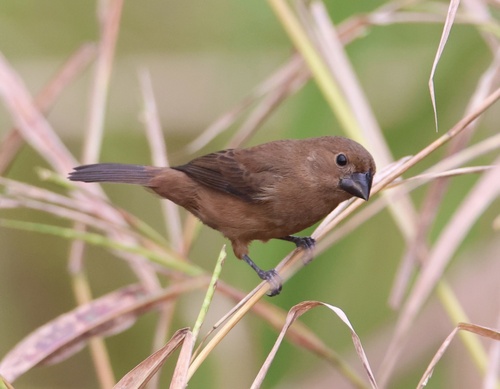
Rufous-winged Tanager

Rufous-winged Tanager

Tangara lavinia

Silhouette: Sheatherius · PhyloPic

LCLeast ConcernNTVUENCR
Daily sighting probability <5% · Rare
at Cahuita National Park

In 3 days <5% in a week ~10%

8 Verified sightings at Cahuita National Park From 2019 to 2026
2,848 In all 12 parks
October Best month
☀️ Diurnal When it's spotted

About the Rufous-winged Tanager

The rufous-winged tanager (Tangara lavinia) is a species of bird in the family Thraupidae. It is found in Colombia, Costa Rica, Ecuador, Honduras, Nicaragua, and Panama. Its natural habitats are subtropical or tropical moist lowland forests and heavily degraded former forest.

The rufous-winged tanager was first described as Castille lavinia by John Cassin in 1858, on the basis of a specimen collected by W.S. Wood, Jr. at the Isthmus of Panama. The generic name Tangara is from the Tupí word tangara, meaning dancer. The specific name lavinia is after the artist Lavinia Bowen. Rufous-winged tanager is the official common name designated by the International Ornithologists' Union (IOC). Other names for the species include rufous winged tanager and Lavinia's tanager.

It is one of 27 species in the genus Tangara. Within the genus, it was placed in a species group with the bay-headed tanager and rufous-cheeked tanager by Isler and Isler in 1987. This placement is supported by mitochondrial DNA evidence. Within the species group, the rufous-winged tanager is sister to the bay-headed tanager.

There are three recognized subspecies of the saffron... Wikipedia →

Sounds

Call0:29

Ecuador · 2025

© Manuel Sánchez-Nivicela · XC1179302 · CC BY-NC-ND 4.0

Song0:14

Ecuador · 1998

© Patricio Mena Valenzuela · XC275634 · CC BY-NC-SA 4.0

Flight call0:09

Ecuador · 1997

© Olaf Jahn · XC262585 · CC BY-NC-SA 4.0

Global Distribution

Parks Where Found

# Park Country Daily sighting probability
1 Chagres National Park 🇵🇦 Panama
~30%
2 Tenorio Volcano National Park 🇨🇷 Costa Rica
~20%
3 Arenal Volcano National Park 🇨🇷 Costa Rica
~10%
4 Farallones de Cali National Natural Park 🇨🇴 Colombia
<5%
5 Rincón de la Vieja National Park 🇨🇷 Costa Rica
<5%
6 Darién National Park 🇵🇦 Panama
<5%
7 Pico Bonito National Park 🇭🇳 Honduras
<5%
8 Gandoca-Manzanillo Wildlife Refuge 🇨🇷 Costa Rica
<5%
9 Cahuita National Park 🇨🇷 Costa Rica
<5%
10 Braulio Carrillo National Park 🇨🇷 Costa Rica
<5%
11 Tapantí-Macizo de la Muerte National Park 🇨🇷 Costa Rica
<5%
12 La Amistad International Park (Panama) 🇵🇦 Panama
<5%

Zoos & Centres Where Found

# Zoo / Centre Country
1 Dallas World Aquarium 🇺🇸 United States In captivity

Before you go

What are the chances of seeing a Rufous-winged Tanager in Cahuita National Park?

Rare

Under 5% of wildlife watchers report a Rufous-winged Tanager sighting in Cahuita National Park on a given day, based on 8 verified sightings from GBIF citizen-science data from 2019 to 2026. It is the 265th most-seen of the 303 birds we can rate there. Over three days the chance rises to under 5%, and over a week to about 10%, if each day is a fresh chance.

When is the best time to see a Rufous-winged Tanager in Cahuita National Park?

Any time of year

In every month with enough records, under 5% of wildlife watchers report a Rufous-winged Tanager in Cahuita National Park on a given day, so our monthly data shows no clear season.

What time of day is best to see a Rufous-winged Tanager?

Between 8 and 11 am

Across all the parks we cover, that three-hour window holds the most Rufous-winged Tanager sightings with a recorded time, and about 9 in 10 of them come between 6 am and 6 pm: it is a daytime animal.

Where does the Rufous-winged Tanager sighting chance come from?

GBIF citizen-science records

It is estimated from how often the Rufous-winged Tanager is recorded against all the birds logged in Cahuita National Park (8 verified sightings from 2019 to 2026), calibrated against known sighting rates. Figures are rounded to the nearest 10% because citizen-science data supports honest approximations, not decimals, and months with records from fewer than five people show "—". How it works.

← Back to Cahuita National Park