Giant Woodwasp

Giant Woodwasp

Urocerus gigas

Daily sighting probability ~10% · With luck
at Cairngorms National Park

In 3 days ~30% in a week ~50%

16 Verified sightings at Cairngorms National Park From 2019 to 2026
51 In all 5 parks
August Best month
☀️ Diurnal When it's spotted

About the Giant Woodwasp

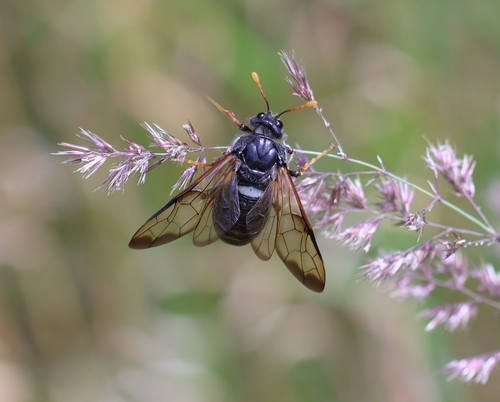
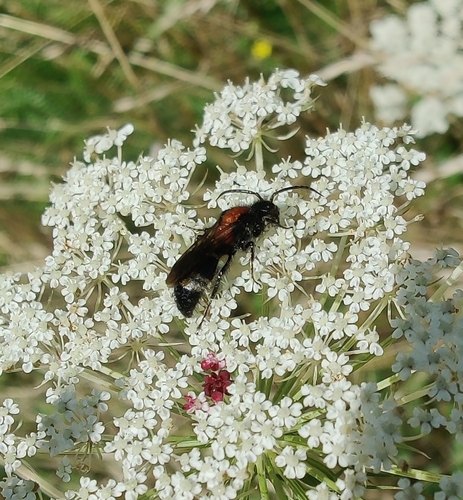
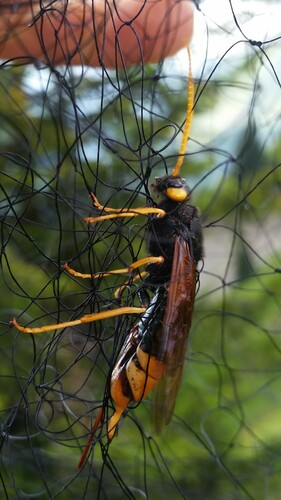
Urocerus gigas, the giant woodwasp, banded horntail, or greater horntail, is a species of sawfly native to the Palearctic realm and North Africa but also reside in North America since 2004 Though they are not wasps, their appearance resembles one due to mimicry. Adults are usually between 10 and 40 millimetres (1⁄2 and 1+1⁄2 inches) in length.

Subspecies: Urocerus gigas gigas Urocerus gigas taiganus Urocerus gigas is a wood-boring insect that attacks softwoods of freshly felled logs/unhealthy trees. The species lives in discrete tunnels, frequently filled with hard-packed coarse fibrous frass, hard to dig out from tunnels. The tunnels are large, round and discrete, between 6 and 7 mm (1⁄4 and 9⁄32 in) in diameter. Both sexes have a chitinous spike emerging from the abdomen, derived from the last segment, which is found in all woodwasps. However, unlike in true wasps, the projection is harmless and the insect cannot sting.

The second, longer and lower projection in females only is the ovipositor. The ovipositor has saw-like teeth which she uses to drill a hole, and then deposit her eggs, into wood. Urocerus flavicornis was once considered a subspecies of gigas but is now known to be a separate species. Wikipedia →
Global Distribution

Parks Where Found

# Park Country Daily sighting probability
1 Snowdonia National Park 🇬🇧 United Kingdom
~10%
2 Cairngorms National Park 🇬🇧 United Kingdom
~10%
3 Tatra National Park 🇸🇰 Slovakia
~10%
4 Bavarian Forest National Park 🇩🇪 Germany
~10%
5 Pyrénées National Park 🇫🇷 France
<5%

Cities Where Found

# City Country Daily sighting probability
1 Copenhagen 🇩🇰 Denmark
<5%
2 Berlin 🇩🇪 Germany
<5%
3 Moscow 🇷🇺 Russia
<5%

Before you go

What are the chances of seeing a Giant Woodwasp in Cairngorms National Park?

With luck

About 10% of wildlife watchers report a Giant Woodwasp sighting in Cairngorms National Park on a given day, based on 16 verified sightings from GBIF citizen-science data from 2019 to 2026. It is the 104th most-seen of the 300 insects we can rate there. Over three days the chance rises to about 30%, and over a week to about 50%, if each day is a fresh chance.

When is the best time to see a Giant Woodwasp in Cairngorms National Park?

July and August

In those months about 20% of wildlife watchers report a Giant Woodwasp in Cairngorms National Park on a given day, against under 5% in September to May, the lowest months.

What time of day is best to see a Giant Woodwasp?

Between 11 am and 2 pm

Across all the parks we cover, that three-hour window holds the most Giant Woodwasp sightings with a recorded time, and about 9 in 10 of them come between 6 am and 6 pm: it is a daytime animal.

Is Cairngorms National Park the best place to see a Giant Woodwasp?

Among the best

Of the 5 parks where we can rate Giant Woodwasp sightings, Cairngorms National Park ranks 2nd at about 10%, level with the leaders once rounded. The best odds are in Snowdonia National Park (United Kingdom, about 10%).

Which relatives of the Giant Woodwasp live in Cairngorms National Park?

Same order: Hymenoptera

The closest relatives of the Giant Woodwasp that you can see in Cairngorms National Park (order Hymenoptera, Ants, Bees, Wasps, and Sawflies) are Mountain Bumble Bee (about 30%), Common Carder Bumble Bee (about 20%) and Early Bumble Bee (about 20%), with each one's daily chance of a sighting.

Where does the Giant Woodwasp sighting chance come from?

GBIF citizen-science records

It is estimated from how often the Giant Woodwasp is recorded against all the insects logged in Cairngorms National Park (16 verified sightings from 2019 to 2026), calibrated against known sighting rates. Figures are rounded to the nearest 10% because citizen-science data supports honest approximations, not decimals, and months with records from fewer than five people show "—". How it works.

← Back to Cairngorms National Park