Noon Fly

Noon Fly

Mesembrina meridiana

Daily sighting probability ~10% · With luck
at Cairngorms National Park

In 3 days ~20% in a week ~40%

9 Verified sightings at Cairngorms National Park From 2019 to 2026
80 In all 6 parks
May Best month
☀️ Diurnal When it's spotted

About the Noon Fly

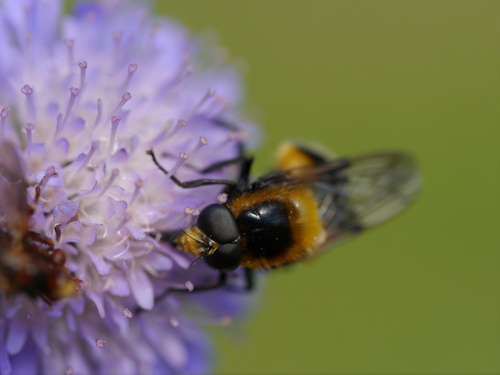
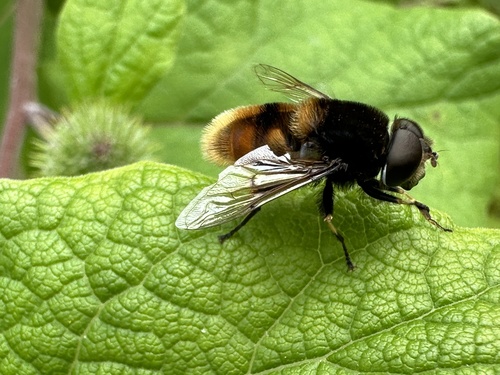
Mesembrina meridiana, sometimes known as the noon fly or noonday fly, is a species of fly in the family Muscidae. This common species is widespread in most of Europe, in the Near East, in the eastern Palearctic realm (Russia, Mongolia, China), and in North Africa.

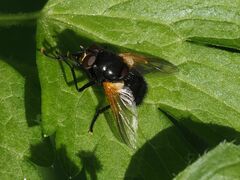
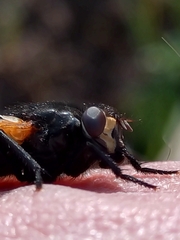
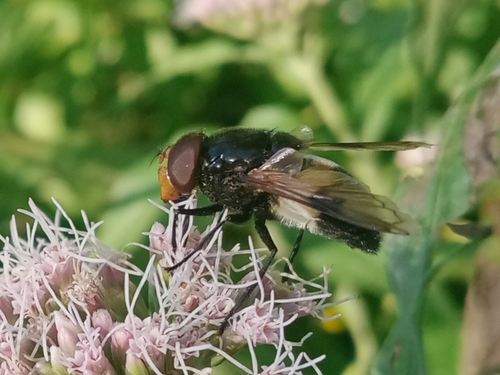
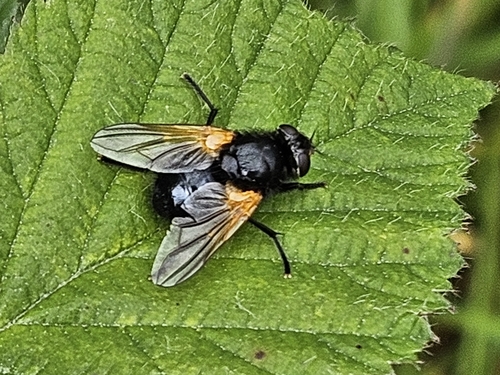
Mesembrina meridiana can reach a length of 9–13 millimetres (0.35–0.51 in). These medium large flies have a stout body. Thorax and abdomen are shiny black, covered with uniform black hair. Numerous bristles are present on the edge of the scutellum. Occiput has no yellow hairiness. Eyes are bare and the cheeks under the eyes are covered with fine yellow short hairs. Orbits are separated by a wide black space. Antennae and palps are black, but arista is yellow. An orange colouration is present on the base of the wings, on the feet and the face.

This species can be easily confused with Mesembrina resplendens and Mesembrina intermedia. This species is ovoviviparous, as the eggs hatch prior or within an hour after deposition. The female lays up to five eggs in a lifetime, each one in a different pat, at two-day intervals. Eggs are laid in cow dung.

Adults can be found between... Wikipedia →
Global Distribution

Parks Where Found

# Park Country Daily sighting probability
1 Hohe Tauern National Park 🇦🇹 Austria
~10%
2 Vanoise National Park 🇫🇷 France
~10%
3 Pyrénées National Park 🇫🇷 France
~10%
4 Cairngorms National Park 🇬🇧 United Kingdom
~10%
5 Sierra de Guadarrama National Park 🇪🇸 Spain
<5%
6 Wadden Sea National Park 🇩🇪 Germany
<5%

Cities Where Found

# City Country Daily sighting probability
1 London 🇬🇧 United Kingdom
<5%
2 Vienna 🇦🇹 Austria
<5%

Before you go

What are the chances of seeing a Noon Fly in Cairngorms National Park?

With luck

About 10% of wildlife watchers report a Noon Fly sighting in Cairngorms National Park on a given day, based on 9 verified sightings from GBIF citizen-science data from 2019 to 2026. It is the 165th most-seen of the 300 insects we can rate there. Over three days the chance rises to about 20%, and over a week to about 40%, if each day is a fresh chance.

When is the best time to see a Noon Fly in Cairngorms National Park?

May–July and September

In those months about 10% of wildlife watchers report a Noon Fly in Cairngorms National Park on a given day, against under 5% in August and October–April, the lowest months.

What time of day is best to see a Noon Fly?

Between 11 am and 2 pm

Across all the parks we cover, that three-hour window holds the most Noon Fly sightings with a recorded time, and nearly all of them come between 6 am and 6 pm: it is a daytime animal.

Is Cairngorms National Park the best place to see a Noon Fly?

Among the best

Of the 6 parks where we can rate Noon Fly sightings, Cairngorms National Park ranks 4th at about 10%, level with the leaders once rounded. The best odds are in Hohe Tauern National Park (Austria, about 10%), Vanoise National Park (France, about 10%) and Pyrénées National Park (France, about 10%).

Where does the Noon Fly sighting chance come from?

GBIF citizen-science records

It is estimated from how often the Noon Fly is recorded against all the insects logged in Cairngorms National Park (9 verified sightings from 2019 to 2026), calibrated against known sighting rates. Figures are rounded to the nearest 10% because citizen-science data supports honest approximations, not decimals, and months with records from fewer than five people show "—". How it works.

← Back to Cairngorms National Park