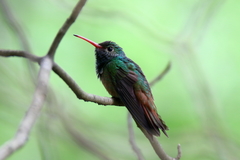
Buff-bellied Hummingbird

Buff-bellied Hummingbird

Amazilia yucatanensis

Silhouette: PhyloPic

LCLeast ConcernNTVUENCR
Daily sighting probability ~10% · With luck
at Calakmul Biosphere Reserve

In 3 days ~40% in a week ~70%

109 Verified sightings at Calakmul Biosphere Reserve From 2019 to 2026
948 In all 7 parks
March Best month
☀️ Diurnal When it's spotted

About the Buff-bellied Hummingbird

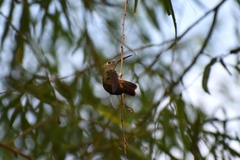
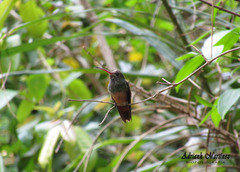
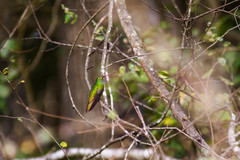
The buff-bellied hummingbird (Amazilia yucatanensis) is a species of hummingbird in the "emeralds", tribe Trochilini of subfamily Trochilinae. It is found in Belize, Guatemala, Mexico, and the United States. The buff-bellied hummingbird is 10 to 11 cm (3.9 to 4.3 in) long and weighs 2.9 to 4.7 g (0.10 to 0.17 oz). Adult males have a rosy reddish bill that is dusky at the end; females' have more dark on the maxilla. Adult males of the nominate subspecies have metallic bronze green upperparts that are duller and darker on the crown. Their uppertail coverts are a mix of bronze green and cinnamon rufous. Their tail feathers are chestnut at the base and metallic bronze at the end. Their chin, throat, and chest are bright metallic yellowish emerald green and the vent area and undertail coverts are deep cinnamon rufous. The adult female is similar to the male but with a less iridescent back and throat. Its central tail feathers are mostly greenish bronze and the outer ones are mostly chestnut with greenish bronze edges... Wikipedia →

Sounds

Call0:08

Mexico · 2018

© Manuel Grosselet · XC446193 · CC BY-NC-SA 4.0

Flight call0:06

United States · 2017

© Paul Marvin · XC452794 · CC BY-NC-SA 4.0

Song0:19

Mexico · 2000

© Peter Boesman · XC221044 · CC BY-NC-ND 4.0

Global Distribution

Parks Where Found

# Park Country Daily sighting probability
1 Cañón del Sumidero National Park 🇲🇽 Mexico
~20%
2 Sian Ka'an Biosphere Reserve 🇲🇽 Mexico
~20%
3 Calakmul Biosphere Reserve 🇲🇽 Mexico
~10%
4 Cumbres de Monterrey National Park 🇲🇽 Mexico
~10%
5 Celestún Biosphere Reserve 🇲🇽 Mexico
<5%
6 Tikal National Park 🇬🇹 Guatemala
<5%
7 Ría Lagartos Biosphere Reserve 🇲🇽 Mexico
<5%

Cities Where Found

# City Country Daily sighting probability
1 Monterrey 🇲🇽 México
<5%

Before you go

What are the chances of seeing a Buff-bellied Hummingbird in Calakmul Biosphere Reserve?

With luck

About 10% of wildlife watchers report a Buff-bellied Hummingbird sighting in Calakmul Biosphere Reserve on a given day, based on 109 verified sightings from GBIF citizen-science data from 2019 to 2026. It is the 91st most-seen of the 271 birds we can rate there. Over three days the chance rises to about 40%, and over a week to about 70%, if each day is a fresh chance.

When is the best time to see a Buff-bellied Hummingbird in Calakmul Biosphere Reserve?

March

In that month about 30% of wildlife watchers report a Buff-bellied Hummingbird in Calakmul Biosphere Reserve on a given day, against under 5% in November, the lowest month. That is one of Calakmul Biosphere Reserve's driest months, with about 20 mm of rain against 130 mm in June.

What time of day is best to see a Buff-bellied Hummingbird?

Between 9 am and noon

Across all the parks we cover, that three-hour window holds the most Buff-bellied Hummingbird sightings with a recorded time, and about 9 in 10 of them come between 6 am and 6 pm: it is a daytime animal.

Is Calakmul Biosphere Reserve the best place to see a Buff-bellied Hummingbird?

3rd of 7

Of the 7 parks where we can rate Buff-bellied Hummingbird sightings, Calakmul Biosphere Reserve ranks 3rd at about 10%. The best odds are in Cañón del Sumidero National Park (Mexico, about 20%) and Sian Ka'an Biosphere Reserve (Mexico, about 20%).

Where does the Buff-bellied Hummingbird sighting chance come from?

GBIF citizen-science records

It is estimated from how often the Buff-bellied Hummingbird is recorded against all the birds logged in Calakmul Biosphere Reserve (109 verified sightings from 2019 to 2026), calibrated against known sighting rates. Figures are rounded to the nearest 10% because citizen-science data supports honest approximations, not decimals, and months with records from fewer than five people show "—". How it works.

← Back to Calakmul Biosphere Reserve