Mahogany Tree Frog

Mahogany Tree Frog

Tlalocohyla loquax

Silhouette: Dmitry Bogdanov (vectorized by T. Michael Keesey) · PhyloPic

LCLeast ConcernNTVUENCR
Daily sighting probability ~10% · With luck
at Calakmul Biosphere Reserve

In 3 days ~20% in a week ~50%

6 Verified sightings at Calakmul Biosphere Reserve From 2019 to 2026
162 In all 3 parks
September Best month
🌙 Nocturnal When it's spotted

About the Mahogany Tree Frog

The mahogany tree frog (Tlalocohyla loquax) is a species of frog in the family Hylidae found in Belize, Costa Rica, Guatemala, Honduras, Mexico, and Nicaragua. Its natural habitats are subtropical or tropical moist lowland forests, subtropical or tropical moist montane forests, freshwater marshes, intermittent freshwater marshes, pastureland, rural gardens, and heavily degraded former forests. It is threatened by habitat loss.

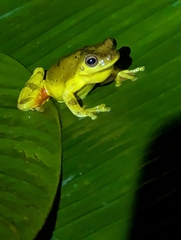
The adult male frog measures 33 to 45 mm in snout-vent length and the adult female frog 38 to 47 mm. This frog has webbed skin on all four feet. This frog has bright yellow color on its back and some bright red near its vent and sides. This frog can change color, appearing yellow and orange at night and almost white during the day. This frog is nocturnal.

The female frog lays eggs in deep bodies of water, about 250 per clutch. The eggs adhere to surface plants. After the tadpoles hatch, they swim downward. This frog is not in danger of dying out because it can live in many kinds of habitat so long as there is sufficient plant cover. Many of its habitats are in protected areas. Wikipedia →

Sounds

Advertisement call0:39

Costa Rica · 2025

© Chris Harrison · XC1029803 · CC BY-NC-SA 4.0

Uncertain0:15

Costa Rica · 2025

© Linzy L. · XC1069742 · CC BY-NC-SA 4.0

Recording0:06

Costa Rica · 2026

© Amaël Borzée · iNaturalist · CC BY-NC 4.0

Global Distribution

Parks Where Found

# Park Country Daily sighting probability
1 Arenal Volcano National Park 🇨🇷 Costa Rica
~30%
2 Tenorio Volcano National Park 🇨🇷 Costa Rica
~20%
3 Calakmul Biosphere Reserve 🇲🇽 Mexico
~10%

Before you go

What are the chances of seeing a Mahogany Tree Frog in Calakmul Biosphere Reserve?

With luck

About 10% of wildlife watchers report a Mahogany Tree Frog sighting in Calakmul Biosphere Reserve on a given day, based on 6 verified sightings from GBIF citizen-science data from 2019 to 2026. It is the 11th most-seen of the 13 amphibians we can rate there. Over three days the chance rises to about 20%, and over a week to about 50%, if each day is a fresh chance.

When is the best time to see a Mahogany Tree Frog in Calakmul Biosphere Reserve?

September

In that month about 30% of wildlife watchers report a Mahogany Tree Frog in Calakmul Biosphere Reserve on a given day, against under 5% in March–June, August and October–January, the lowest months. That is one of Calakmul Biosphere Reserve's wettest months, with about 130 mm of rain against 15 mm in February.

What time of day is best to see a Mahogany Tree Frog?

Between 6 and 9 pm

Across all the parks we cover, that three-hour window holds the most Mahogany Tree Frog sightings with a recorded time, and about 9 in 10 of them come between 6 pm and 6 am: it is mostly seen at night.

Is Calakmul Biosphere Reserve the best place to see a Mahogany Tree Frog?

3rd of 3

Of the 3 parks where we can rate Mahogany Tree Frog sightings, Calakmul Biosphere Reserve ranks 3rd at about 10%. The best odds are in Arenal Volcano National Park (Costa Rica, about 30%) and Tenorio Volcano National Park (Costa Rica, about 20%).

Which relatives of the Mahogany Tree Frog live in Calakmul Biosphere Reserve?

Same family: Hylidae

The closest relatives of the Mahogany Tree Frog that you can see in Calakmul Biosphere Reserve (family Hylidae, Hylid Tree Frogs) are Mexican Smilisca (about 30%), Yucatán Casque-headed Tree Frog (about 20%) and Yellow Treefrog (about 20%), with each one's daily chance of a sighting.

Where does the Mahogany Tree Frog sighting chance come from?

GBIF citizen-science records

It is estimated from how often the Mahogany Tree Frog is recorded against all the amphibians logged in Calakmul Biosphere Reserve (6 verified sightings from 2019 to 2026), calibrated against known sighting rates. Figures are rounded to the nearest 10% because citizen-science data supports honest approximations, not decimals, and months with records from fewer than five people show "—". How it works.

← Back to Calakmul Biosphere Reserve