Yucatán Casque-headed Tree Frog

Yucatán Casque-headed Tree Frog

Triprion petasatus

Silhouette: Jose Carlos Arenas-Monroy · PhyloPic

LCLeast ConcernNTVUENCR
Daily sighting probability ~20% · Possible
at Calakmul Biosphere Reserve

In 3 days ~50% in a week ~80%

30 Verified sightings at Calakmul Biosphere Reserve From 2019 to 2026
30 In 1 park
June Best month
🌙 Nocturnal When it's spotted

About the Yucatán Casque-headed Tree Frog

Triprion petasatus, Yucatán shovel-headed tree frog, Yucatán casque-headed tree frog, or Yucatán casquehead tree frog is a species of frog in the family Hylidae found in Belize, Guatemala, Honduras, and Mexico. Its natural habitats are subtropical or tropical dry forests, moist savanna, freshwater marshes, intermittent freshwater marshes, rural gardens, heavily degraded former forests, aquaculture ponds, and canals and ditches.

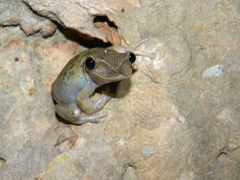
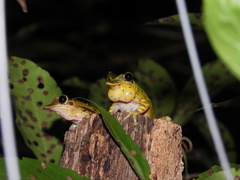
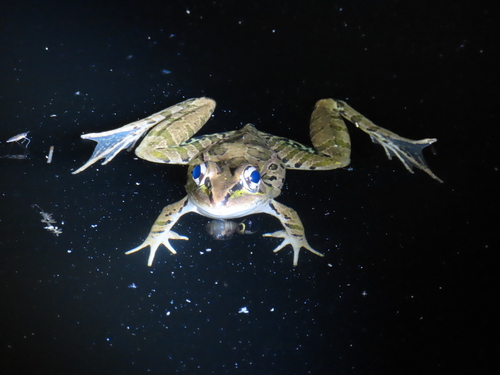
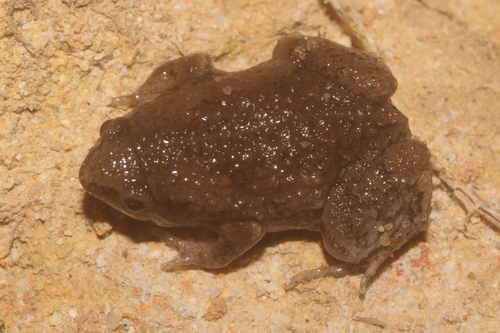
The adult male frog measures 48.1 to 60.8 mm in snout-vent length and the adult female frog 65.0 to 75.2 mm. This frog has thick, strong front legs and relatively short hind legs. There are very large disks on the front toes. Its large, bony head, resembles a hat or helmet, which is the inspiration for its English and Latin names. The adult male frog is olive green in color, and the adult female frog is light brown or green-brown. There are dark brown or black marks on the back and legs. Some frogs have silver marks on their backs and head. The frogs have some yellow coloration on their flanks or red-brown on their hind legs. The belly is white and tan.

This frog lays eggs during the rainy season. The male frog climbs to a... Wikipedia →

Sounds

Advertisement call0:13

Mexico · 2017

© Chris Harrison · XC893996 · CC BY-NC-SA 4.0

Recording0:12

Mexico · 2024

© Sebastián de Jesús Herrera Buenfil · iNaturalist · CC BY 4.0

Recording0:09

Mexico · 2019

© Thomas Brooks · iNaturalist · CC BY-NC-SA 4.0

Global Distribution

Parks Where Found

# Park Country Daily sighting probability
1 Calakmul Biosphere Reserve 🇲🇽 Mexico
~20%

More parks will be added in future updates.

Zoos & Centres Where Found

# Zoo / Centre Country
1 San Diego Zoo 🇺🇸 United States In captivity

Before you go

What are the chances of seeing a Yucatán Casque-headed Tree Frog in Calakmul Biosphere Reserve?

Possible

About 20% of wildlife watchers report a Yucatán Casque-headed Tree Frog sighting in Calakmul Biosphere Reserve on a given day, based on 30 verified sightings from GBIF citizen-science data from 2019 to 2026. It is the 5th most-seen of the 13 amphibians we can rate there. Over three days the chance rises to about 50%, and over a week to about 80%, if each day is a fresh chance.

When is the best time to see a Yucatán Casque-headed Tree Frog in Calakmul Biosphere Reserve?

June and July

In those months about 40% of wildlife watchers report a Yucatán Casque-headed Tree Frog in Calakmul Biosphere Reserve on a given day, against under 5% in September to March, the lowest months. Those are among Calakmul Biosphere Reserve's wettest months, with about 90 mm of rain a month against 15 mm in February.

What time of day is best to see a Yucatán Casque-headed Tree Frog?

Between 7 and 10 pm

Across all the parks we cover, that three-hour window holds the most Yucatán Casque-headed Tree Frog sightings with a recorded time, and about 9 in 10 of them come between 6 pm and 6 am: it is mostly seen at night.

Where else can you see a Yucatán Casque-headed Tree Frog?

Only Calakmul Biosphere Reserve, in our data

Calakmul Biosphere Reserve is the only park on Wallace's Line with enough records to rate Yucatán Casque-headed Tree Frog sightings: about 20% of wildlife watchers there report one on a given day.

Which relatives of the Yucatán Casque-headed Tree Frog live in Calakmul Biosphere Reserve?

Same family: Hylidae

The closest relatives of the Yucatán Casque-headed Tree Frog that you can see in Calakmul Biosphere Reserve (family Hylidae, Hylid Tree Frogs) are Mexican Smilisca (about 30%), Yellow Treefrog (about 20%) and Stauffer's Tree Frog (about 10%), with each one's daily chance of a sighting.

Where does the Yucatán Casque-headed Tree Frog sighting chance come from?

GBIF citizen-science records

It is estimated from how often the Yucatán Casque-headed Tree Frog is recorded against all the amphibians logged in Calakmul Biosphere Reserve (30 verified sightings from 2019 to 2026), calibrated against known sighting rates. Figures are rounded to the nearest 10% because citizen-science data supports honest approximations, not decimals, and months with records from fewer than five people show "—". How it works.

← Back to Calakmul Biosphere Reserve