Mexican Burrowing Toad

Mexican Burrowing Toad

Rhinophrynus dorsalis

Silhouette: Jose Carlos Arenas-Monroy · PhyloPic

LCLeast ConcernNTVUENCR
Daily sighting probability ~10% · With luck
at Calakmul Biosphere Reserve

In 3 days ~30% in a week ~60%

16 Verified sightings at Calakmul Biosphere Reserve From 2019 to 2026
55 In all 3 parks
July Best month
☀️🌙 Day & Night When it's spotted

About the Mexican Burrowing Toad

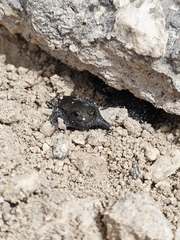
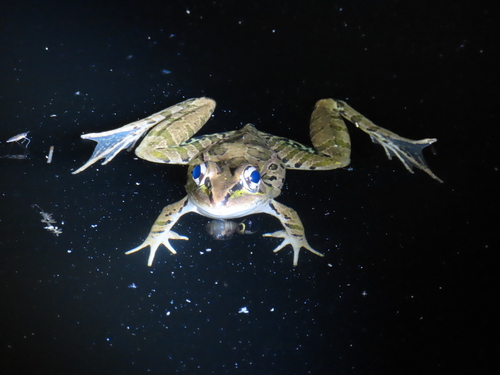
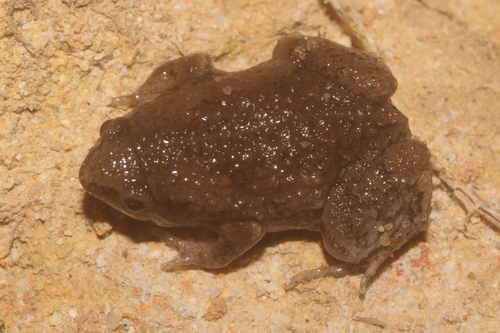
The Mexican burrowing toad (Rhinophrynus dorsalis) is the single living representative of the family Rhinophrynidae. It is a unique species in its taxonomy and morphology, with special adaptations to assist them in digging burrows where they spend most of their time. These adaptations include a small pointed snout and face, keratinized structures and a lack of webbing on front limbs, and specialized tongue morphology to assist in feeding on ants and termites underground. The body is nearly equal in width and length. It is a dark brown to black color with a red-orange stripe on its back along with splotches of color on its body. The generic name Rhinophrynus means 'nose-toad', from rhino- (ῥῑνο-), the combining form of the Ancient Greek rhis (ῥίς, 'nose') and phrunē (φρύνη, 'toad').

The Mexican burrowing toad diverged from other amphibians over 190 million years ago and has been evolving independently for a longer period of time than the evolutionary differences between mammals like humans, fruit bats, polar bears and killer whales. Its closest sister group is Pipidae, or the aquatic clawed frogs.

The Mexican burrowing toad has a unique appearance that makes it easy... Wikipedia →

Sounds

Advertisement call1:10

United States · 2025

© Chris Harrison · XC984016 · CC BY-NC-SA 4.0

Recording0:08

Mexico · 2024

© carlos_garcia_diver_pdc · iNaturalist · CC BY-NC 4.0

Recording0:21

Mexico · 2024

© gesmex · iNaturalist · CC BY-NC 4.0

Global Distribution

Parks Where Found

# Park Country Daily sighting probability
1 Santa Rosa National Park 🇨🇷 Costa Rica
~30%
2 Palo Verde National Park 🇨🇷 Costa Rica
~30%
3 Calakmul Biosphere Reserve 🇲🇽 Mexico
~10%

Before you go

What are the chances of seeing a Mexican Burrowing Toad in Calakmul Biosphere Reserve?

With luck

About 10% of wildlife watchers report a Mexican Burrowing Toad sighting in Calakmul Biosphere Reserve on a given day, based on 16 verified sightings from GBIF citizen-science data from 2019 to 2026. It is the 8th most-seen of the 13 amphibians we can rate there. Over three days the chance rises to about 30%, and over a week to about 60%, if each day is a fresh chance.

When is the best time to see a Mexican Burrowing Toad in Calakmul Biosphere Reserve?

July and August

In those months about 30% of wildlife watchers report a Mexican Burrowing Toad in Calakmul Biosphere Reserve on a given day, against under 5% in September and November–April, the lowest months.

What time of day is best to see a Mexican Burrowing Toad?

Between 8 and 11 pm

Across all the parks we cover, that three-hour window holds the most Mexican Burrowing Toad sightings with a recorded time, and about 6 in 10 of them come between 6 pm and 6 am: it is seen both by day and at night.

Is Calakmul Biosphere Reserve the best place to see a Mexican Burrowing Toad?

3rd of 3

Of the 3 parks where we can rate Mexican Burrowing Toad sightings, Calakmul Biosphere Reserve ranks 3rd at about 10%. The best odds are in Santa Rosa National Park (Costa Rica, about 30%) and Palo Verde National Park (Costa Rica, about 30%).

Which relatives of the Mexican Burrowing Toad live in Calakmul Biosphere Reserve?

Same order: Anura

The closest relatives of the Mexican Burrowing Toad that you can see in Calakmul Biosphere Reserve (order Anura, Frogs and Toads) are Central American Gulf Coast Toad (about 40%), Mexican Smilisca (about 30%) and Sheep Frog (about 30%), with each one's daily chance of a sighting.

Where does the Mexican Burrowing Toad sighting chance come from?

GBIF citizen-science records

It is estimated from how often the Mexican Burrowing Toad is recorded against all the amphibians logged in Calakmul Biosphere Reserve (16 verified sightings from 2019 to 2026), calibrated against known sighting rates. Figures are rounded to the nearest 10% because citizen-science data supports honest approximations, not decimals, and months with records from fewer than five people show "—". How it works.

← Back to Calakmul Biosphere Reserve