Black Jungle-Frog

Black Jungle-Frog

Leptodactylus melanonotus

Silhouette: Jose Carlos Arenas-Monroy · PhyloPic

LCLeast ConcernNTVUENCR
Daily sighting probability ~10% · With luck
at Calakmul Biosphere Reserve

In 3 days ~30% in a week ~60%

11 Verified sightings at Calakmul Biosphere Reserve From 2019 to 2026
43 In all 5 parks
July Best month
☀️🌙 Day & Night When it's spotted

About the Black Jungle-Frog

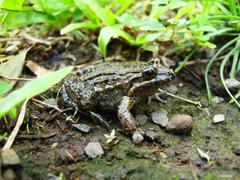
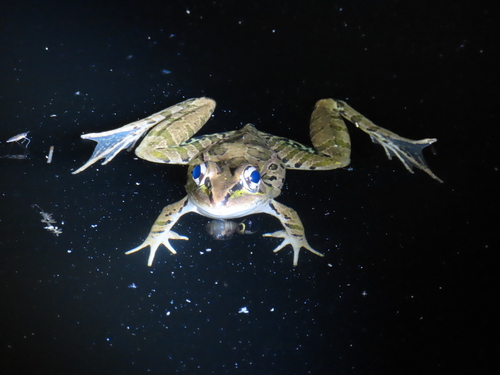
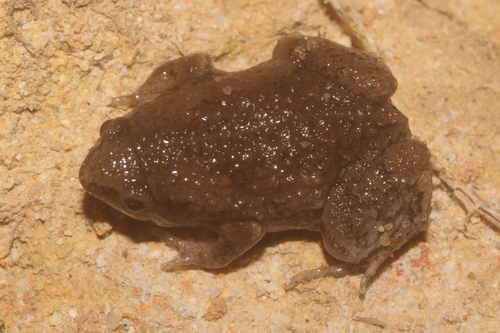
Leptodactylus melanonotus, known commonly as the Sabinal Frog, is a species of frog in the family Leptodactylidae. It is found along coasts and in inland wetlands in Central America and northern South America. The first description of the species was published in 1861 by Edward Hallowell, who placed it in the genus Cystignathus; a genus later determined to be a synonym of Leptodactylus, but Paul Brocchi had already moved melanonotus there in 1881, long before synonymization.

L. melanotus is part of a species group bearing its name, and its closest relatives are L. colombiensis, L. validus and L. wagneri. Average snout–vent length is about 46 mm (1.8 in) in males and 50 mm (2.0 in) in females. L. melanotus digs burrows and builds nest out of bubbles for its eggs. If the burrow fails to flood or becomes too dry, the female frog will dig a channel to a nearby body of water.

It is a nocturnal species. L. melanotus can be found in Mexico, along the west and east coasts and on the Yucatán Peninsula, Belize, Guatemala, Honduras, El Salvador, Nicaragua, including on Mancarroncito Island, Costa Rica, Panama and along... Wikipedia →

Sounds

Advertisement call1:07

Ecuador · 2010

© Manuel Sánchez-Nivicela · XC1025138 · CC BY-NC-ND 4.0

Uncertain0:15

Costa Rica · 2014

© Chris Harrison · XC896450 · CC BY-NC-SA 4.0

Recording0:15

Mexico · 2022

© mariana_1234 · iNaturalist · CC BY-NC 4.0

Global Distribution

Parks Where Found

# Park Country Daily sighting probability
1 Palo Verde National Park 🇨🇷 Costa Rica
~20%
2 Tenorio Volcano National Park 🇨🇷 Costa Rica
~10%
3 Calakmul Biosphere Reserve 🇲🇽 Mexico
~10%
4 Braulio Carrillo National Park 🇨🇷 Costa Rica
~10%
5 Arenal Volcano National Park 🇨🇷 Costa Rica
~10%

Before you go

What are the chances of seeing a Black Jungle-Frog in Calakmul Biosphere Reserve?

With luck

About 10% of wildlife watchers report a Black Jungle-Frog sighting in Calakmul Biosphere Reserve on a given day, based on 11 verified sightings from GBIF citizen-science data from 2019 to 2026. It is the 9th most-seen of the 13 amphibians we can rate there. Over three days the chance rises to about 30%, and over a week to about 60%, if each day is a fresh chance.

When is the best time to see a Black Jungle-Frog in Calakmul Biosphere Reserve?

April and June–August

In those months about 20% of wildlife watchers report a Black Jungle-Frog in Calakmul Biosphere Reserve on a given day, against under 5% in March, May and September–January, the lowest months.

What time of day is best to see a Black Jungle-Frog?

Between 7 and 10 pm

Across all the parks we cover, that three-hour window holds the most Black Jungle-Frog sightings with a recorded time, and about 6 in 10 of them come between 6 pm and 6 am: it is seen both by day and at night.

Is Calakmul Biosphere Reserve the best place to see a Black Jungle-Frog?

3rd of 5

Of the 5 parks where we can rate Black Jungle-Frog sightings, Calakmul Biosphere Reserve ranks 3rd at about 10%. The best odds are in Palo Verde National Park (Costa Rica, about 20%) and Tenorio Volcano National Park (Costa Rica, about 10%).

Which relatives of the Black Jungle-Frog live in Calakmul Biosphere Reserve?

Same order: Anura

The closest relatives of the Black Jungle-Frog that you can see in Calakmul Biosphere Reserve (order Anura, Frogs and Toads) are Central American Gulf Coast Toad (about 40%), Mexican Smilisca (about 30%) and Sheep Frog (about 30%), with each one's daily chance of a sighting.

Where does the Black Jungle-Frog sighting chance come from?

GBIF citizen-science records

It is estimated from how often the Black Jungle-Frog is recorded against all the amphibians logged in Calakmul Biosphere Reserve (11 verified sightings from 2019 to 2026), calibrated against known sighting rates. Figures are rounded to the nearest 10% because citizen-science data supports honest approximations, not decimals, and months with records from fewer than five people show "—". How it works.

← Back to Calakmul Biosphere Reserve