Little Crow

Little Crow

Corvus bennetti

Silhouette: Peileppe · PhyloPic

LCLeast ConcernNTVUENCR Endemic
Daily sighting probability <5% · Rare
at Cape Range

In 3 days ~10% in a week ~20%

8 Verified sightings at Cape Range From 2019 to 2026
123 In all 5 parks
September Best month
☀️ Diurnal When it's spotted

About the Little Crow

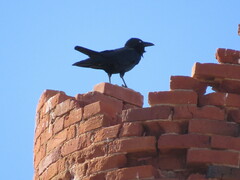
The little crow (Corvus bennetti) is an Australian species of crow, very similar to the Torresian crow in having white bases to the neck and head feathers (shown when ruffled in strong wind) but slightly smaller (38–45 cm in length) and with a slightly smaller bill. It has the same white iris that distinguish the Australian species from all other Corvus except a few island species to the north of Australia. The western jackdaw (now Coloeus monedula) shares that trait; but while formerly considered members of Corvus, the jackdaws are now commonly put into their own genus Coloeus. Like the Australian raven, the little crow has a blue ring around the pupil.

It ranges over western and central Australia, often inhabiting very dry, near desert areas. It frequents small country towns and cultivated areas, where its flocks have reminded people of the European rook. C. bennetti was named in honour of the New South Wales ornithologist and collector of natural history specimens, Kenric Harold Bennett.

Its food is mainly taken from the ground and includes insects, cereals and other seeds. It is less of a scavenger than the... Wikipedia →

Sounds

Call0:27

Australia · 2021

© Marc Anderson · XC1070975 · CC BY-NC-ND 4.0

Call0:32

Australia · 2019

© Nigel Jackett · XC513390 · CC BY-NC-SA 4.0

Call1:02

Australia · 2015

© Frank Lambert · XC407705 · CC BY-NC-ND 4.0

Global Distribution

Parks Where Found

# Park Country Daily sighting probability
1 Ningaloo Marine Park 🇦🇺 Australia
~10%
2 Uluru-Kata Tjuta National Park 🇦🇺 Australia
~10%
3 Cape Range 🇦🇺 Australia
<5%
4 Flinders Ranges National Park 🇦🇺 Australia
<5%
5 Hattah-Kulkyne National Park 🇦🇺 Australia
<5%

Before you go

What are the chances of seeing a Little Crow in Cape Range?

Rare

Under 5% of wildlife watchers report a Little Crow sighting in Cape Range on a given day, based on 8 verified sightings from GBIF citizen-science data from 2019 to 2026. It is the 76th most-seen of the 84 birds we can rate there. Over three days the chance rises to about 10%, and over a week to about 20%, if each day is a fresh chance.

When is the best time to see a Little Crow in Cape Range?

March, June and September

In those months about 10% of wildlife watchers report a Little Crow in Cape Range on a given day, against under 5% in April–May, July–August and October–January, the lowest months. Those are among Cape Range's wettest months, with about 35 mm of rain a month against almost none in October. February has too few records to rate.

What time of day is best to see a Little Crow?

Between 9 am and noon

Across all the parks we cover, that three-hour window holds the most Little Crow sightings with a recorded time, and about 9 in 10 of them come between 6 am and 6 pm: it is a daytime animal.

Is Cape Range the best place to see a Little Crow?

3rd of 5

Of the 5 parks where we can rate Little Crow sightings, Cape Range ranks 3rd at under 5%. The best odds are in Ningaloo Marine Park (Australia, about 10%) and Uluru-Kata Tjuta National Park (Australia, about 10%).

Where does the Little Crow sighting chance come from?

GBIF citizen-science records

It is estimated from how often the Little Crow is recorded against all the birds logged in Cape Range (8 verified sightings from 2019 to 2026), calibrated against known sighting rates. Figures are rounded to the nearest 10% because citizen-science data supports honest approximations, not decimals, and months with records from fewer than five people show "—". How it works.

← Back to Cape Range