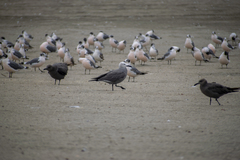
Grey Gull

Grey Gull

Leucophaeus modestus

Silhouette: Kai Caspar · PhyloPic

Daily sighting probability ~20% · Possible
at Celestún Biosphere Reserve

In 3 days ~50% in a week ~80%

10 Verified sightings at Celestún Biosphere Reserve From 2019 to 2026
48 In all 2 parks
June Best month
☀️ Diurnal When it's spotted

About the Grey Gull

The grey gull, also known as garuma gull (Leucophaeus modestus), is a medium-sized gull native to South America. Unusual among gulls, it breeds inland in the extremely dry Atacama Desert in northern Chile, although it is present as a non-breeding bird along much of the Pacific coast of South America.

The sexes are similar in grey gulls. Adults grow to a length of about 45 cm (18 in) and weigh some 360 to 400 g (13 to 14 oz). The head is white in summer but brownish-grey in winter. The body and wings are grey with the dorsal surface rather darker than the ventral region. The flight feathers are black and the inner primaries and the secondaries have white tips, visible in flight. The tail has a band of black with a white trailing edge. The legs and beak are black and the iris is brown. The call is similar to that of the laughing gull (Leucophaeus atricilla).

The grey gull breeds inland in the Atacama Desert in northern Chile. Its non-breeding range includes Costa Rica, Colombia, Ecuador, Peru and Chile, and it has been recorded in the Falkland Islands, South Georgia and the South Sandwich Islands. It is a vagrant to Panama and Florida; an earlier report... Wikipedia →

Sounds

Call0:22

Chile · 2023

© Scott Olmstead · XC871857 · CC BY-NC-SA 4.0

Song0:16

Chile · 2005

© Alvaro Jaramillo · XC59985 · CC BY-NC-ND 2.5

Call0:11

Chile · 2023

© Barry Edmonston · XC856823 · CC BY-NC-SA 4.0

Global Distribution

Parks Where Found

# Park Country Daily sighting probability
1 Celestún Biosphere Reserve 🇲🇽 Mexico
~20%
2 Galápagos Islands 🇪🇨 Ecuador
<5%

Cities Where Found

# City Country Daily sighting probability
1 Lima 🇵🇪 Peru
~10%

Zoos & Centres Where Found

# Zoo / Centre Country
1 Tierpark Berlin 🇩🇪 Germany In captivity
2 Bronx Zoo 🇺🇸 United States In captivity
3 Brookfield Zoo 🇺🇸 United States In captivity
4 Sedgwick County Zoo 🇺🇸 United States In captivity
5 Hellabrunn Zoo 🇩🇪 Germany In captivity
6 Oregon Zoo 🇺🇸 United States In captivity
7 Tierpark Schlichtweg 15 in München 🇩🇪 Germany In captivity
8 Zoo Schlichtweg 11 in München 🇩🇪 Germany In captivity
9 Zoo Siebenbrunner Straße 6 in München 🇩🇪 Germany In captivity

Before you go

What are the chances of seeing a Grey Gull in Celestún Biosphere Reserve?

Possible

About 20% of wildlife watchers report a Grey Gull sighting in Celestún Biosphere Reserve on a given day, based on 10 verified sightings from GBIF citizen-science data from 2019 to 2026. It is the 66th most-seen of the 297 birds we can rate there. Over three days the chance rises to about 50%, and over a week to about 80%, if each day is a fresh chance.

When is the best time to see a Grey Gull in Celestún Biosphere Reserve?

June

In that month about 70% of wildlife watchers report a Grey Gull in Celestún Biosphere Reserve on a given day, against under 5% in August to May, the lowest months. That is one of Celestún Biosphere Reserve's wettest months, with about 160 mm of rain against 10 mm in February.

What time of day is best to see a Grey Gull?

Between 11 am and 2 pm

Across all the parks we cover, that three-hour window holds the most Grey Gull sightings with a recorded time, and about 8 in 10 of them come between 6 am and 6 pm: it is a daytime animal.

Is Celestún Biosphere Reserve the best place to see a Grey Gull?

Yes

Of the 2 parks where we can rate Grey Gull sightings, Celestún Biosphere Reserve has the highest daily chance: about 20%. Next come Galápagos Islands (Ecuador, under 5%).

Which relatives of the Grey Gull live in Celestún Biosphere Reserve?

Same genus: Leucophaeus

The closest relatives of the Grey Gull that you can see in Celestún Biosphere Reserve (genus Leucophaeus, Hooded Gulls) are Laughing Gull (about 70%) and Franklin's Gull (about 10%), with each one's daily chance of a sighting.

Where does the Grey Gull sighting chance come from?

GBIF citizen-science records

It is estimated from how often the Grey Gull is recorded against all the birds logged in Celestún Biosphere Reserve (10 verified sightings from 2019 to 2026), calibrated against known sighting rates. Figures are rounded to the nearest 10% because citizen-science data supports honest approximations, not decimals, and months with records from fewer than five people show "—". How it works.

← Back to Celestún Biosphere Reserve