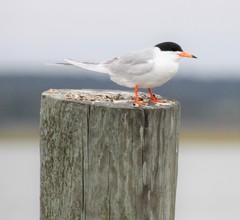
Forster's Tern

Forster's Tern

Sterna forsteri

Silhouette: Sharon Wegner-Larsen · PhyloPic

LCLeast ConcernNTVUENCR
Daily sighting probability ~10% · With luck
at Celestún Biosphere Reserve

In 3 days ~20% in a week ~50%

130 Verified sightings at Celestún Biosphere Reserve From 2019 to 2026
8,337 In all 18 parks
November Best month
☀️ Diurnal When it's spotted

About the Forster's Tern

Forster's tern (Sterna forsteri) is a tern in the family Laridae. The genus name Sterna is derived from Old English "stearn", "tern", and forsteri commemorates the naturalist Johann Reinhold Forster. It breeds inland in North America in the northern United States and southern Canada, and migrates south to winter in the southern United States, Mexico, the Caribbean, and northern Central America. It is also a rare but annual vagrant in western Europe, and has wintered in Ireland and Great Britain on a number of occasions.

This species breeds in colonies in marshes. It nests in a ground scrape and lays two or more eggs. Like all white terns, it is fiercely defensive of its nest and young. The Forster's tern feeds by plunge-diving for fish, but will also hawk for insects in its breeding marshes. It usually feeds from saline environments in winter, like most Sterna terns. It usually dives directly, and not from the "stepped-hover" favored by the Arctic tern. The offering of fish by the male to the female is part of the courtship display.

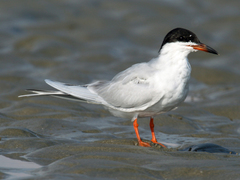
This is a medium-small tern, 33–36 cm (13–14 in) long with a 78–80 cm (31–31 in) wingspan and a weight ranging from 130 to 190 g (4.6 to 6.7 oz). It is most similar to the common tern, with pale gray upperparts and white underparts. Its legs are red and its bill is red, tipped with black. In winter, the forehead becomes white and a characteristic black eye mask remains. Juvenile Forster's terns are similar to the winter adult, but with a scaly gingery-brown pattern on the back and wing coverts. The call is similar to that of common terns, but also some harsher sounds suggestive of a small gull like Bonaparte's gull.

This species is unlikely to be confused with the common tern in winter because of the black eye mask, but is much more similar in breeding plumage. Forster's has a gray center to its white tail, and the upperwings are whiter, without the darker primary wedge of the common tern. Wikipedia →

Sounds

Call0:22

United States · 2025

© Paul Driver · XC1027067 · CC BY-NC-SA 4.0

Flight call0:20

United States · 2024

© Valerie Heemstra · XC883553 · CC BY-NC-SA 4.0

Begging call0:07

United States · 2019

© William Whitehead · XC491838 · CC BY-NC-SA 4.0

Global Distribution

Parks Where Found

# Park Country Daily sighting probability
1 Padre Island National Seashore 🇺🇸 United States
~60%
2 Merritt Island National Wildlife Refuge 🇺🇸 United States
~30%
3 Ría Lagartos Biosphere Reserve 🇲🇽 Mexico
~30%
4 El Vizcaíno Biosphere Reserve 🇲🇽 Mexico
~20%
5 Channel Islands National Park 🇺🇸 United States
~20%
6 Elk Island National Park 🇨🇦 Canada
~10%
7 Riding Mountain National Park 🇨🇦 Canada
~10%
8 Celestún Biosphere Reserve 🇲🇽 Mexico
~10%
9 Ciénaga de Zapata 🇨🇺 Cuba
~10%
10 Point Pelee National Park 🇨🇦 Canada
~10%
11 Everglades National Park 🇺🇸 United States
~10%
12 Bahía de Loreto National Park 🇲🇽 Mexico
<5%
13 Big Cypress National Preserve 🇺🇸 United States
<5%
14 Redwood National Park 🇺🇸 United States
<5%
15 Bastimentos Island National Marine Park 🇵🇦 Panama
<5%
16 Grand Teton National Park 🇺🇸 United States
<5%
17 La Amistad International Park (Panama) 🇵🇦 Panama
<5%
18 Yellowstone National Park 🇺🇸 United States
<5%

Cities Where Found

# City Country Daily sighting probability
1 San Francisco 🇺🇸 United States
~10%
2 San Diego 🇺🇸 United States
~10%
3 Los Angeles 🇺🇸 United States
~10%
4 Mexico City 🇲🇽 México
~10%
5 New York City 🇺🇸 United States
~10%
6 Tijuana 🇲🇽 México
<5%
7 Dallas 🇺🇸 United States
<5%
8 Salt Lake City 🇺🇸 United States
<5%
9 Detroit 🇺🇸 United States
<5%
10 Miami 🇺🇸 United States
<5%

Zoos & Centres Where Found

# Zoo / Centre Country
1 National Zoological Park 🇺🇸 United States In captivity

Before you go

What are the chances of seeing a Forster's Tern in Celestún Biosphere Reserve?

With luck

About 10% of wildlife watchers report a Forster's Tern sighting in Celestún Biosphere Reserve on a given day, based on 130 verified sightings from GBIF citizen-science data from 2019 to 2026. It is the 111th most-seen of the 297 birds we can rate there. Over three days the chance rises to about 20%, and over a week to about 50%, if each day is a fresh chance.

When is the best time to see a Forster's Tern in Celestún Biosphere Reserve?

May, July–August and October–March

In those months about 10% of wildlife watchers report a Forster's Tern in Celestún Biosphere Reserve on a given day, against under 5% in April, June and September, the lowest months.

What time of day is best to see a Forster's Tern?

Between 9 am and noon

Across all the parks we cover, that three-hour window holds the most Forster's Tern sightings with a recorded time, and about 9 in 10 of them come between 6 am and 6 pm: it is a daytime animal.

Where does the Forster's Tern sighting chance come from?

GBIF citizen-science records

It is estimated from how often the Forster's Tern is recorded against all the birds logged in Celestún Biosphere Reserve (130 verified sightings from 2019 to 2026), calibrated against known sighting rates. Figures are rounded to the nearest 10% because citizen-science data supports honest approximations, not decimals, and months with records from fewer than five people show "—". How it works.

← Back to Celestún Biosphere Reserve