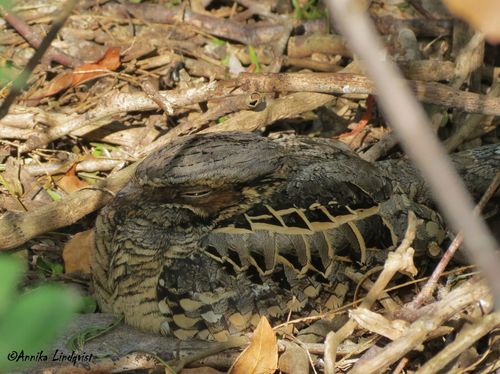
Yucatán Nightjar

Yucatán Nightjar

Antrostomus badius

Silhouette: Sheatherius · PhyloPic

LCLeast ConcernNTVUENCR
Daily sighting probability <5% · Rare
at Celestún Biosphere Reserve

In 3 days <5%

17 Verified sightings at Celestún Biosphere Reserve From 2019 to 2026
116 In all 4 parks
April Best month
🌙 Nocturnal When it's spotted

About the Yucatán Nightjar

The Yucatan nightjar (Antrostomus badius) is a species of nightjar in the family Caprimulgidae. It is found in Belize, Guatemala, Mexico, and Honduras. The Yucatan nightjar was for many years classified in genus Caprimulgus but was later restored to its original genus Antrostomus. It and the tawny-collared nightjar (A. salvini) were for a time considered subspecies of the silky-tailed nightjar (A. sericocaudatus). The Yucatan nightjar is monotypic.

The Yucatan nightjar is 24 to 25.5 cm (9.4 to 10 in) long. One male weighed 65.5 g (2.3 oz) and three females 51.2 to 64.3 g (1.8 to 2.3 oz). The male's upperparts are grayish brown. The crown has blackish brown spots and grayish white speckles, and the back and rump have buff and cinnamon speckles and broad blackish brown streaks. It has a broad tawny or buff collar on the nape and the sides of the neck. The tail is brown with faint tawny bars; the three outermost pairs of feathers have wide white tips and the innermost pair grayish brown mottling on the tips. The wings are brown to grayish brown with tawny spots and bars. The face is tawny with blackish brown speckles. The chin and throat... Wikipedia →

Sounds

Song0:13

Mexico · 2018

© George Wagner · XC437944 · CC BY-NC-SA 4.0

Song0:47

Mexico · 2016

© Ross Gallardy · XC332439 · CC BY-NC-SA 4.0

Song1:02

Mexico · 2023

© Bobby Wilcox · XC797206 · CC BY-NC-SA 4.0

Global Distribution

Parks Where Found

# Park Country Daily sighting probability
1 Ría Lagartos Biosphere Reserve 🇲🇽 Mexico
~10%
2 Calakmul Biosphere Reserve 🇲🇽 Mexico
<5%
3 Celestún Biosphere Reserve 🇲🇽 Mexico
<5%
4 Arrecifes de Cozumel National Park 🇲🇽 Mexico
<5%

Before you go

What are the chances of seeing a Yucatán Nightjar in Celestún Biosphere Reserve?

Rare

Under 5% of wildlife watchers report a Yucatán Nightjar sighting in Celestún Biosphere Reserve on a given day, based on 17 verified sightings from GBIF citizen-science data from 2019 to 2026. It is the 249th most-seen of the 297 birds we can rate there. Over three days the chance rises to under 5%, if each day is a fresh chance.

When is the best time to see a Yucatán Nightjar in Celestún Biosphere Reserve?

Any time of year

In every month with enough records, under 5% of wildlife watchers report a Yucatán Nightjar in Celestún Biosphere Reserve on a given day, so our monthly data shows no clear season.

What time of day is best to see a Yucatán Nightjar?

Between 6 and 9 pm

Across all the parks we cover, that three-hour window holds the most Yucatán Nightjar sightings with a recorded time, and about 8 in 10 of them come between 6 pm and 6 am: it is mostly seen at night.

Is Celestún Biosphere Reserve the best place to see a Yucatán Nightjar?

3rd of 4

Of the 4 parks where we can rate Yucatán Nightjar sightings, Celestún Biosphere Reserve ranks 3rd at under 5%. The best odds are in Ría Lagartos Biosphere Reserve (Mexico, about 10%) and Calakmul Biosphere Reserve (Mexico, under 5%).

Where does the Yucatán Nightjar sighting chance come from?

GBIF citizen-science records

It is estimated from how often the Yucatán Nightjar is recorded against all the birds logged in Celestún Biosphere Reserve (17 verified sightings from 2019 to 2026), calibrated against known sighting rates. Figures are rounded to the nearest 10% because citizen-science data supports honest approximations, not decimals, and months with records from fewer than five people show "—". How it works.


← Back to Celestún Biosphere Reserve