Gray-throated Chat

Gray-throated Chat

Granatellus sallaei

Silhouette: Sheatherius · PhyloPic

LCLeast ConcernNTVUENCR
Daily sighting probability ~10% · With luck
at Biotopo Cerro Cahuí

In 3 days ~20% in a week ~40%

22 Verified sightings at Biotopo Cerro Cahuí From 2019 to 2026
597 In all 5 parks
February Best month
☀️ Diurnal When it's spotted

About the Gray-throated Chat

The grey-throated chat (Granatellus sallaei) is a species of bird in the family Cardinalidae, the cardinals or cardinal grosbeaks. It is found in Belize, Guatemala, and Mexico. The genus Granatellus was traditionally placed in family Parulidae, the New World warblers. Studies of DNA sequences in the early 2000s resulted in its being moved to its present family. The grey-throated chat and the other two members of its genus, red-breasted chat (G. venustus) and rose-breasted chat (G. pelzelni) form a superspecies.

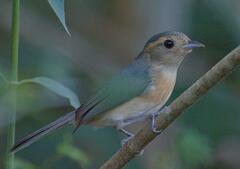
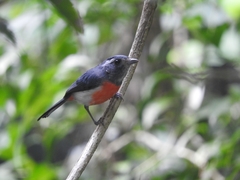
The grey-throated chat has two subspecies, the nominate Granatellus sallaei sallaei and G. s. boucardi. The grey-throated chat is approximately 13 cm (5.1 in) long and weighs 8.8 to 11 g (0.31 to 0.39 oz). The adult nominate male's head, back, wings, and tail are gray but for a white supercilium behind the eye. The breast and vent area are rose-red, the flanks are gray, and the rest of the underparts are white. The female's crown, nape, and upperparts are a duller gray than the male's. Its supercillium, face, breast, flanks, and vent area are buff; the throat and belly are white. Wikipedia →

Sounds

Song0:33

Belize · 2023

© Pritam Baruah · XC819218 · CC BY-NC-SA 4.0

Call0:17

Mexico · 1998

© Peter Boesman · XC223769 · CC BY-NC-ND 4.0

Song1:04

Guatemala · 2018

© Oscar Campbell · XC433901 · CC BY-NC-SA 4.0

Global Distribution

Parks Where Found

# Park Country Daily sighting probability
1 Calakmul Biosphere Reserve 🇲🇽 Mexico
~20%
2 Tikal National Park 🇬🇹 Guatemala
~20%
3 Biotopo Cerro Cahuí 🇬🇹 Guatemala
~10%
4 Sian Ka'an Biosphere Reserve 🇲🇽 Mexico
<5%
5 Cockscomb Basin Wildlife Sanctuary 🇧🇿 Belize
<5%

Before you go

What are the chances of seeing a Gray-throated Chat in Biotopo Cerro Cahuí?

With luck

About 10% of wildlife watchers report a Gray-throated Chat sighting in Biotopo Cerro Cahuí on a given day, based on 22 verified sightings from GBIF citizen-science data from 2019 to 2026. It is the 109th most-seen of the 191 birds we can rate there. Over three days the chance rises to about 20%, and over a week to about 40%, if each day is a fresh chance.

When is the best time to see a Gray-throated Chat in Biotopo Cerro Cahuí?

April, October and December–February

In those months about 10% of wildlife watchers report a Gray-throated Chat in Biotopo Cerro Cahuí on a given day, against under 5% in March, May–September and November, the lowest months.

What time of day is best to see a Gray-throated Chat?

Between 7 and 10 am

Across all the parks we cover, that three-hour window holds the most Gray-throated Chat sightings with a recorded time, and about 9 in 10 of them come between 6 am and 6 pm: it is a daytime animal.

Is Biotopo Cerro Cahuí the best place to see a Gray-throated Chat?

3rd of 5

Of the 5 parks where we can rate Gray-throated Chat sightings, Biotopo Cerro Cahuí ranks 3rd at about 10%. The best odds are in Calakmul Biosphere Reserve (Mexico, about 20%) and Tikal National Park (Guatemala, about 20%).

Which relatives of the Gray-throated Chat live in Biotopo Cerro Cahuí?

Same family: Cardinalidae

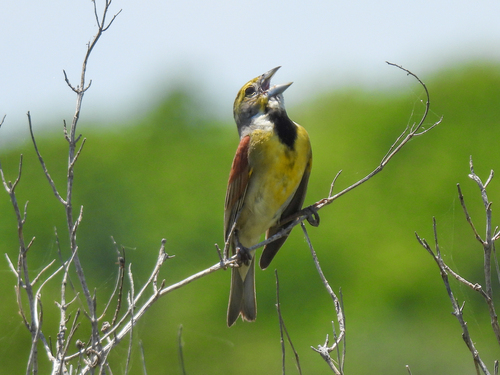
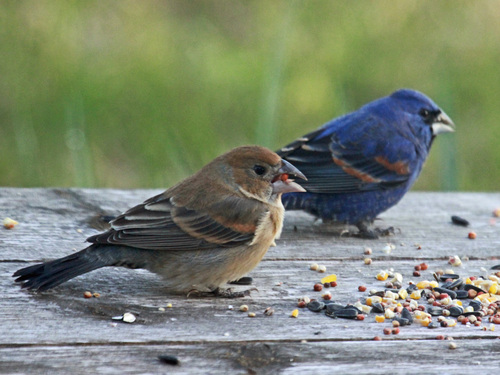
The closest relatives of the Gray-throated Chat that you can see in Biotopo Cerro Cahuí (family Cardinalidae, Cardinals and Allies) are Summer Tanager (about 30%), Indigo Bunting (about 10%) and Rose-breasted Grosbeak (about 10%), with each one's daily chance of a sighting.

Where does the Gray-throated Chat sighting chance come from?

GBIF citizen-science records

It is estimated from how often the Gray-throated Chat is recorded against all the birds logged in Biotopo Cerro Cahuí (22 verified sightings from 2019 to 2026), calibrated against known sighting rates. Figures are rounded to the nearest 10% because citizen-science data supports honest approximations, not decimals, and months with records from fewer than five people show "—". How it works.

← Back to Biotopo Cerro Cahuí