Rose-breasted Grosbeak

Rose-breasted Grosbeak

Pheucticus ludovicianus

Silhouette: Sheatherius · PhyloPic

LCLeast ConcernNTVUENCR
Daily sighting probability ~10% · With luck
at Biotopo Cerro Cahuí

In 3 days ~20% in a week ~40%

28 Verified sightings at Biotopo Cerro Cahuí From 2019 to 2026
17,939 In all 66 parks
October Best month
☀️ Diurnal When it's spotted

About the Rose-breasted Grosbeak

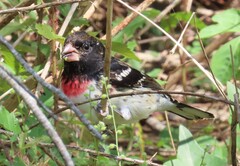
The rose-breasted grosbeak (Pheucticus ludovicianus), colloquially called "cut-throat" due to its coloration, is a large, seed-eating grosbeak in the cardinal family (Cardinalidae). It is primarily a foliage gleaner. Males have black heads, wings, backs, and tails, and a bright rose colored patch on their white breast. Males and females exhibit marked sexual dimorphism.

Breeding habitat consists of cool-temperate open deciduous woods throughout much of eastern North America, with migration to tropical America in winter. Rose-breasted grosbeaks have an average maximum lifespan of 7.3 years in the wild, and up to 24 years in captivity. Death in the wild is generally due to collision with objects (buildings, cars, etc.) and predation, to eggs, nestlings and adults.

In 1760 the French zoologist Mathurin Jacques Brisson included a description of the rose-breasted grosbeak in his Ornithologie based on a specimen collected in Louisiana. He used the French name Le gros-bec de la Louisiane and the Latin Coccothraustes Ludoviciana. Although Brisson coined Latin names, these do not conform to the binomial system and are not recognised by the International Commission on Zoological... Wikipedia →

Sounds

Song1:11

United States · 2022

© Sue Riffe · XC1087131 · CC BY-NC-SA 4.0

Call0:07

United States · 2024

© David Tattersley · XC901102 · CC BY-NC-SA 4.0

Alarm call1:12

United States · 2017

© Matt Wistrand · XC375343 · CC BY-NC-SA 4.0

Global Distribution

Parks Where Found

# Park Country Daily sighting probability
1 Point Pelee National Park 🇨🇦 Canada
~60%
2 El Triunfo 🇲🇽 Mexico
~40%
3 Elk Island National Park 🇨🇦 Canada
~30%
4 Riding Mountain National Park 🇨🇦 Canada
~20%
5 Volcán Barú National Park 🇵🇦 Panama
~20%
6 Arrecifes de Cozumel National Park 🇲🇽 Mexico
~20%
7 Los Quetzales National Park 🇨🇷 Costa Rica
~10%
8 Pico Bonito National Park 🇭🇳 Honduras
~10%
9 Cockscomb Basin Wildlife Sanctuary 🇧🇿 Belize
~10%
10 Shenandoah National Park 🇺🇸 United States
~10%
11 Cerro Azul Meámbar National Park 🇭🇳 Honduras
~10%
12 Great Smoky Mountains National Park 🇺🇸 United States
~10%
13 Voyageurs National Park 🇺🇸 United States
~10%
14 Cañón del Sumidero National Park 🇲🇽 Mexico
~10%
15 La Amistad International Park (Panama) 🇵🇦 Panama
~10%
16 Lago de Yojoa 🇭🇳 Honduras
~10%
17 Calakmul Biosphere Reserve 🇲🇽 Mexico
~10%
18 Biotopo Cerro Cahuí 🇬🇹 Guatemala
~10%
19 Cusuco National Park 🇭🇳 Honduras
~10%
20 Celaque National Park 🇭🇳 Honduras
~10%
21 Chirripó National Park 🇨🇷 Costa Rica
~10%
22 Bastimentos Island National Marine Park 🇵🇦 Panama
<5%
23 Soberanía National Park 🇵🇦 Panama
<5%
24 Chagres National Park 🇵🇦 Panama
<5%
25 La Tigra National Park 🇭🇳 Honduras
<5%
26 Monteverde Cloud Forest Reserve 🇨🇷 Costa Rica
<5%
27 Sian Ka'an Biosphere Reserve 🇲🇽 Mexico
<5%
28 Masaya Volcano National Park 🇳🇮 Nicaragua
<5%
29 Rincón de la Vieja National Park 🇨🇷 Costa Rica
<5%
30 Celestún Biosphere Reserve 🇲🇽 Mexico
<5%
31 Gandoca-Manzanillo Wildlife Refuge 🇨🇷 Costa Rica
<5%
32 Death Valley National Park 🇺🇸 United States
<5%
33 Tayrona National Natural Park 🇨🇴 Colombia
<5%
34 Tenorio Volcano National Park 🇨🇷 Costa Rica
<5%
35 Cahuita National Park 🇨🇷 Costa Rica
<5%
36 Tikal National Park 🇬🇹 Guatemala
<5%
37 Arenal Volcano National Park 🇨🇷 Costa Rica
<5%
38 Tapantí-Macizo de la Muerte National Park 🇨🇷 Costa Rica
<5%
39 Tortuguero National Park 🇨🇷 Costa Rica
<5%
40 Big Bend National Park 🇺🇸 United States
<5%
41 Isle Royale National Park 🇺🇸 United States
<5%
42 Parque Natural Metropolitano 🇵🇦 Panama
<5%
43 Poás Volcano National Park 🇨🇷 Costa Rica
<5%
44 Blue and John Crow Mountains National Park 🇯🇲 Jamaica
<5%
45 Congaree National Park 🇺🇸 United States
<5%
46 Farallones de Cali National Natural Park 🇨🇴 Colombia
<5%
47 Acadia National Park 🇺🇸 United States
<5%
48 Braulio Carrillo National Park 🇨🇷 Costa Rica
<5%
49 Santa Rosa National Park 🇨🇷 Costa Rica
<5%
50 Piedras Blancas National Park 🇨🇷 Costa Rica
<5%
51 El Vizcaíno Biosphere Reserve 🇲🇽 Mexico
<5%
52 Las Baulas Marine National Park 🇨🇷 Costa Rica
<5%
53 Palo Verde National Park 🇨🇷 Costa Rica
<5%
54 Jasper National Park 🇨🇦 Canada
<5%
55 Cabo Blanco Absolute Nature Reserve 🇨🇷 Costa Rica
<5%
56 Chingaza National Natural Park 🇨🇴 Colombia
<5%
57 Manuel Antonio National Park 🇨🇷 Costa Rica
<5%
58 Everglades National Park 🇺🇸 United States
<5%
59 Merritt Island National Wildlife Refuge 🇺🇸 United States
<5%
60 Banff National Park 🇨🇦 Canada
<5%
61 Carara National Park 🇨🇷 Costa Rica
<5%
62 Corcovado National Park 🇨🇷 Costa Rica
<5%
63 Los Nevados National Natural Park 🇨🇴 Colombia
<5%
64 Big Cypress National Preserve 🇺🇸 United States
<5%
65 Grand Teton National Park 🇺🇸 United States
<5%
66 Rocky Mountain National Park 🇺🇸 United States
<5%

Cities Where Found

# City Country Daily sighting probability
1 Guatemala City 🇬🇹 Guatemala
~10%
2 Detroit 🇺🇸 United States
~10%
3 Chicago 🇺🇸 United States
~10%
4 Toronto 🇨🇦 Canada
~10%
5 San Pedro Sula 🇭🇳 Honduras
~10%
6 New York City 🇺🇸 United States
~10%
7 Minneapolis [Saint Paul] 🇺🇸 United States
~10%
8 Torreón 🇲🇽 México
~10%
9 Quito 🇪🇨 Ecuador
~10%
10 Tegucigalpa 🇭🇳 Honduras
~10%

Zoos & Centres Where Found

# Zoo / Centre Country
1 National Zoological Park 🇺🇸 United States In captivity
2 Columbus Zoo and Aquarium 🇺🇸 United States In captivity
3 Xcaret 🇲🇽 Mexico In captivity
4 Fort Worth Zoo 🇺🇸 United States In captivity
5 Houston Zoo 🇺🇸 United States In captivity
6 Aviario Nacional de Colombia 🇨🇴 Colombia In captivity
7 Tracy Aviary 🇺🇸 United States In captivity
8 Florida Aquarium 🇺🇸 United States In captivity

Before you go

What are the chances of seeing a Rose-breasted Grosbeak in Biotopo Cerro Cahuí?

With luck

About 10% of wildlife watchers report a Rose-breasted Grosbeak sighting in Biotopo Cerro Cahuí on a given day, based on 28 verified sightings from GBIF citizen-science data from 2019 to 2026. It is the 111th most-seen of the 191 birds we can rate there. Over three days the chance rises to about 20%, and over a week to about 40%, if each day is a fresh chance.

When is the best time to see a Rose-breasted Grosbeak in Biotopo Cerro Cahuí?

October

In that month about 20% of wildlife watchers report a Rose-breasted Grosbeak in Biotopo Cerro Cahuí on a given day, against under 5% in May–September and November–February, the lowest months. That is one of Biotopo Cerro Cahuí's wettest months, with about 210 mm of rain against 25 mm in March.

What time of day is best to see a Rose-breasted Grosbeak?

Between 8 and 11 am

Across all the parks we cover, that three-hour window holds the most Rose-breasted Grosbeak sightings with a recorded time, and about 9 in 10 of them come between 6 am and 6 pm: it is a daytime animal.

Which relatives of the Rose-breasted Grosbeak live in Biotopo Cerro Cahuí?

Same family: Cardinalidae

The closest relatives of the Rose-breasted Grosbeak that you can see in Biotopo Cerro Cahuí (family Cardinalidae, Cardinals and Allies) are Summer Tanager (about 30%), Indigo Bunting (about 10%) and Gray-throated Chat (about 10%), with each one's daily chance of a sighting.

Where does the Rose-breasted Grosbeak sighting chance come from?

GBIF citizen-science records

It is estimated from how often the Rose-breasted Grosbeak is recorded against all the birds logged in Biotopo Cerro Cahuí (28 verified sightings from 2019 to 2026), calibrated against known sighting rates. Figures are rounded to the nearest 10% because citizen-science data supports honest approximations, not decimals, and months with records from fewer than five people show "—". How it works.

← Back to Biotopo Cerro Cahuí