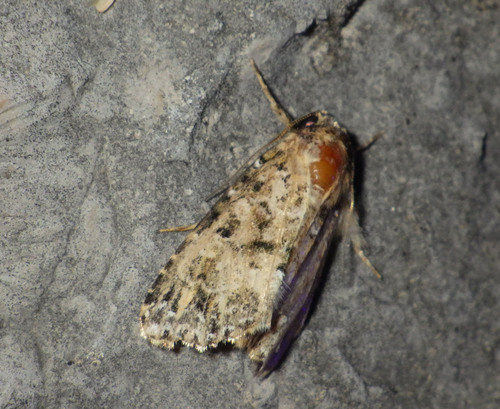
Beautiful Yellow Underwing

Beautiful Yellow Underwing

Anarta myrtilli

Daily sighting probability ~10% · With luck
at Cévennes National Park

In 3 days ~30% in a week ~50%

51 Verified sightings at Cévennes National Park From 2019 to 2026
74 In all 5 parks
June Best month
☀️🌙 Day & Night When it's spotted

About the Beautiful Yellow Underwing

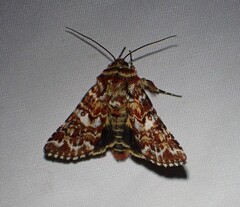
Anarta myrtilli, the beautiful yellow underwing, is a moth in the family Noctuidae. The species was first described by Carl Linnaeus in 1761. It is found in most of Europe including Scandinavia, Britain, France, Germany, Switzerland, Spain, Portugal, Italy, and Russia.

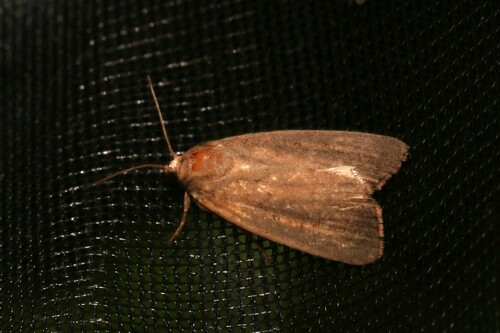
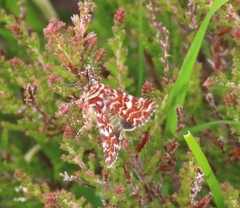
The wingspan is 20–22 mm. Forewing dull dark fuscous purple, with the lines slightly paler; the stigmata obscure; a subtriangular whitish blotch on base of vein 2; hindwing orange with broad black terminal border; the costa and inner margin narrowly black and the base of wing often smoky blackish; this, the type form, occurring in Sweden, the north of England and Scotland, and other northern localities is very different from the usual bright red form, which is the ab. rufescens Tutt. In this the forewing is a mixture of bright red, and olive brown or olive yellow; the transverse lines being more or less strongly whitish, the stigmata red brown with pale rings, and the white spot on vein 2 distinct; ab. peralbata ab. nov. [Warren] is an extreme form of this, in which the white lines are strongly developed, and the central area is milk white from costa to inner margin, including the white blotch on vein 2; in the hindwing the yellow is ampler, the black of the costal, and inner margins and the basal suffusion being reduced; - ab.albivena Haw., described from East Anglian specimens, has the forewing suffused with olive brown, wing remaining normal; while in alpina Ractzer not only is the forewing olive brown, but the hindwing shows only a dull yellowish median band crossed by black veins; and again in olivacea Fuchs the yellow of the hindwing is suffused with olive brown, while the coloration of the forewing remains of the normal bright red; in ab. nigrescens ab. nov. [Warren] occurring at Hyères in the south of France, the usual red fusion is almost entirely replaced by black; lastly, in subsp. citrina subsp. nov. [Warren] from Sintra, Portugal, the whole forewing is suffused with blackish, leaving only the white blotch on vein 2 conspicuous, and the orange of the hindwing, both above and below, is pale lemon yellow; as the insect is decidedly larger than average typical myrtilli, it may prove a distinct species; at present I have seen only one - taken in the spring of 1909 by Mr N. C. Rothschild, and now in the Tring Museum.

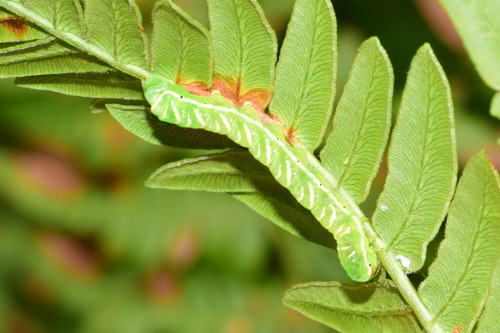
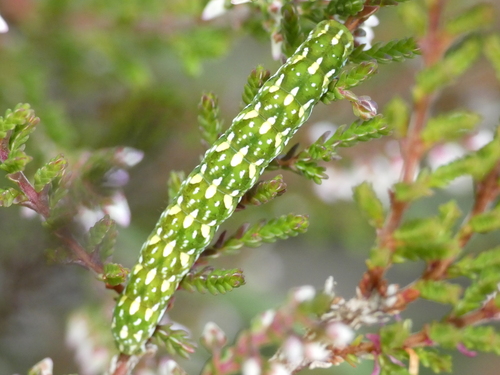
Adults are on wing between May and August depending on the location. There are probably two generations per year. The larvae feed on Calluna vulgaris and Erica tetralix. Wikipedia →
Global Distribution

Parks Where Found

# Park Country Daily sighting probability
1 Cévennes National Park 🇫🇷 France
~10%
2 Snowdonia National Park 🇬🇧 United Kingdom
~10%
3 Cairngorms National Park 🇬🇧 United Kingdom
~10%
4 Bavarian Forest National Park 🇩🇪 Germany
<5%
5 Pyrénées National Park 🇫🇷 France
<5%

Cities Where Found

# City Country Daily sighting probability
1 Porto 🇵🇹 Portugal
<5%

Before you go

What are the chances of seeing a Beautiful Yellow Underwing in Cévennes National Park?

With luck

About 10% of wildlife watchers report a Beautiful Yellow Underwing sighting in Cévennes National Park on a given day, based on 51 verified sightings from GBIF citizen-science data from 2019 to 2026. It is the 232nd most-seen of the 996 insects we can rate there. Over three days the chance rises to about 30%, and over a week to about 50%, if each day is a fresh chance.

When is the best time to see a Beautiful Yellow Underwing in Cévennes National Park?

June

In that month about 20% of wildlife watchers report a Beautiful Yellow Underwing in Cévennes National Park on a given day, against under 5% in October to March, the lowest months.

What time of day is best to see a Beautiful Yellow Underwing?

Between 11 pm and 2 am

Across all the parks we cover, that three-hour window holds the most Beautiful Yellow Underwing sightings with a recorded time, and about half of them come between 6 am and 6 pm: it is seen both by day and at night.

Is Cévennes National Park the best place to see a Beautiful Yellow Underwing?

Yes

Of the 5 parks where we can rate Beautiful Yellow Underwing sightings, Cévennes National Park has the highest daily chance: about 10%. Next come Snowdonia National Park (United Kingdom, about 10%) and Cairngorms National Park (United Kingdom, about 10%).

Which relatives of the Beautiful Yellow Underwing live in Cévennes National Park?

Same family: Noctuidae

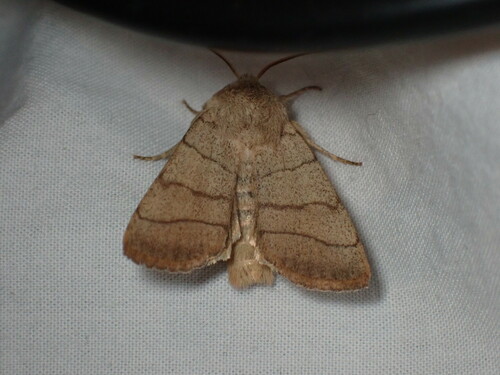
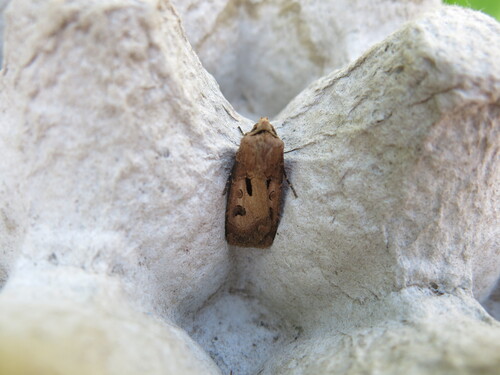
The closest relatives of the Beautiful Yellow Underwing that you can see in Cévennes National Park (family Noctuidae, Cutworm Moths and Allies) are The Latin (about 10%), Treble Lines (about 10%) and Heart And Dart (about 10%), with each one's daily chance of a sighting.

Where does the Beautiful Yellow Underwing sighting chance come from?

GBIF citizen-science records

It is estimated from how often the Beautiful Yellow Underwing is recorded against all the insects logged in Cévennes National Park (51 verified sightings from 2019 to 2026), calibrated against known sighting rates. Figures are rounded to the nearest 10% because citizen-science data supports honest approximations, not decimals, and months with records from fewer than five people show "—". How it works.

← Back to Cévennes National Park