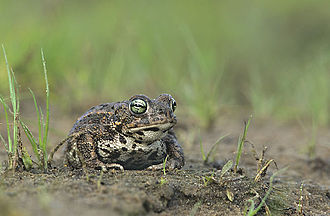
Common Midwife Toad

Common Midwife Toad

Alytes obstetricans

Silhouette: Steven Traver · PhyloPic

LCLeast ConcernNTVUENCR
Daily sighting probability ~30% · Possible
at Cévennes National Park

In 3 days ~60% in a week ~90%

54 Verified sightings at Cévennes National Park From 2019 to 2026
422 In all 6 parks
July Best month
☀️🌙 Day & Night When it's spotted

About the Common Midwife Toad

The common midwife toad (Alytes obstetricans) is a species of midwife frog in the family Alytidae (formerly Discoglossidae). It is found in Belgium, France, Germany, Luxembourg, the Netherlands, Portugal, Spain, Switzerland, and the United Kingdom (although, in the latter, only as an introduction). Like other members of its genus (Alytes), the male toad carries the eggs around entwined on his back and thighs until they are ready to hatch.

Its natural habitats are temperate forests, dry forests, shrubland, rivers, freshwater lakes, freshwater marshes, temperate desert, arable land, pastureland and urban areas. It is threatened by habitat loss. The common midwife toad can grow to a length of 5.5 centimetres (2.2 in) but is usually rather smaller than this, the females generally being larger than the males. It is broad and stocky and has a large head with prominent eyes, the pupils being vertical slits. The skin is mostly smooth with a few small warts and granules and a row of large warts down either side. The parotoid glands are small and there are additional glands in the under arm and ankle regions. There are three tubercles on each metacarpal. The colour is quite... Wikipedia →

Sounds

Advertisement call0:29

Germany · 2026

© Henning Pehlemann · XC1099398 · CC BY-NC-SA 4.0

Territorial call0:31

France · 2024

© Manuel Oudard · XC896444 · CC BY-NC-ND 4.0

Advertisement call0:36

France · 2025

© Olivier SWIFT · XC1012060 · CC BY-NC-SA 4.0

Global Distribution

Parks Where Found

# Park Country Daily sighting probability
1 Picos de Europa National Park 🇪🇸 Spain
~50%
2 Pyrénées National Park 🇫🇷 France
~30%
3 Cévennes National Park 🇫🇷 France
~30%
4 Aigüestortes National Park 🇪🇸 Spain
~30%
5 Mercantour National Park 🇫🇷 France
~10%
6 Sierra de Guadarrama National Park 🇪🇸 Spain
<5%

Cities Where Found

# City Country Daily sighting probability
1 Porto 🇵🇹 Portugal
~20%
2 Lyon 🇫🇷 France
~20%
3 Valencia 🇪🇸 Spain
~10%
4 Paris 🇫🇷 France
~10%

Before you go

What are the chances of seeing a Common Midwife Toad in Cévennes National Park?

Possible

About 30% of wildlife watchers report a Common Midwife Toad sighting in Cévennes National Park on a given day, based on 54 verified sightings from GBIF citizen-science data from 2019 to 2026. It is the 5th most-seen of the 11 amphibians we can rate there. Over three days the chance rises to about 60%, and over a week to about 90%, if each day is a fresh chance.

When is the best time to see a Common Midwife Toad in Cévennes National Park?

July

In that month about 40% of wildlife watchers report a Common Midwife Toad in Cévennes National Park on a given day, against about 20% in January–April, June and September, the lowest months. That is one of Cévennes National Park's driest months, with about 35 mm of rain against 260 mm in October.

What time of day is best to see a Common Midwife Toad?

Between 9 pm and midnight

Across all the parks we cover, that three-hour window holds the most Common Midwife Toad sightings with a recorded time, and about 6 in 10 of them come between 6 pm and 6 am: it is seen both by day and at night.

Which relatives of the Common Midwife Toad live in Cévennes National Park?

Same order: Anura

The closest relatives of the Common Midwife Toad that you can see in Cévennes National Park (order Anura, Frogs and Toads) are Giant Toad (about 50%), European Common Frog (about 40%) and Mediterranean Tree Frog (about 30%), with each one's daily chance of a sighting.

Where does the Common Midwife Toad sighting chance come from?

GBIF citizen-science records

It is estimated from how often the Common Midwife Toad is recorded against all the amphibians logged in Cévennes National Park (54 verified sightings from 2019 to 2026), calibrated against known sighting rates. Figures are rounded to the nearest 10% because citizen-science data supports honest approximations, not decimals, and months with records from fewer than five people show "—". How it works.

← Back to Cévennes National Park