Blue Cotinga

Blue Cotinga

Cotinga nattererii

Silhouette: Edwin Price · PhyloPic

LCLeast ConcernNTVUENCR
Daily sighting probability ~20% · Possible
at Chagres National Park

In 3 days ~40% in a week ~70%

218 Verified sightings at Chagres National Park From 2019 to 2026
2,485 In all 5 parks
May Best month
☀️ Diurnal When it's spotted

About the Blue Cotinga

The blue cotinga (Cotinga nattererii) is a species of bird in the family Cotingidae. It is found in Colombia, north-west Ecuador, eastern to western Panama and western Venezuela in tropical moist lowland forests and heavily degraded former forest. In relation to range and population size this species is not considered to be vulnerable.

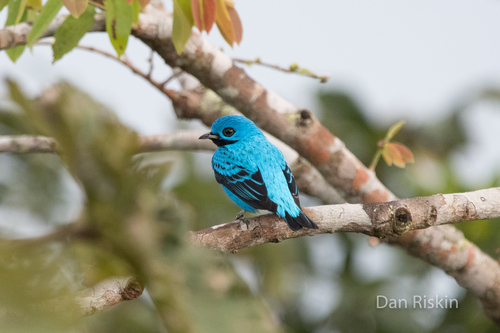
The blue cotinga is a plump, dove-like bird with a small head. It grows to a length of about 7 inches (18 cm). The male has glossy blue plumage and a black bib with a purple iridescent sheen on the throat and breast. There is a black ring round the eye, and the wings and tail are black with broad blue margins. On the belly there is a circular patch of purple. The female looks quite different; she is dark brown above, each feather having a pale margin which gives the bird a scaly appearance, and the underparts are pale brown with each feather having a buff margin. The turquoise cotinga (Cotinga ridgwayi) is a similar species with which this bird might be confused, but it has a different range.

This species is native to Central America and South America. Its range extends from central Panama southwards to... Wikipedia →

Sounds

Wing noise0:11

Ecuador · 1997

© Olaf Jahn · XC262286 · CC BY-NC-SA 4.0

Global Distribution

Parks Where Found

# Park Country Daily sighting probability
1 Soberanía National Park 🇵🇦 Panama
~20%
2 Chagres National Park 🇵🇦 Panama
~20%
3 Utría National Natural Park 🇨🇴 Colombia
~10%
4 Darién National Park 🇵🇦 Panama
<5%
5 San Lorenzo Protected Forest 🇵🇦 Panama
<5%

Zoos & Centres Where Found

# Zoo / Centre Country
1 Xcaret 🇲🇽 Mexico In captivity
2 Warsaw Zoo 🇵🇱 Poland In captivity
3 Bird Paradise 🇸🇬 Singapore In captivity
4 Rainforest Wild Asia 🇸🇬 Singapore In captivity
5 herpetarium warszawskiego ZOO 🇵🇱 Poland In captivity
6 akwarium warszawskiego ZOO 🇵🇱 Poland In captivity
7 hipopotamiarnia i akwarium morskie warszawskiego ZOO 🇵🇱 Poland In captivity

Before you go

What are the chances of seeing a Blue Cotinga in Chagres National Park?

Possible

About 20% of wildlife watchers report a Blue Cotinga sighting in Chagres National Park on a given day, based on 218 verified sightings from GBIF citizen-science data from 2019 to 2026. It is the 89th most-seen of the 372 birds we can rate there. Over three days the chance rises to about 40%, and over a week to about 70%, if each day is a fresh chance.

When is the best time to see a Blue Cotinga in Chagres National Park?

May–June and September

In those months about 30% of wildlife watchers report a Blue Cotinga in Chagres National Park on a given day, against about 10% in January–February and April, the lowest months. Those are among Chagres National Park's wettest months, with about 270 mm of rain a month against 30 mm in February.

What time of day is best to see a Blue Cotinga?

Between 7 and 10 am

Across all the parks we cover, that three-hour window holds the most Blue Cotinga sightings with a recorded time, and about 9 in 10 of them come between 6 am and 6 pm: it is a daytime animal.

Is Chagres National Park the best place to see a Blue Cotinga?

Among the best

Of the 5 parks where we can rate Blue Cotinga sightings, Chagres National Park ranks 2nd at about 20%, level with the leaders once rounded. The best odds are in Soberanía National Park (Panama, about 20%).

Where does the Blue Cotinga sighting chance come from?

GBIF citizen-science records

It is estimated from how often the Blue Cotinga is recorded against all the birds logged in Chagres National Park (218 verified sightings from 2019 to 2026), calibrated against known sighting rates. Figures are rounded to the nearest 10% because citizen-science data supports honest approximations, not decimals, and months with records from fewer than five people show "—". How it works.

← Back to Chagres National Park