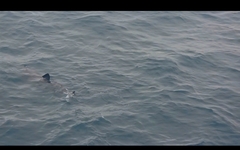
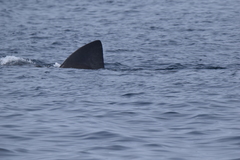
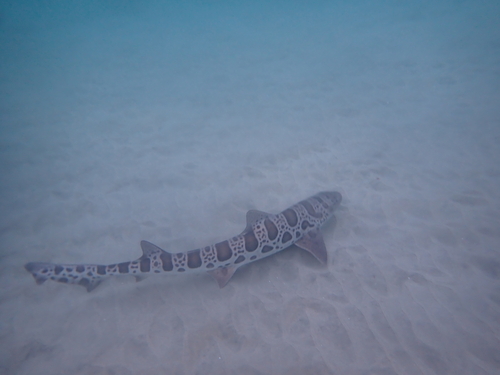
Basking Shark

Basking Shark

Cetorhinus maximus

Silhouette: Stephen O'Connor · PhyloPic

Daily sighting probability ~30% · Possible
at Channel Islands National Park

In 3 days ~70% in a week ~90%

14 Verified sightings at Channel Islands National Park From 2019 to 2026
14 In 1 park
April Best month
🌅 Crepuscular When it's spotted

About the Basking Shark

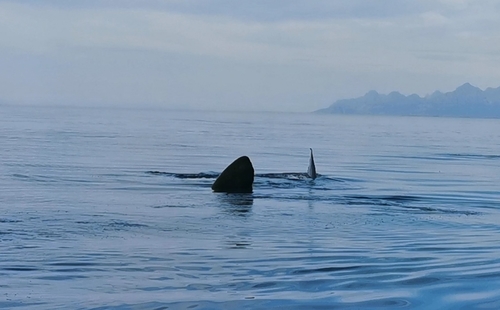
The basking shark (Cetorhinus maximus) is the second-largest living shark and fish, after the whale shark. It is one of three plankton-eating shark species, along with the whale shark and megamouth shark. Typically, basking sharks reach 7.9 m (26 ft) in length, but large individuals have been known to grow more than 10 m (33 ft) long. It is usually greyish-brown, with mottled skin, with the inside of the mouth being white in colour. The caudal fin has a strong lateral keel and a crescent shape. Other common names include bone shark, elephant shark, sailfish, and sunfish.

The basking shark is a cosmopolitan migratory species found in all the world's temperate oceans. A slow-moving filter feeder, its common name derives from its habit of feeding at the surface, appearing to be basking in the warmer water there. It has anatomical adaptations for filter-feeding, such as a greatly enlarged mouth and highly developed gill rakers. Its snout is conical, and the gill slits extend around the top and bottom of its head. The gill rakers, dark and bristle-like, are used to catch plankton as water filters through the mouth and over the gills. The teeth are numerous, often numbering 100 per row. The teeth are very small, have a single conical cusp, are curved backwards, and are the same on both the upper and lower jaws. This species has the smallest weight-for-weight brain size of any shark, reflecting its relatively passive lifestyle.

Basking sharks have been shown from satellite tracking to overwinter in both continental shelf (less than 200 m or 660 ft) and deeper waters. They may be found either in small shoals or alone. Despite their large size and threatening appearance, basking sharks are not aggressive and are harmless to humans.

The basking shark has long been a commercially important fish as a source of food, shark fin, animal feed, and shark liver oil. Overexploitation has reduced its populations to the point where some have disappeared and others need protection. Wikipedia →
Global Distribution

Parks Where Found

# Park Country Daily sighting probability
1 Channel Islands National Park 🇺🇸 United States
~30%

More parks will be added in future updates.

Zoos & Centres Where Found

# Zoo / Centre Country
1 Dublin Zoo 🇮🇪 Ireland In captivity
2 Aqua World 🇯🇵 Japan In captivity
3 Nordsøen Oceanarium 🇩🇰 Denmark In captivity

Before you go

What are the chances of seeing a Basking Shark in Channel Islands National Park?

Possible

About 30% of wildlife watchers report a Basking Shark sighting in Channel Islands National Park on a given day, based on 14 verified sightings from GBIF citizen-science data from 2019 to 2026. It is the 5th most-seen of the 7 sharks and rays we can rate there. Over three days the chance rises to about 70%, and over a week to about 90%, if each day is a fresh chance.

When is the best time to see a Basking Shark in Channel Islands National Park?

April

In that month about 80% of wildlife watchers report a Basking Shark in Channel Islands National Park on a given day, against about 10% in June and August–November, the lowest months. That is one of Channel Islands National Park's driest months, with about 10 mm of rain against 60 mm in January. December to February have too few records to rate.

What time of day is best to see a Basking Shark?

Between 3 and 6 pm

Across all the parks we cover, that three-hour window holds the most Basking Shark sightings with a recorded time, and about half of them come between 6 am and 6 pm: it is most active around dawn and dusk.

Where else can you see a Basking Shark?

Only Channel Islands National Park, in our data

Channel Islands National Park is the only park on Wallace's Line with enough records to rate Basking Shark sightings: about 30% of wildlife watchers there report one on a given day.

Where does the Basking Shark sighting chance come from?

GBIF citizen-science records

It is estimated from how often the Basking Shark is recorded against all the sharks and rays logged in Channel Islands National Park (14 verified sightings from 2019 to 2026), calibrated against known sighting rates. Figures are rounded to the nearest 10% because citizen-science data supports honest approximations, not decimals, and months with records from fewer than five people show "—". How it works.

← Back to Channel Islands National Park