Horn Shark

Horn Shark

Heterodontus francisci

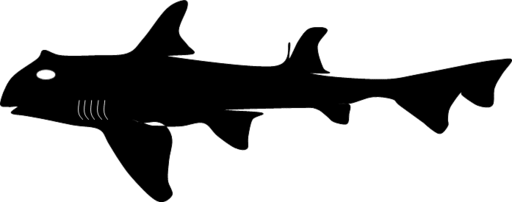
Silhouette: M Kolmann · PhyloPic

Daily sighting probability ~50% · Likely
at Channel Islands National Park

In 3 days ~90% in a week >90%

40 Verified sightings at Channel Islands National Park From 2019 to 2026
40 In 1 park
October Best month
☀️ Diurnal When it's spotted

About the Horn Shark

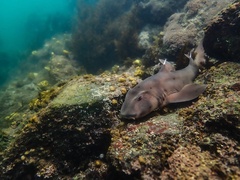
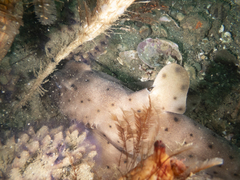
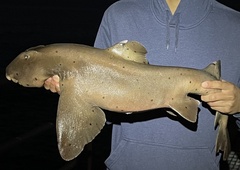
The horn shark (Heterodontus francisci) is a species of bullhead shark, in the family Heterodontidae. It is endemic to the coastal waters off the western coast of North America, from California to the Gulf of California. Young sharks are segregated spatially from the adults, with the former preferring deeper sandy flats and the latter preferring shallower rocky reefs or algal beds. A small species typically measuring 1 m (3.3 ft) in length, the horn shark can be recognized by a short, blunt head with ridges over its eyes, two high dorsal fins with large spines, and a brown or gray coloration with many small dark spots.

Slow-moving, generally solitary predators, horn sharks hunt at night inside small home ranges and retreat to a favored shelter during the day. Their daily activity cycles are controlled by environmental light levels. Adult sharks prey mainly on hard-shelled molluscs, echinoderms, and crustaceans, which they crush between powerful jaws and molar-like teeth, while also feeding opportunistically on a wide variety of other invertebrates and small bony fishes. Juveniles prefer softer-bodied prey such as polychaete worms and sea anemones. The shark extracts its prey from the substrate using suction and, if necessary, levering motions with its body. Reproduction is oviparous, with females laying up to 24 eggs from February to April. After laying, the female picks up the auger-shaped egg cases and wedges them into crevices to protect them from predators.

Horn sharks are harmless unless harassed, and are readily maintained in captivity. They are not targeted by either commercial or recreational fisheries, though small numbers are caught as bycatch. In Mexico this species is used for food and fishmeal, and in California its spines are made into jewelry. The International Union for Conservation of Nature (IUCN) does not yet have enough information to determine the horn shark's conservation status. It faces few threats off the coast of the United States. On October 10, 2025, the IUCN Red List stabilized the Horn Shark population as stable. Wikipedia →

Global Distribution

Parks Where Found

# Park Country Daily sighting probability
1 Channel Islands National Park 🇺🇸 United States
~50%

More parks will be added in future updates.

Zoos & Centres Where Found

# Zoo / Centre Country
1 California Academy of Sciences 🇺🇸 United States In captivity
2 Lisbon Oceanarium 🇵🇹 Portugal In captivity
3 Nausicaà Centre National de la Mer 🇫🇷 France In captivity
4 Toledo Zoo 🇺🇸 United States In captivity
5 Chessington World of Adventures 🇬🇧 United Kingdom In captivity
6 Berlin Zoological Garden 🇩🇪 Germany In captivity
7 Wilhelma 🇩🇪 Germany In captivity
8 Arizona-Sonora Desert Museum 🇺🇸 United States In captivity
9 L'Oceanogràfic 🇪🇸 Spain In captivity
10 The Living Planet Aquarium 🇺🇸 United States In captivity
11 New York Aquarium 🇺🇸 United States In captivity
12 Aquarium of the Pacific 🇺🇸 United States In captivity
13 Adventure Aquarium 🇺🇸 United States In captivity
14 AquaRio 🇧🇷 Brazil In captivity
15 Monterey Bay Aquarium 🇺🇸 United States In captivity
16 Newport Aquarium 🇺🇸 United States In captivity
17 Osaka Aquarium Kaiyukan 🇯🇵 Japan In captivity
18 Poema del Mar Aquarium 🇪🇸 Spain In captivity
19 Haus des Meeres 🇦🇹 Austria In captivity
20 Acuario de Sevilla 🇪🇸 Spain In captivity
21 Aquarium Berlin 🇩🇪 Germany In captivity
22 Birch Aquarium 🇺🇸 United States In captivity
23 Cabrillo Marine Aquarium 🇺🇸 United States In captivity
24 Aquarium of the Bay 🇺🇸 United States In captivity
25 Jenkinson's Aquarium 🇺🇸 United States In captivity
26 Sea Life Aquarium 🇺🇸 United States In captivity
27 Sea Life Centre, Blackpool 🇬🇧 United Kingdom In captivity
28 SEA LIFE Oberhausen 🇩🇪 Germany In captivity
29 Sea Life München 🇩🇪 Germany In captivity
30 Shark Reef at Mandalay Bay 🇺🇸 United States In captivity
31 Heal the Bay Aquarium 🇺🇸 United States In captivity
32 King House 🇺🇸 United States In captivity
33 Sea Life Paris Val d'Europe 🇫🇷 France In captivity
34 Ty Warner Sea Center 🇺🇸 United States In captivity

Before you go

What are the chances of seeing a Horn Shark in Channel Islands National Park?

Likely

About 50% of wildlife watchers report a Horn Shark sighting in Channel Islands National Park on a given day, based on 40 verified sightings from GBIF citizen-science data from 2019 to 2026. It is the most-seen of the 7 sharks and rays we can rate there. Over three days the chance rises to about 90%, and over a week to over 90%, if each day is a fresh chance.

When is the best time to see a Horn Shark in Channel Islands National Park?

August to November

In those months about 80% of wildlife watchers report a Horn Shark in Channel Islands National Park on a given day, against about 50% in June, the lowest month. Those are among Channel Islands National Park's driest months, with about 5 mm of rain a month against 60 mm in January. December to February have too few records to rate.

What time of day is best to see a Horn Shark?

Between 8 and 11 am

Across all the parks we cover, that three-hour window holds the most Horn Shark sightings with a recorded time, and about 8 in 10 of them come between 6 am and 6 pm: it is a daytime animal.

Where else can you see a Horn Shark?

Only Channel Islands National Park, in our data

Channel Islands National Park is the only park on Wallace's Line with enough records to rate Horn Shark sightings: about 50% of wildlife watchers there report one on a given day.

Where does the Horn Shark sighting chance come from?

GBIF citizen-science records

It is estimated from how often the Horn Shark is recorded against all the sharks and rays logged in Channel Islands National Park (40 verified sightings from 2019 to 2026), calibrated against known sighting rates. Figures are rounded to the nearest 10% because citizen-science data supports honest approximations, not decimals, and months with records from fewer than five people show "—". How it works.

← Back to Channel Islands National Park