Leopard Shark

Leopard Shark

Triakis semifasciata

Silhouette: Nick Schooler · PhyloPic

Daily sighting probability ~40% · Likely
at Channel Islands National Park

In 3 days ~70% in a week >90%

18 Verified sightings at Channel Islands National Park From 2019 to 2026
18 In 1 park
April Best month
🌙 Nocturnal When it's spotted

About the Leopard Shark

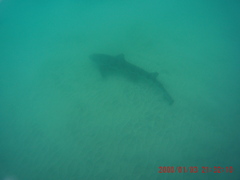
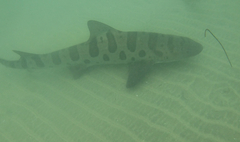
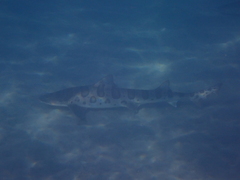
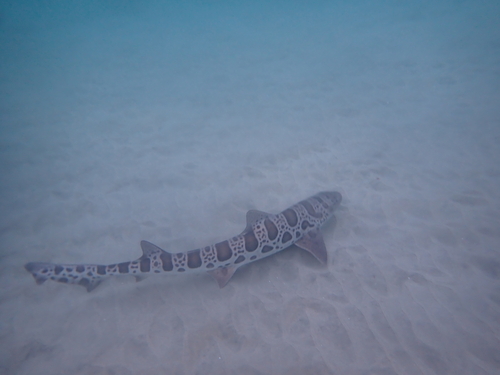
The leopard shark (Triakis semifasciata) is a species of houndshark, in the family Triakidae. It is found along the Pacific coast of North America, from the U.S. state of Oregon to Mazatlán in Mexico. Typically measuring 1.2–1.5 m (3.9–4.9 ft) long, this slender-bodied shark is immediately identifiable by the striking pattern of black saddle-like markings and large spots over its back, from which it derives its common name. Large schools of leopard sharks are a common sight in bays and estuaries, swimming over sandy or muddy flats or rock-strewn areas near kelp beds and reefs. They are most common near the coast, in water less than 4 m (13 ft) deep.

Active-swimming predators, groups of leopard sharks often follow the tide onto intertidal mudflats to forage for food, mainly clams, spoon worms, crabs, shrimp, bony fish, and fish eggs. Most leopard sharks tend to remain within a particular area rather than undertaking long movements elsewhere, which has led to genetic divergence between populations of sharks living in different regions. This species is aplacental viviparous, meaning that the young hatch inside the uterus and are nourished by yolk. From March to June, the female gives birth to as many as 37 young after a gestation period of 10–12 months. It is relatively slow-growing and takes many years to mature.

Harmless to humans, the leopard shark is caught by commercial and recreational fisheries for food and the aquarium trade. This species is mostly fished in the waters off California where, after a period of population decline in the 1980s, new fishing regulations in the early 1990s reduced harvesting to sustainable levels. The International Union for Conservation of Nature has assessed this species as of Least Concern, while noting that local stocks may easily become overfished because of the shark's slow growth and limited migratory habits. Wikipedia →
Global Distribution

Parks Where Found

# Park Country Daily sighting probability
1 Channel Islands National Park 🇺🇸 United States
~40%

More parks will be added in future updates.

Zoos & Centres Where Found

# Zoo / Centre Country
1 SeaWorld Orlando 🇺🇸 United States In captivity
2 SeaWorld San Diego 🇺🇸 United States In captivity
3 San Diego Zoo 🇺🇸 United States In captivity
4 Shedd Aquarium 🇺🇸 United States In captivity
5 Natura Artis Magistra 🇳🇱 Netherlands In captivity
6 California Academy of Sciences 🇺🇸 United States In captivity
7 Lisbon Oceanarium 🇵🇹 Portugal In captivity
8 Nausicaà Centre National de la Mer 🇫🇷 France In captivity
9 Minnesota Zoo 🇺🇸 United States In captivity
10 Brookfield Zoo 🇺🇸 United States In captivity
11 Milwaukee County Zoo 🇺🇸 United States In captivity
12 Toledo Zoo 🇺🇸 United States In captivity
13 Wilhelma 🇩🇪 Germany In captivity
14 Akron Zoo 🇺🇸 United States In captivity
15 Point Defiance Zoo & Aquarium 🇺🇸 United States In captivity
16 Riverbanks Zoo 🇺🇸 United States In captivity
17 Aquarium du Québec 🇨🇦 Canada In captivity
18 Discovery Cove 🇺🇸 United States In captivity
19 L'Oceanogràfic 🇪🇸 Spain In captivity
20 Oregon Coast Aquarium 🇺🇸 United States In captivity
21 Aquarium of the Pacific 🇺🇸 United States In captivity
22 Long Island Aquarium and Exhibition Center 🇺🇸 United States In captivity
23 Adventure Aquarium 🇺🇸 United States In captivity
24 Downtown Aquarium, Denver 🇺🇸 United States In captivity
25 Monterey Bay Aquarium 🇺🇸 United States In captivity
26 Newport Aquarium 🇺🇸 United States In captivity
27 Oklahoma Aquarium 🇺🇸 United States In captivity
28 Ripley's Aquarium of Canada 🇨🇦 Canada In captivity
29 Ripley's Aquarium of the Smokies 🇺🇸 United States In captivity
30 Seattle Aquarium 🇺🇸 United States In captivity
31 Marine Life Park 🇸🇬 Singapore In captivity
32 Singapore Oceanarium 🇸🇬 Singapore In captivity
33 Seaquarium du Grau-du-Roi 🇫🇷 France In captivity
34 The Wildlife Habitat 🇺🇸 United States In captivity
35 Birch Aquarium 🇺🇸 United States In captivity
36 Cabrillo Marine Aquarium 🇺🇸 United States In captivity
37 Downtown Aquarium, Houston 🇺🇸 United States In captivity
38 National Aquarium 🇺🇸 United States In captivity
39 New England Aquarium 🇺🇸 United States In captivity
40 Sea Life Centre 🇬🇧 United Kingdom In captivity
41 Aquarium of the Bay 🇺🇸 United States In captivity
42 Jenkinson's Aquarium 🇺🇸 United States In captivity
43 Ocean World 🇺🇸 United States In captivity
44 Sea Life Aquarium 🇺🇸 United States In captivity
45 Acuario Inbursa 🇲🇽 Mexico In captivity
46 Shark Reef at Mandalay Bay 🇺🇸 United States In captivity
47 Aquarium de Vannes 🇫🇷 France In captivity
48 Sea Life Grapevine 🇺🇸 United States In captivity
49 Seattle Marine Aquarium 🇺🇸 United States In captivity
50 Siegfried & Roy's Secret Garden and Dolphin Habitat 🇺🇸 United States In captivity

Before you go

What are the chances of seeing a Leopard Shark in Channel Islands National Park?

Likely

About 40% of wildlife watchers report a Leopard Shark sighting in Channel Islands National Park on a given day, based on 18 verified sightings from GBIF citizen-science data from 2019 to 2026. It is the 4th most-seen of the 7 sharks and rays we can rate there. Over three days the chance rises to about 70%, and over a week to over 90%, if each day is a fresh chance.

When is the best time to see a Leopard Shark in Channel Islands National Park?

April

In that month about 80% of wildlife watchers report a Leopard Shark in Channel Islands National Park on a given day, against about 10% in June and September, the lowest months. That is one of Channel Islands National Park's driest months, with about 10 mm of rain against 60 mm in January. December to February have too few records to rate.

What time of day is best to see a Leopard Shark?

Between 8 and 11 pm

Across all the parks we cover, that three-hour window holds the most Leopard Shark sightings with a recorded time, and about 9 in 10 of them come between 6 pm and 6 am: it is mostly seen at night.

Where else can you see a Leopard Shark?

Only Channel Islands National Park, in our data

Channel Islands National Park is the only park on Wallace's Line with enough records to rate Leopard Shark sightings: about 40% of wildlife watchers there report one on a given day.

Where does the Leopard Shark sighting chance come from?

GBIF citizen-science records

It is estimated from how often the Leopard Shark is recorded against all the sharks and rays logged in Channel Islands National Park (18 verified sightings from 2019 to 2026), calibrated against known sighting rates. Figures are rounded to the nearest 10% because citizen-science data supports honest approximations, not decimals, and months with records from fewer than five people show "—". How it works.

← Back to Channel Islands National Park