Thornback Guitarfish

Thornback Guitarfish

Platyrhinoidis triseriata

Silhouette: Nick Schooler · PhyloPic

Daily sighting probability ~20% · Possible
at Channel Islands National Park

In 3 days ~60% in a week ~90%

8 Verified sightings at Channel Islands National Park From 2019 to 2026
8 In 1 park
July Best month
☀️🌙 Day & Night When it's spotted

About the Thornback Guitarfish

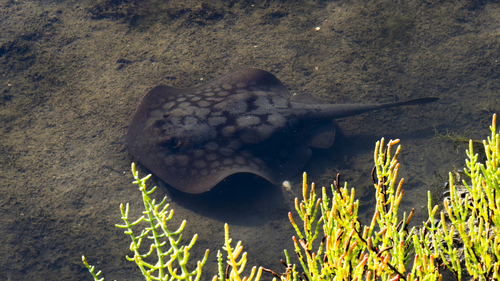
The thornback guitarfish (Platyrhinoidis triseriata) is a species of ray in the family Platyrhinidae, and the only member of its genus. Despite its name and appearance, it is more closely related to electric rays than to true guitarfishes of the family Rhinobatidae. This species ranges from Tomales Bay to the Gulf of California, generally in inshore waters no deeper than 6 m (20 ft). It can be found on or buried in sand or mud, or in and near kelp beds. Reaching 91 cm (36 in) in length, the thornback guitarfish has a heart-shaped pectoral fin disc and a long, robust tail bearing two posteriorly positioned dorsal fins and a well-developed caudal fin. The most distinctive traits of this plain-colored ray are the three parallel rows of large, hooked thorns that start from the middle of the back and run onto the tail.

Encountered singly or in groups, the thornback guitarfish feeds on small, benthic invertebrates and bony fishes. It is aplacental viviparous, with the developing young drawing sustenance from a yolk sac. Females give birth to 1–15 pups annually in late summer, following a roughly year-long gestation period. The International Union for Conservation of Nature (IUCN) has listed the thornback guitarfish under Least Concern because the majority of its range lies within United States waters, where it is common since it has no commercial value and is not heavily fished commercially or recreationally. The status of this species in Mexican waters is inadequately known but may be more precarious. Wikipedia →

Global Distribution

Parks Where Found

# Park Country Daily sighting probability
1 Channel Islands National Park 🇺🇸 United States
~20%

More parks will be added in future updates.

Zoos & Centres Where Found

# Zoo / Centre Country
1 Monterey Bay Aquarium 🇺🇸 United States In captivity
2 Ty Warner Sea Center 🇺🇸 United States In captivity

Before you go

What are the chances of seeing a Thornback Guitarfish in Channel Islands National Park?

Possible

About 20% of wildlife watchers report a Thornback Guitarfish sighting in Channel Islands National Park on a given day, based on 8 verified sightings from GBIF citizen-science data from 2019 to 2026. It is the 6th most-seen of the 7 sharks and rays we can rate there. Over three days the chance rises to about 60%, and over a week to about 90%, if each day is a fresh chance.

When is the best time to see a Thornback Guitarfish in Channel Islands National Park?

July

In that month about 70% of wildlife watchers report a Thornback Guitarfish in Channel Islands National Park on a given day, against about 10% in March–May and October–November, the lowest months. That is one of Channel Islands National Park's driest months, with almost no rain against 60 mm in January. December to February have too few records to rate.

What time of day is best to see a Thornback Guitarfish?

Between 1 and 4 pm

Across all the parks we cover, that three-hour window holds the most Thornback Guitarfish sightings with a recorded time, and about 7 in 10 of them come between 6 am and 6 pm: it is seen both by day and at night.

Where else can you see a Thornback Guitarfish?

Only Channel Islands National Park, in our data

Channel Islands National Park is the only park on Wallace's Line with enough records to rate Thornback Guitarfish sightings: about 20% of wildlife watchers there report one on a given day.

Where does the Thornback Guitarfish sighting chance come from?

GBIF citizen-science records

It is estimated from how often the Thornback Guitarfish is recorded against all the sharks and rays logged in Channel Islands National Park (8 verified sightings from 2019 to 2026), calibrated against known sighting rates. Figures are rounded to the nearest 10% because citizen-science data supports honest approximations, not decimals, and months with records from fewer than five people show "—". How it works.

← Back to Channel Islands National Park