Russet-Crowned Crake

Russet-Crowned Crake

Anurolimnas viridis

Silhouette: T. Michael Keesey (vectorization) and HuttyMcphoo (photography) · PhyloPic

Daily sighting probability ~10% · With luck
at Chapada Diamantina National Park

In 3 days ~30% in a week ~50%

65 Verified sightings at Chapada Diamantina National Park From 2019 to 2026
70 In all 2 parks
May Best month
☀️ Diurnal When it's spotted

About the Russet-Crowned Crake

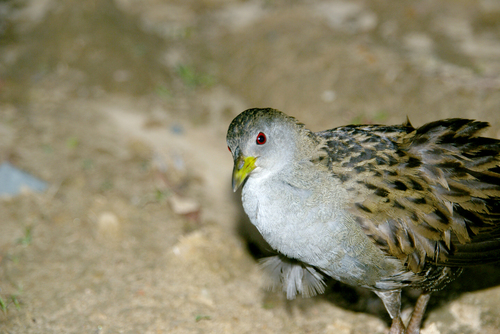
The russet-crowned crake (Rufirallus viridis) is a species of bird in subfamily Rallinae of family Rallidae, the rails, gallinules, and coots. It is found in Bolivia, Brazil, Colombia, Ecuador, the Guianas, Paraguay, Peru, and Venezuela.

The russet-crowned crake was formally described in 1776 by the German zoologist Philipp Statius Müller under the binomial name Rallus viridis. Müller based his account on a plate of the "Râle de Cayenne" that had been published to accompany the Comte de Buffon's Histoire Naturelle des Oiseaux. The russet-crowned crake is now placed in the genus Rufirallus that was introduced in 1856 by the French naturalist Charles Lucien Bonaparte. The genus name combines the Latin rufus meaning "rufous" with the genus Rallus that had been introduced by Carl Linnaeus in 1758 for the rails. The specific epithet viridis is Latin meaning "green".

Two subspecies are recognised: Males... Wikipedia →

Sounds

Recording0:19

Brazil · 2022

© Gustavo Gonsioroski · iNaturalist · CC BY-NC 4.0

Recording1:25

Brazil · 2002

© dbeadle · iNaturalist · CC BY-NC 4.0

Recording0:32

Brazil · 2024

© Luciano Bernardes · iNaturalist · CC BY-NC 4.0

Global Distribution

Parks Where Found

# Park Country Daily sighting probability
1 Chapada Diamantina National Park 🇧🇷 Brazil
~10%
2 Chapada dos Guimarães National Park 🇧🇷 Brazil
<5%

Cities Where Found

# City Country Daily sighting probability
1 Goiânia 🇧🇷 Brazil
~10%
2 Belém 🇧🇷 Brazil
<5%
3 Rio de Janeiro 🇧🇷 Brazil
<5%
4 Santos 🇧🇷 Brazil
<5%
5 Niterói 🇧🇷 Brazil
<5%
6 Medellín 🇨🇴 Colombia
<5%

Before you go

What are the chances of seeing a Russet-Crowned Crake in Chapada Diamantina National Park?

With luck

About 10% of wildlife watchers report a Russet-Crowned Crake sighting in Chapada Diamantina National Park on a given day, based on 65 verified sightings from GBIF citizen-science data from 2019 to 2026. It is the 120th most-seen of the 271 birds we can rate there. Over three days the chance rises to about 30%, and over a week to about 50%, if each day is a fresh chance.

When is the best time to see a Russet-Crowned Crake in Chapada Diamantina National Park?

May

In that month about 30% of wildlife watchers report a Russet-Crowned Crake in Chapada Diamantina National Park on a given day, against under 5% in August and September, the lowest months.

What time of day is best to see a Russet-Crowned Crake?

Between 7 and 10 am

Across all the parks we cover, that three-hour window holds the most Russet-Crowned Crake sightings with a recorded time, and about 8 in 10 of them come between 6 am and 6 pm: it is a daytime animal.

Is Chapada Diamantina National Park the best place to see a Russet-Crowned Crake?

Yes

Of the 2 parks where we can rate Russet-Crowned Crake sightings, Chapada Diamantina National Park has the highest daily chance: about 10%. Next come Chapada dos Guimarães National Park (Brazil, under 5%).

Where does the Russet-Crowned Crake sighting chance come from?

GBIF citizen-science records

It is estimated from how often the Russet-Crowned Crake is recorded against all the birds logged in Chapada Diamantina National Park (65 verified sightings from 2019 to 2026), calibrated against known sighting rates. Figures are rounded to the nearest 10% because citizen-science data supports honest approximations, not decimals, and months with records from fewer than five people show "—". How it works.

← Back to Chapada Diamantina National Park