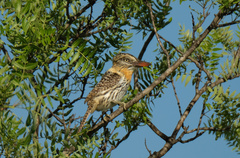
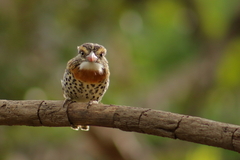
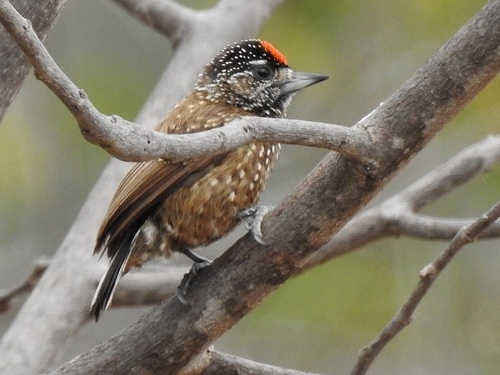
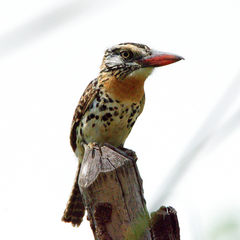
Spot-backed Puffbird

Spot-backed Puffbird

Nystalus maculatus

Silhouette: Matt Wilkins (Photo by Len Blumin) · PhyloPic

LCLeast ConcernNTVUENCR
Daily sighting probability <5% · Rare
at Chapada Diamantina National Park

In 3 days ~10% in a week ~20%

23 Verified sightings at Chapada Diamantina National Park From 2019 to 2026
120 In all 3 parks
May Best month
☀️ Diurnal When it's spotted

About the Spot-backed Puffbird

The spot-backed puffbird (Nystalus maculatus) is a species of bird in the family Bucconidae, the puffbirds, nunlets, and nunbirds. It is found in South America from northeastern Brazil to northwestern Argentina. The spot-backed puffbird has sometimes been split into two species, the Caatinga puffbird and the Chaco puffbird.

The spot-backed puffbird was described in 1648 by the German naturalist Georg Marcgrave in his Historia Naturalis Brasiliae. In his Latin text Marcgrave used the name Matuitui which was the local name for the bird in the Tupi language. A series of later ornithologists based their own descriptions on that by Marcgrave. These include Francis Willughby in 1678, John Ray in 1713, Mathurin Brisson in 1760, the Comte de Buffon in 1780, and John Latham in 1782.

When the German naturalist Johann Friedrich Gmelin revised and expanded Carl Linnaeus's Systema Naturae in 1788 he included the spot-backed puffbird and cited descriptions by earlier ornithologists. He placed it with the kingfishers in the genus Alcedo and coined the binomial name Alcedo maculata. The specific epithet is Latin and means "spotted" or "blotched". In 1807 the spot-backed... Wikipedia →

Sounds

Song0:46

Brazil · 2026

© JAYRSON ARAUJO DE OLIVEIRA · XC1162128 · CC BY-NC-SA 4.0

Duet1:14

Brazil · 2017

© Caio Brito · XC561666 · CC BY-NC-SA 4.0

Song0:04

Brazil · 2022

© Ricardo José Mitidieri · XC749121 · CC BY-NC-SA 4.0

Global Distribution

Parks Where Found

# Park Country Daily sighting probability
1 El Impenetrable National Park 🇦🇷 Argentina
~20%
2 Chapada dos Guimarães National Park 🇧🇷 Brazil
~10%
3 Chapada Diamantina National Park 🇧🇷 Brazil
<5%

Cities Where Found

# City Country Daily sighting probability
1 Fortaleza 🇧🇷 Brazil
<5%
2 Cordoba 🇦🇷 Argentina
<5%
3 Santa Cruz de la Sierra 🇧🇴 Bolivia
<5%
4 Campo Grande 🇧🇷 Brazil
<5%

Before you go

What are the chances of seeing a Spot-backed Puffbird in Chapada Diamantina National Park?

Rare

Under 5% of wildlife watchers report a Spot-backed Puffbird sighting in Chapada Diamantina National Park on a given day, based on 23 verified sightings from GBIF citizen-science data from 2019 to 2026. It is the 184th most-seen of the 271 birds we can rate there. Over three days the chance rises to about 10%, and over a week to about 20%, if each day is a fresh chance.

When is the best time to see a Spot-backed Puffbird in Chapada Diamantina National Park?

January–February, May and September

In those months about 10% of wildlife watchers report a Spot-backed Puffbird in Chapada Diamantina National Park on a given day, against under 5% in March–April, June–August and October–December, the lowest months.

What time of day is best to see a Spot-backed Puffbird?

Between 6 and 9 am

Across all the parks we cover, that three-hour window holds the most Spot-backed Puffbird sightings with a recorded time, and about 9 in 10 of them come between 6 am and 6 pm: it is a daytime animal.

Is Chapada Diamantina National Park the best place to see a Spot-backed Puffbird?

3rd of 3

Of the 3 parks where we can rate Spot-backed Puffbird sightings, Chapada Diamantina National Park ranks 3rd at under 5%. The best odds are in El Impenetrable National Park (Argentina, about 20%) and Chapada dos Guimarães National Park (Brazil, about 10%).

Where does the Spot-backed Puffbird sighting chance come from?

GBIF citizen-science records

It is estimated from how often the Spot-backed Puffbird is recorded against all the birds logged in Chapada Diamantina National Park (23 verified sightings from 2019 to 2026), calibrated against known sighting rates. Figures are rounded to the nearest 10% because citizen-science data supports honest approximations, not decimals, and months with records from fewer than five people show "—". How it works.

← Back to Chapada Diamantina National Park