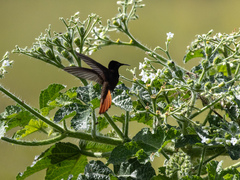
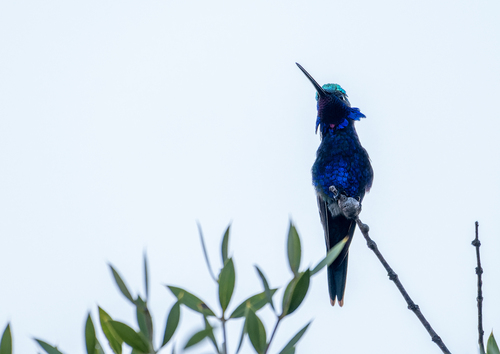
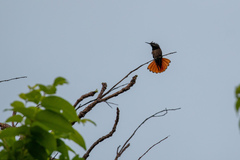
Ruby-topaz Hummingbird

Ruby-topaz Hummingbird

Chrysolampis mosquitus

Silhouette: Ferran Sayol · PhyloPic

LCLeast ConcernNTVUENCR
Daily sighting probability <5% · Rare
at Chapada dos Guimarães National Park

In 3 days <5% in a week ~10%

10 Verified sightings at Chapada dos Guimarães National Park From 2019 to 2026
525 In all 6 parks
September Best month
☀️ Diurnal When it's spotted

About the Ruby-topaz Hummingbird

The ruby-topaz hummingbird (Chrysolampis mosquitus), commonly referred to simply as the ruby topaz, is a species of hummingbird in the subfamily Polytminae, the mangoes. It is found in Aruba, Bolivia, Bonaire, Brazil, Colombia, Curaçao, French Guiana, Guyana, Panama, Suriname, Trinidad and Tobago, and Venezuela.

The ruby-topaz hummingbird was formally described by the Swedish naturalist Carl Linnaeus in 1758 in the tenth edition of his Systema Naturae under the binomial name Trochilus mosquitus. The type locality is Suriname. The ruby-topaz hummingbird is now the only species placed in the genus Chrysolampis, which was introduced by the German zoologist Friedrich Boie in 1831. The name Chrysolampis is from the Ancient Greek khrusolampis meaning "glow-worm". The specific name mosquitus is a Spanish diminutive and means "little fly". The species is monotypic: no subspecies are recognised.

The ruby-topaz hummingbird is 8 to 9.5 cm (3.1 to 3.7 in) long and weighs 2.5 to 5 g (0.09 to 0.18 oz). Its almost straight, black bill is relatively short compared to those of most other hummingbirds. The male has dark brown upperparts with an olive gloss. Its crown... Wikipedia →

Sounds

Call0:11

Brazil · 2025

© JAYRSON ARAUJO DE OLIVEIRA · XC974305 · CC BY-NC-SA 4.0

Song0:31

Brazil · 2019

© Fernando Igor de Godoy · XC705726 · CC BY-NC-SA 4.0

Flight call0:06

Brazil · 2022

© GABRIEL LEITE · XC752778 · CC BY-NC-SA 4.0

Global Distribution

Parks Where Found

# Park Country Daily sighting probability
1 Main Ridge Forest Reserve 🇹🇹 Trinidad and Tobago
~40%
2 Chapada Diamantina National Park 🇧🇷 Brazil
~10%
3 Tayrona National Natural Park 🇨🇴 Colombia
<5%
4 Chapada dos Guimarães National Park 🇧🇷 Brazil
<5%
5 Caroni Swamp 🇹🇹 Trinidad and Tobago
<5%
6 Sierra de la Macarena National Park 🇨🇴 Colombia
<5%

Cities Where Found

# City Country Daily sighting probability
1 Cali 🇨🇴 Colombia
<5%

Before you go

What are the chances of seeing a Ruby-topaz Hummingbird in Chapada dos Guimarães National Park?

Rare

Under 5% of wildlife watchers report a Ruby-topaz Hummingbird sighting in Chapada dos Guimarães National Park on a given day, based on 10 verified sightings from GBIF citizen-science data from 2019 to 2026. It is the 213th most-seen of the 273 birds we can rate there. Over three days the chance rises to under 5%, and over a week to about 10%, if each day is a fresh chance.

When is the best time to see a Ruby-topaz Hummingbird in Chapada dos Guimarães National Park?

Any time of year

In every month with enough records, under 5% of wildlife watchers report a Ruby-topaz Hummingbird in Chapada dos Guimarães National Park on a given day, so our monthly data shows no clear season. February to April have too few records to rate.

What time of day is best to see a Ruby-topaz Hummingbird?

Between 8 and 11 am

Across all the parks we cover, that three-hour window holds the most Ruby-topaz Hummingbird sightings with a recorded time, and about 8 in 10 of them come between 6 am and 6 pm: it is a daytime animal.

Which relatives of the Ruby-topaz Hummingbird live in Chapada dos Guimarães National Park?

Same family: Trochilidae

The closest relatives of the Ruby-topaz Hummingbird that you can see in Chapada dos Guimarães National Park (family Trochilidae, Hummingbirds) are Fork-tailed Woodnymph (about 30%), Glittering-bellied Emerald (about 30%) and Glittering-throated Emerald (about 20%), with each one's daily chance of a sighting.

Where does the Ruby-topaz Hummingbird sighting chance come from?

GBIF citizen-science records

It is estimated from how often the Ruby-topaz Hummingbird is recorded against all the birds logged in Chapada dos Guimarães National Park (10 verified sightings from 2019 to 2026), calibrated against known sighting rates. Figures are rounded to the nearest 10% because citizen-science data supports honest approximations, not decimals, and months with records from fewer than five people show "—". How it works.

← Back to Chapada dos Guimarães National Park