Black-tailed Trainbearer

Black-tailed Trainbearer

Lesbia victoriae

Silhouette: Ferran Sayol · PhyloPic

LCLeast ConcernNTVUENCR
Daily sighting probability ~10% · With luck
at Chingaza National Natural Park

In 3 days ~10% in a week ~30%

60 Verified sightings at Chingaza National Natural Park From 2019 to 2026
60 In 1 park
May Best month
☀️ Diurnal When it's spotted

About the Black-tailed Trainbearer

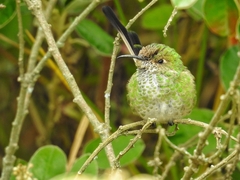
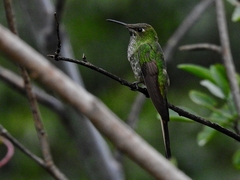
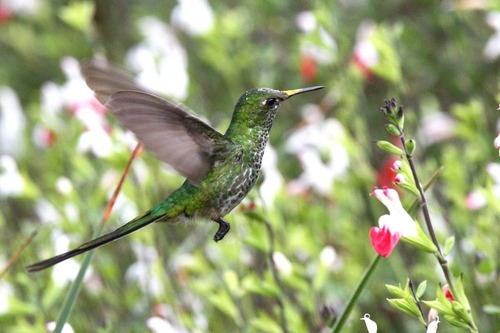
The black-tailed trainbearer (Lesbia victoriae) is a species of hummingbird in the family Trochilidae. It is found between 2500 and 3800m in Colombia, Ecuador, and Peru. Its natural habitats are subtropical or tropical moist montane forest, subtropical or tropical high-altitude shrubland, and heavily degraded former forest.

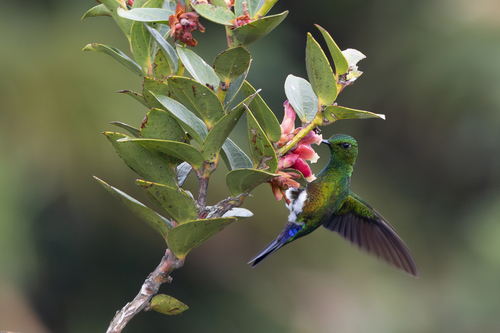
Males measure between 21 and 24 centimeters long, including the long tail. They are mostly green, with long black tail feathers and an iridescent green patch on the chest and throat. Females are between 13.5 and 14.5 centimeters in length. They differ from the male in having a shorter tail and white underparts with green spots. The black-tailed trainbearer has a longer, more decurved bill and (in males) a longer, more curved tail than the green-tailed trainbearer, and also tends to be duller green overall.

With a wing length of 59.9mm, Lesbia victoriae victoriae is the largest subspecies in the genus Lesbia. The black-tailed trainbearer is widely distributed in central and northern Andes from Colombia through Ecuador to Peru, at altitudes between 2500 and 3800 meters.

Three subspecies are currently recognised. Lesbia... Wikipedia →

Sounds

Song0:25

Ecuador · 2023

© Manuel Sánchez-Nivicela · XC1143769 · CC BY-NC-ND 4.0

Call0:14

Ecuador · 1993

© Niels Krabbe · XC238430 · CC BY-NC-SA 3.0

Song0:16

Colombia · 2002

© Doug Knapp · XC11311 · CC BY-NC-ND 2.5

Global Distribution

Parks Where Found

# Park Country Daily sighting probability
1 Chingaza National Natural Park 🇨🇴 Colombia
~10%

More parks will be added in future updates.

Cities Where Found

# City Country Daily sighting probability
1 Quito 🇪🇨 Ecuador
~80%
2 Bogota 🇨🇴 Colombia
<5%

Before you go

What are the chances of seeing a Black-tailed Trainbearer in Chingaza National Natural Park?

With luck

About 10% of wildlife watchers report a Black-tailed Trainbearer sighting in Chingaza National Natural Park on a given day, based on 60 verified sightings from GBIF citizen-science data from 2019 to 2026. It is the 85th most-seen of the 258 birds we can rate there. Over three days the chance rises to about 10%, and over a week to about 30%, if each day is a fresh chance.

When is the best time to see a Black-tailed Trainbearer in Chingaza National Natural Park?

May–July and October–December

In those months about 10% of wildlife watchers report a Black-tailed Trainbearer in Chingaza National Natural Park on a given day, against under 5% in January–April and August–September, the lowest months.

What time of day is best to see a Black-tailed Trainbearer?

Between 9 am and noon

Across all the parks we cover, that three-hour window holds the most Black-tailed Trainbearer sightings with a recorded time, and about 9 in 10 of them come between 6 am and 6 pm: it is a daytime animal.

Where else can you see a Black-tailed Trainbearer?

Only Chingaza National Natural Park, in our data

Chingaza National Natural Park is the only park on Wallace's Line with enough records to rate Black-tailed Trainbearer sightings: about 10% of wildlife watchers there report one on a given day.

Where does the Black-tailed Trainbearer sighting chance come from?

GBIF citizen-science records

It is estimated from how often the Black-tailed Trainbearer is recorded against all the birds logged in Chingaza National Natural Park (60 verified sightings from 2019 to 2026), calibrated against known sighting rates. Figures are rounded to the nearest 10% because citizen-science data supports honest approximations, not decimals, and months with records from fewer than five people show "—". How it works.

← Back to Chingaza National Natural Park