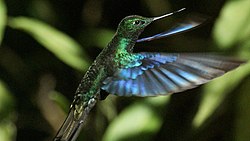

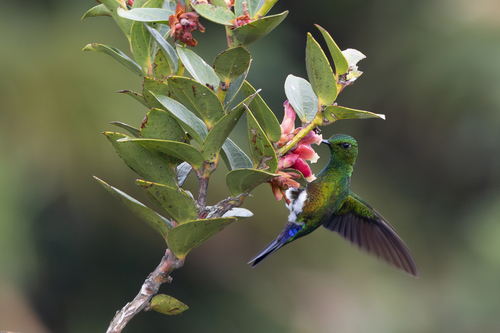
Great Sapphirewing

Great Sapphirewing

Pterophanes cyanopterus

Silhouette: Ferran Sayol · PhyloPic

LCLeast ConcernNTVUENCR
Daily sighting probability ~20% · Possible
at Chingaza National Natural Park

In 3 days ~50% in a week ~80%

240 Verified sightings at Chingaza National Natural Park From 2019 to 2026
2,770 In all 4 parks
January Best month
☀️ Diurnal When it's spotted

About the Great Sapphirewing

The great sapphirewing (Pterophanes cyanopterus) is a species of hummingbird in the "brilliants", tribe Heliantheini in subfamily Lesbiinae. It is found in Bolivia, Colombia, Ecuador, and Peru. The great sapphirewing is the only member of its genus. In the late 1900s it was suggested that Pterophanes be merged into genus Coeligena, but later work showed that those genera are not closely related.

The great sapphirewing has also been called Temminck's sapphirewing, páramo sapphirewing, and simply sapphirewing. The great sapphirewing is one of the largest hummingbirds; only the two of genus Topaza and the giant hummingbird (Patagona gigas) are larger. It is 15.5 to 19 cm (6.1 to 7.5 in) long including the 3.6 cm (1.4 in) bill. Males weigh between 9.6 and 11.2 g (0.34 and 0.40 oz) and females 8.4 to 11 g (0.30 to 0.39 oz). Both sexes have a small white spot behind the eye. Males of the nominate subspecies have dark shining blue-green upperparts. The wing is mostly shining blue and the tail greenish black. The underparts are also blue-green... Wikipedia →

Sounds

Call0:15

Ecuador · 1998

© John V. Moore · XC257833 · CC BY-NC-SA 4.0

Call0:10

Bolivia · 2012

© Dan Lane · XC124012 · CC BY-NC-SA 3.0

Call0:14

Ecuador · 2010

© Andrew Spencer · XC62335 · CC BY-NC-ND 2.5

Global Distribution

Parks Where Found

# Park Country Daily sighting probability
1 Los Nevados National Natural Park 🇨🇴 Colombia
~40%
2 Chingaza National Natural Park 🇨🇴 Colombia
~20%
3 Podocarpus National Park 🇪🇨 Ecuador
<5%
4 Manu National Park 🇵🇪 Peru
<5%

Cities Where Found

# City Country Daily sighting probability
1 Quito 🇪🇨 Ecuador
<5%

Before you go

What are the chances of seeing a Great Sapphirewing in Chingaza National Natural Park?

Possible

About 20% of wildlife watchers report a Great Sapphirewing sighting in Chingaza National Natural Park on a given day, based on 240 verified sightings from GBIF citizen-science data from 2019 to 2026. It is the 36th most-seen of the 258 birds we can rate there. Over three days the chance rises to about 50%, and over a week to about 80%, if each day is a fresh chance.

When is the best time to see a Great Sapphirewing in Chingaza National Natural Park?

January–February and May–June

In those months about 30% of wildlife watchers report a Great Sapphirewing in Chingaza National Natural Park on a given day, against about 10% in August–September and December, the lowest months.

What time of day is best to see a Great Sapphirewing?

Between 10 am and 1 pm

Across all the parks we cover, that three-hour window holds the most Great Sapphirewing sightings with a recorded time, and about 9 in 10 of them come between 6 am and 6 pm: it is a daytime animal.

Is Chingaza National Natural Park the best place to see a Great Sapphirewing?

2nd of 4

Of the 4 parks where we can rate Great Sapphirewing sightings, Chingaza National Natural Park ranks 2nd at about 20%. The best odds are in Los Nevados National Natural Park (Colombia, about 40%).

Which relatives of the Great Sapphirewing live in Chingaza National Natural Park?

Same family: Trochilidae

The closest relatives of the Great Sapphirewing that you can see in Chingaza National Natural Park (family Trochilidae, Hummingbirds) are Tyrian Metaltail (about 60%), Glowing Puffleg (about 50%) and Bronze-tailed Thornbill (about 30%), with each one's daily chance of a sighting.

Where does the Great Sapphirewing sighting chance come from?

GBIF citizen-science records

It is estimated from how often the Great Sapphirewing is recorded against all the birds logged in Chingaza National Natural Park (240 verified sightings from 2019 to 2026), calibrated against known sighting rates. Figures are rounded to the nearest 10% because citizen-science data supports honest approximations, not decimals, and months with records from fewer than five people show "—". How it works.

← Back to Chingaza National Natural Park