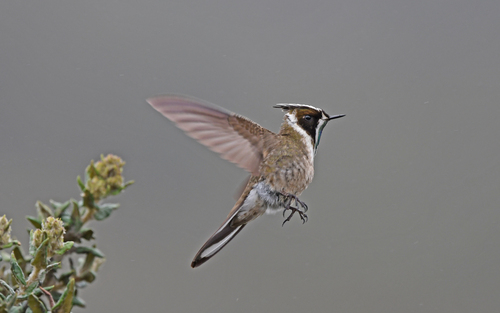

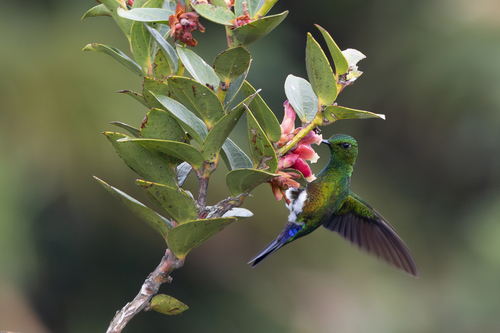
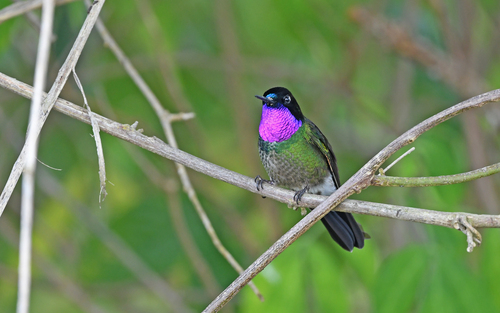
Green-bearded Helmetcrest

Green-bearded Helmetcrest

Oxypogon guerinii

Silhouette: Ferran Sayol · PhyloPic

LCLeast ConcernNTVUENCR Endemic
Daily sighting probability ~10% · With luck
at Chingaza National Natural Park

In 3 days ~30% in a week ~50%

126 Verified sightings at Chingaza National Natural Park From 2019 to 2026
126 In 1 park
January Best month
☀️ Diurnal When it's spotted

About the Green-bearded Helmetcrest

The green-bearded helmetcrest (Oxypogon guerinii) is a species of hummingbird in the "coquettes", tribe Lesbiini of subfamily Lesbiinae. It is endemic to Colombia. The green-bearded helmetcrest was formally described in 1840 by the French ornithologist Auguste Boissonneau from a specimen collected near Bogotá in central Colombia. This species is now placed in the genus Oxypogon that was introduced by the English ornithologist John Gould in 1848. The genus name combines the Ancient Greek oxy meaning ″sharp or pointed″ and pogon meaning beard. The species name was chosen to honour the French naturalist and collector Félix Guérin-Méneville. The species is monotypic: no subspecies are recognised.

The green-bearded helmetcrest was formerly considered a species named bearded helmetcrest with four subspecies. In 2014 the South America Classification Committee (SACC) of the American Ornithological Society agreed to a proposal to split this species into four separate species based on plumage differences and morphometrics. Other taxonomies soon followed suit. The other species are the buffy helmetcrest (O. stuebelii) of the Cordillera Central, the blue-bearded... Wikipedia →

Sounds

Call0:54

Colombia · 2017

© Diana Carolina Macana · XC383422 · CC BY-NC-SA 4.0

Call0:18

Colombia · 2021

© Peter Boesman · XC693731 · CC BY-NC-ND 4.0

Call0:14

Colombia · 2020

© Iván Lau · XC589019 · CC BY-NC-SA 4.0

Global Distribution

Parks Where Found

# Park Country Daily sighting probability
1 Chingaza National Natural Park 🇨🇴 Colombia
~10%

More parks will be added in future updates.

Before you go

What are the chances of seeing a Green-bearded Helmetcrest in Chingaza National Natural Park?

With luck

About 10% of wildlife watchers report a Green-bearded Helmetcrest sighting in Chingaza National Natural Park on a given day, based on 126 verified sightings from GBIF citizen-science data from 2019 to 2026. It is the 66th most-seen of the 258 birds we can rate there. Over three days the chance rises to about 30%, and over a week to about 50%, if each day is a fresh chance.

When is the best time to see a Green-bearded Helmetcrest in Chingaza National Natural Park?

January and February

In those months about 20% of wildlife watchers report a Green-bearded Helmetcrest in Chingaza National Natural Park on a given day, against under 5% in December, the lowest month.

What time of day is best to see a Green-bearded Helmetcrest?

Between 8 and 11 am

Across all the parks we cover, that three-hour window holds the most Green-bearded Helmetcrest sightings with a recorded time, and about 8 in 10 of them come between 6 am and 6 pm: it is a daytime animal.

Where else can you see a Green-bearded Helmetcrest?

Only Chingaza National Natural Park, in our data

Chingaza National Natural Park is the only park on Wallace's Line with enough records to rate Green-bearded Helmetcrest sightings: about 10% of wildlife watchers there report one on a given day.

Which relatives of the Green-bearded Helmetcrest live in Chingaza National Natural Park?

Same family: Trochilidae

The closest relatives of the Green-bearded Helmetcrest that you can see in Chingaza National Natural Park (family Trochilidae, Hummingbirds) are Tyrian Metaltail (about 60%), Glowing Puffleg (about 50%) and Bronze-tailed Thornbill (about 30%), with each one's daily chance of a sighting.

Where does the Green-bearded Helmetcrest sighting chance come from?

GBIF citizen-science records

It is estimated from how often the Green-bearded Helmetcrest is recorded against all the birds logged in Chingaza National Natural Park (126 verified sightings from 2019 to 2026), calibrated against known sighting rates. Figures are rounded to the nearest 10% because citizen-science data supports honest approximations, not decimals, and months with records from fewer than five people show "—". How it works.

← Back to Chingaza National Natural Park