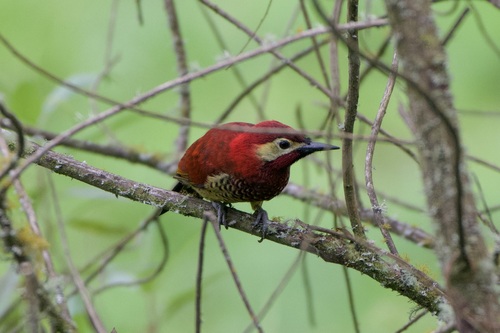
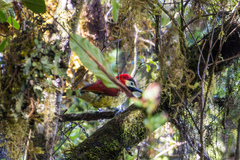
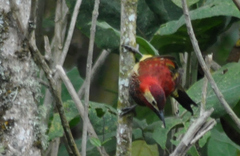
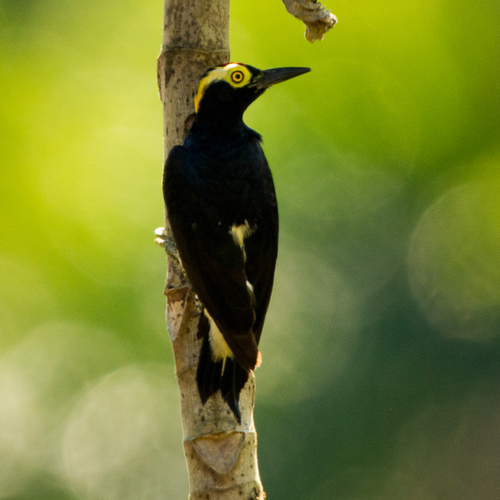
Crimson-mantled Woodpecker

Crimson-mantled Woodpecker

Colaptes rivolii

Silhouette: FJDegrange · PhyloPic

LCLeast ConcernNTVUENCR
Daily sighting probability ~10% · With luck
at Chingaza National Natural Park

In 3 days ~40% in a week ~70%

163 Verified sightings at Chingaza National Natural Park From 2019 to 2026
1,170 In all 4 parks
December Best month
☀️ Diurnal When it's spotted

About the Crimson-mantled Woodpecker

The crimson-mantled woodpecker (Colaptes rivolii) is a species of bird in subfamily Picinae of the woodpecker family Picidae. It is found in Bolivia, Colombia, Ecuador, Peru, and Venezuela. The crimson-mantled woodpecker was originally described as Picus Rivolii. It was later placed in genus Hypoxanthus that was still later merged into Piculus; since about 2007 it has been moved into Colaptes by taxonomic systems.

The American Ornithological Society, the International Ornithological Committee, and the Clements taxonomy recognize these six subspecies of crimson-mantled woodpecker: BirdLife International's Handbook of the Birds of the World (HBW) treats C. r. atriceps as a separate species, the black-crowned woodpecker.

The specific epithet rivolii honors French ornithologist François Victor Masséna, third Duke of Rivoli and third Prince of Essling. This article follows the six-subspecies model. The crimson-mantled woodpecker... Wikipedia →

Sounds

Call0:05

Ecuador · 2026

© Manuel Sánchez-Nivicela · XC1140483 · CC BY-NC-ND 4.0

Uncertain0:26

Colombia · 2020

© Julio Delgado · XC607003 · CC BY-NC-SA 4.0

Song0:04

Colombia · 2020

© Marcela Morales sánchez · XC585337 · CC BY-NC-SA 4.0

Global Distribution

Parks Where Found

# Park Country Daily sighting probability
1 Chingaza National Natural Park 🇨🇴 Colombia
~10%
2 Podocarpus National Park 🇪🇨 Ecuador
~10%
3 Los Nevados National Natural Park 🇨🇴 Colombia
~10%
4 Farallones de Cali National Natural Park 🇨🇴 Colombia
<5%

Cities Where Found

# City Country Daily sighting probability
1 Quito 🇪🇨 Ecuador
~10%
2 Bogota 🇨🇴 Colombia
<5%

Before you go

What are the chances of seeing a Crimson-mantled Woodpecker in Chingaza National Natural Park?

With luck

About 10% of wildlife watchers report a Crimson-mantled Woodpecker sighting in Chingaza National Natural Park on a given day, based on 163 verified sightings from GBIF citizen-science data from 2019 to 2026. It is the 49th most-seen of the 258 birds we can rate there. Over three days the chance rises to about 40%, and over a week to about 70%, if each day is a fresh chance.

When is the best time to see a Crimson-mantled Woodpecker in Chingaza National Natural Park?

December

In that month about 30% of wildlife watchers report a Crimson-mantled Woodpecker in Chingaza National Natural Park on a given day, against about 10% in February, April and June–November, the lowest months. That is one of Chingaza National Natural Park's driest months, with about 130 mm of rain against 350 mm in April.

What time of day is best to see a Crimson-mantled Woodpecker?

Between 8 and 11 am

Across all the parks we cover, that three-hour window holds the most Crimson-mantled Woodpecker sightings with a recorded time, and about 9 in 10 of them come between 6 am and 6 pm: it is a daytime animal.

Is Chingaza National Natural Park the best place to see a Crimson-mantled Woodpecker?

Yes

Of the 4 parks where we can rate Crimson-mantled Woodpecker sightings, Chingaza National Natural Park has the highest daily chance: about 10%. Next come Podocarpus National Park (Ecuador, about 10%) and Los Nevados National Natural Park (Colombia, about 10%).

Where does the Crimson-mantled Woodpecker sighting chance come from?

GBIF citizen-science records

It is estimated from how often the Crimson-mantled Woodpecker is recorded against all the birds logged in Chingaza National Natural Park (163 verified sightings from 2019 to 2026), calibrated against known sighting rates. Figures are rounded to the nearest 10% because citizen-science data supports honest approximations, not decimals, and months with records from fewer than five people show "—". How it works.

← Back to Chingaza National Natural Park