
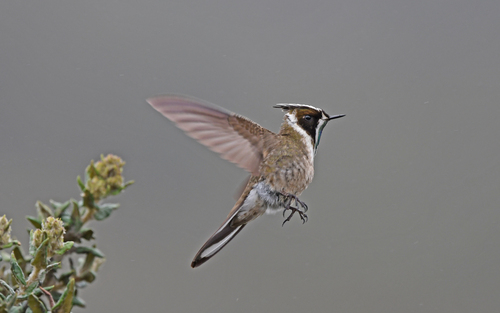
Shining Sunbeam

Shining Sunbeam

Aglaeactis cupripennis

Silhouette: Ferran Sayol · PhyloPic

LCLeast ConcernNTVUENCR
Daily sighting probability ~10% · With luck
at Chingaza National Natural Park

In 3 days ~10% in a week ~30%

52 Verified sightings at Chingaza National Natural Park From 2019 to 2026
3,077 In all 3 parks
February Best month
☀️ Diurnal When it's spotted

About the Shining Sunbeam

The shining sunbeam (Aglaeactis cupripennis) is a species of hummingbird in the "brilliants", tribe Heliantheini in subfamily Lesbiinae. It is found in Colombia, Ecuador, and Peru. In the past the species had been subdivided into as many as six subspecies. In addition, what is now the purple-backed sunbeam (A. aliciae) has also been treated as a subspecies of shining sunbeam.

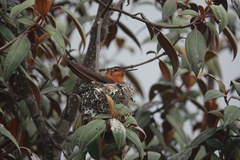
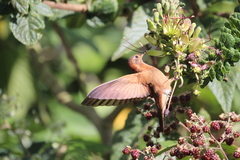
The shining sunbeam is 12 to 13 cm (4.7 to 5.1 in) long. Males weigh 7.6 to 8.1 g (0.27 to 0.29 oz) and females 6.9 to 7.5 g (0.24 to 0.26 oz). Both sexes have a short, straight, black bill. Unique among sunbeams, neither sex has any white plumage. Males of the nominate subspecies have a dark brown crown and upper back; their lower back and rump are lilac-gold becoming silvery green on the uppertail coverts. Their tail feathers are dark brown to rufous, usually with bronzy edges. Their throat is rufous dotted with dusky gray, the breast a patchy buff, and the belly reddish brown. From north to south, the male's underparts become brighter, the crown... Wikipedia →

Sounds

Song0:19

Peru · 2026

© Étienne Leroy · XC1184401 · CC BY-NC-SA 4.0

Call0:47

Ecuador · 2025

© Manuel Sánchez-Nivicela · XC1002425 · CC BY-NC-ND 4.0

Flight call0:06

Ecuador · 2024

© Sue Riffe · XC929113 · CC BY-NC-SA 4.0

Global Distribution

Parks Where Found

# Park Country Daily sighting probability
1 Los Nevados National Natural Park 🇨🇴 Colombia
~40%
2 Chingaza National Natural Park 🇨🇴 Colombia
~10%
3 Podocarpus National Park 🇪🇨 Ecuador
<5%

Cities Where Found

# City Country Daily sighting probability
1 Quito 🇪🇨 Ecuador
~10%
2 Bogota 🇨🇴 Colombia
<5%

Before you go

What are the chances of seeing a Shining Sunbeam in Chingaza National Natural Park?

With luck

About 10% of wildlife watchers report a Shining Sunbeam sighting in Chingaza National Natural Park on a given day, based on 52 verified sightings from GBIF citizen-science data from 2019 to 2026. It is the 89th most-seen of the 258 birds we can rate there. Over three days the chance rises to about 10%, and over a week to about 30%, if each day is a fresh chance.

When is the best time to see a Shining Sunbeam in Chingaza National Natural Park?

February–March, July and November–December

In those months about 10% of wildlife watchers report a Shining Sunbeam in Chingaza National Natural Park on a given day, against under 5% in January, April–June and August–October, the lowest months.

What time of day is best to see a Shining Sunbeam?

Between 8 and 11 am

Across all the parks we cover, that three-hour window holds the most Shining Sunbeam sightings with a recorded time, and about 9 in 10 of them come between 6 am and 6 pm: it is a daytime animal.

Is Chingaza National Natural Park the best place to see a Shining Sunbeam?

2nd of 3

Of the 3 parks where we can rate Shining Sunbeam sightings, Chingaza National Natural Park ranks 2nd at about 10%. The best odds are in Los Nevados National Natural Park (Colombia, about 40%).

Which relatives of the Shining Sunbeam live in Chingaza National Natural Park?

Same family: Trochilidae

The closest relatives of the Shining Sunbeam that you can see in Chingaza National Natural Park (family Trochilidae, Hummingbirds) are Tyrian Metaltail (about 60%), Glowing Puffleg (about 50%) and Bronze-tailed Thornbill (about 30%), with each one's daily chance of a sighting.

Where does the Shining Sunbeam sighting chance come from?

GBIF citizen-science records

It is estimated from how often the Shining Sunbeam is recorded against all the birds logged in Chingaza National Natural Park (52 verified sightings from 2019 to 2026), calibrated against known sighting rates. Figures are rounded to the nearest 10% because citizen-science data supports honest approximations, not decimals, and months with records from fewer than five people show "—". How it works.

← Back to Chingaza National Natural Park