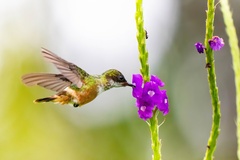
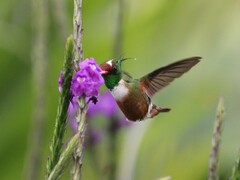
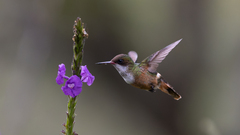
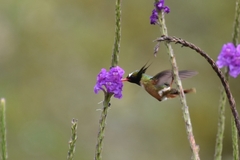

White-crested Coquette

White-crested Coquette

Lophornis adorabilis

Silhouette: Ferran Sayol · PhyloPic

LCLeast ConcernNTVUENCR
Daily sighting probability ~10% · With luck
at Chirripó National Park

In 3 days ~40% in a week ~70%

227 Verified sightings at Chirripó National Park From 2019 to 2026
490 In all 6 parks
September Best month
☀️ Diurnal When it's spotted

About the White-crested Coquette

The white-crested coquette (Lophornis adorabilis) is a species of hummingbird in the "coquettes", tribe Lesbiini of subfamily Lesbiinae. It is found in Costa Rica and Panama. At one time the white-crested coquette and the black-crested coquette (Lophornis helenae) were placed in genus Paphosia. The white-crested coquette is monotypic.

The white-crested coquette is about 7 cm (2.8 in) long and weighs about 2.7 g (0.095 oz). The adult male has a coppery bronze forecrown and lores, and the crown has an erect white crest. The nape and back are bronzy green; a white band separates the back from the purplish bronze rump and uppertail coverts. The tail is chestnut-rufous and the feathers have bronze edges. The throat and cheeks are glittering green and the latter have long wispy tufts. A white band separates the throat from the cinnamon-rufous breast, belly, and undertail coverts. Its bill is red with a black tip.

The adult female is generally duller than the male and lacks the crest and cheek tufts. Its face and forecrown are dusky bronze and the throat and chest white with bronzy green speckles. The tail is chestnut-rufous with a black band... Wikipedia →

Sounds

Call0:20

Costa Rica · 2013

© Andrew Spencer · XC168730 · CC BY-NC-SA 3.0

Global Distribution

Parks Where Found

# Park Country Daily sighting probability
1 Chirripó National Park 🇨🇷 Costa Rica
~10%
2 Corcovado National Park 🇨🇷 Costa Rica
<5%
3 Piedras Blancas National Park 🇨🇷 Costa Rica
<5%
4 Marino Ballena National Park 🇨🇷 Costa Rica
<5%
5 La Amistad International Park (Panama) 🇵🇦 Panama
<5%
6 Carara National Park 🇨🇷 Costa Rica
<5%

Before you go

What are the chances of seeing a White-crested Coquette in Chirripó National Park?

With luck

About 10% of wildlife watchers report a White-crested Coquette sighting in Chirripó National Park on a given day, based on 227 verified sightings from GBIF citizen-science data from 2019 to 2026. It is the 75th most-seen of the 332 birds we can rate there. Over three days the chance rises to about 40%, and over a week to about 70%, if each day is a fresh chance.

When is the best time to see a White-crested Coquette in Chirripó National Park?

February and September

In those months about 40% of wildlife watchers report a White-crested Coquette in Chirripó National Park on a given day, against under 5% in April to July, the lowest months.

What time of day is best to see a White-crested Coquette?

Between 8 and 11 am

Across all the parks we cover, that three-hour window holds the most White-crested Coquette sightings with a recorded time, and about 9 in 10 of them come between 6 am and 6 pm: it is a daytime animal.

Is Chirripó National Park the best place to see a White-crested Coquette?

Yes

Of the 6 parks where we can rate White-crested Coquette sightings, Chirripó National Park has the highest daily chance: about 10%. Next come Corcovado National Park (Costa Rica, under 5%) and Piedras Blancas National Park (Costa Rica, under 5%).

Which relatives of the White-crested Coquette live in Chirripó National Park?

Same family: Trochilidae

The closest relatives of the White-crested Coquette that you can see in Chirripó National Park (family Trochilidae, Hummingbirds) are Rufous-tailed Hummingbird (about 60%), Snowy-bellied Hummingbird (about 40%) and Violet Sabrewing (about 30%), with each one's daily chance of a sighting.

Where does the White-crested Coquette sighting chance come from?

GBIF citizen-science records

It is estimated from how often the White-crested Coquette is recorded against all the birds logged in Chirripó National Park (227 verified sightings from 2019 to 2026), calibrated against known sighting rates. Figures are rounded to the nearest 10% because citizen-science data supports honest approximations, not decimals, and months with records from fewer than five people show "—". How it works.

← Back to Chirripó National Park