Clapper Rail

Clapper Rail

Rallus crepitans

Silhouette: Ferran Sayol · PhyloPic

LCLeast ConcernNTVUENCR Endemic
Daily sighting probability ~30% · Possible
at Ciénaga de Zapata

In 3 days ~60% in a week ~90%

345 Verified sightings at Ciénaga de Zapata From 2019 to 2026
1,546 In all 7 parks
November Best month
☀️ Diurnal When it's spotted

About the Clapper Rail

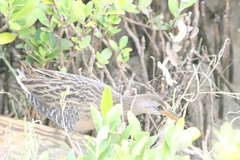
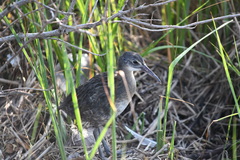
The clapper rail (Rallus crepitans) is a member of the rail family, Rallidae. The taxonomy for this species is confusing and still being determined. It is a large brown rail that is resident in wetlands along the Atlantic coasts of the eastern United States, eastern Mexico and some Caribbean islands. This species was formerly considered to be conspecific with the mangrove rail.

The clapper rail was formally described in 1789 by the German naturalist Johann Friedrich Gmelin in his revised and expanded edition of Carl Linnaeus's Systema Naturae. He placed it with all the other rails in the genus Rallus and coined the binomial name Rallus crepitans. Gmelin based his description on those by Thomas Pennant and John Latham. The type locality is Long Island, New York. The genus Rallus had been erected in 1758 by the Swedish naturalist Carl Linnaeus in the tenth edition of his Systema Naturae. The specific epithet crepitans is Latin meaning "breaking wind" or "resounding".

The clapper rail was formerly treated as a subspecies of the mangrove rail (Rallus longirostris). The decision to treat the clapper rail as a separate species was based on the results of a molecular phylogenetic... Wikipedia →

Sounds

Call0:23

United States · 2023

© Sue Riffe · XC1087852 · CC BY-NC-SA 4.0

Alarm call0:07

United States · 2020

© William Whitehead · XC597422 · CC BY-NC-ND 4.0

Chamado0:46

United States · 2019

© Caio Brito · XC556547 · CC BY-NC-SA 4.0

Global Distribution

Parks Where Found

# Park Country Daily sighting probability
1 Ciénaga de Zapata 🇨🇺 Cuba
~30%
2 Ría Lagartos Biosphere Reserve 🇲🇽 Mexico
~20%
3 Merritt Island National Wildlife Refuge 🇺🇸 United States
~10%
4 Celestún Biosphere Reserve 🇲🇽 Mexico
<5%
5 Arrecifes de Cozumel National Park 🇲🇽 Mexico
<5%
6 Sian Ka'an Biosphere Reserve 🇲🇽 Mexico
<5%
7 Everglades National Park 🇺🇸 United States
<5%

Cities Where Found

# City Country Daily sighting probability
1 New York City 🇺🇸 United States
<5%
2 Boston 🇺🇸 United States
<5%
3 Miami 🇺🇸 United States
<5%

Zoos & Centres Where Found

# Zoo / Centre Country
1 National Zoological Park 🇺🇸 United States In captivity
2 Cameron Park Zoo 🇺🇸 United States In captivity

Before you go

What are the chances of seeing a Clapper Rail in Ciénaga de Zapata?

Possible

About 30% of wildlife watchers report a Clapper Rail sighting in Ciénaga de Zapata on a given day, based on 345 verified sightings from GBIF citizen-science data from 2019 to 2026. It is the 69th most-seen of the 177 birds we can rate there. Over three days the chance rises to about 60%, and over a week to about 90%, if each day is a fresh chance.

When is the best time to see a Clapper Rail in Ciénaga de Zapata?

January–March and November

In those months about 30% of wildlife watchers report a Clapper Rail in Ciénaga de Zapata on a given day, against about 10% in June–July, October and December, the lowest months. Those are among Ciénaga de Zapata's driest months, with about 25 mm of rain a month against 150 mm in June. September has too few records to rate.

What time of day is best to see a Clapper Rail?

Between 6 and 9 am

Across all the parks we cover, that three-hour window holds the most Clapper Rail sightings with a recorded time, and about 8 in 10 of them come between 6 am and 6 pm: it is a daytime animal.

Where does the Clapper Rail sighting chance come from?

GBIF citizen-science records

It is estimated from how often the Clapper Rail is recorded against all the birds logged in Ciénaga de Zapata (345 verified sightings from 2019 to 2026), calibrated against known sighting rates. Figures are rounded to the nearest 10% because citizen-science data supports honest approximations, not decimals, and months with records from fewer than five people show "—". How it works.

← Back to Ciénaga de Zapata