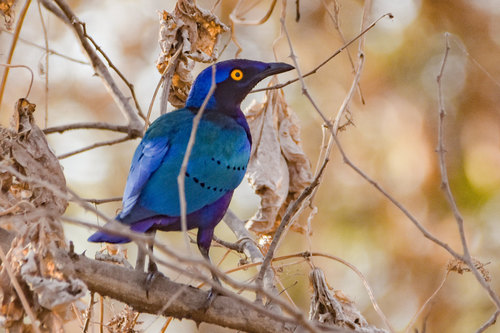
Lesser Blue-eared Glossy-starling

Lesser Blue-eared Glossy-starling

Lamprotornis chloropterus

Silhouette: Rafael Maia · PhyloPic

LCLeast ConcernNTVUENCR
Daily sighting probability <5% · Rare
at Accra

In 3 days ~10% in a week ~30%

18 Verified sightings at Accra
424 In all 10 parks From 2019 to 2026
December Best month
☀️ Diurnal When it's spotted

About the Lesser Blue-eared Glossy-starling

The lesser blue-eared starling or lesser blue-eared glossy-starling (Lamprotornis chloropterus) is a species of starling in the family Sturnidae. It is found in Benin, Burkina Faso, Burundi, Cameroon, the Central African Republic, Chad, the Democratic Republic of the Congo, Eritrea, Ethiopia, Gambia, Ghana, Guinea, Guinea-Bissau, Ivory Coast, Kenya, Liberia, Malawi, Malaysia, Mali, Mozambique, Namibia, Nigeria, Senegal, Sierra Leone, South Sudan, Sudan, Tanzania, Togo, Uganda, Zambia, and Zimbabwe.

The lesser blue-eared starling was formally described in 1838 by the English zoologist William Swainson under the current binomial name Lamprotornis chloropterus based on a specimen collected in West Africa. The specific epithet combines the Ancient Greek χλωρος/khlōros meaning "yellow" with -πτερος/-pteros meaning "-winged".

Two subspecies are recognised: The subspecies L. c. elisabeth has sometimes been considered as a separate species, the Miombo blue-eared starling. During the non-breeding... Wikipedia →

Sounds

Call0:08

Ethiopia · 2014

© Andrew Spencer · XC210343 · CC BY-NC-SA 4.0

Song0:21

Kenya · 2018

© James Bradley · XC444678 · CC BY-NC-SA 4.0

Flight call0:32

Burkina Faso · 2017

© Étienne Leroy · XC390808 · CC BY-NC-SA 4.0

Global Distribution

Parks Where Found

# Park Country Daily sighting probability
1 Mikumi National Park 🇹🇿 Tanzania
~40%
2 Kidepo Valley National Park 🇺🇬 Uganda
~30%
3 Awash National Park 🇪🇹 Ethiopia
~10%
4 Kafue National Park 🇿🇲 Zambia
~10%
5 Niokolo-Koba National Park 🇸🇳 Senegal
~10%
6 Liwonde National Park 🇲🇼 Malawi
~10%
7 Murchison Falls National Park 🇺🇬 Uganda
<5%
8 Hwange National Park 🇿🇼 Zimbabwe
<5%
9 South Luangwa National Park 🇿🇲 Zambia
<5%
10 Lake Mburo National Park 🇺🇬 Uganda
<5%

Cities Where Found

# City Country Daily sighting probability
1 Harare 🇿🇼 Zimbabwe
~20%
2 Maiduguri 🇳🇬 Nigeria
~10%
3 Accra 🇬🇭 Ghana
<5%
4 Serrekunda 🇬🇲 Gambia
<5%
5 Kampala 🇺🇬 Uganda
<5%

Zoos & Centres Where Found

# Zoo / Centre Country
1 Zoo Lagos 🇵🇹 Portugal In captivity

Before you go

What are the chances of seeing a Lesser Blue-eared Glossy-starling in Accra?

Rare

Under 5% of wildlife watchers report a Lesser Blue-eared Glossy-starling sighting in Accra on a given day, based on 18 verified sightings from GBIF citizen-science data. It is the 108th most-seen of the 162 birds we can rate there. Over three days the chance rises to about 10%, and over a week to about 30%, if each day is a fresh chance.

When is the best time to see a Lesser Blue-eared Glossy-starling in Accra?

March and December

In those months about 10% of wildlife watchers report a Lesser Blue-eared Glossy-starling in Accra on a given day, against under 5% in January–February and April–November, the lowest months.

What time of day is best to see a Lesser Blue-eared Glossy-starling?

Between 7 and 10 am

Across all the parks we cover, that three-hour window holds the most Lesser Blue-eared Glossy-starling sightings with a recorded time, and about 8 in 10 of them come between 6 am and 6 pm: it is a daytime animal.

Is Accra the best place to see a Lesser Blue-eared Glossy-starling?

3rd of 5

Of the 5 cities where we can rate Lesser Blue-eared Glossy-starling sightings, Accra ranks 3rd at under 5%. The best odds are in Harare (Zimbabwe, about 20%) and Maiduguri (Nigeria, about 10%).

Where does the Lesser Blue-eared Glossy-starling sighting chance come from?

GBIF citizen-science records

It is estimated from how often the Lesser Blue-eared Glossy-starling is recorded against all the birds logged in Accra (18 verified sightings), calibrated against known sighting rates. Figures are rounded to the nearest 10% because citizen-science data supports honest approximations, not decimals, and months with records from fewer than five people show "—". How it works.

← Back to Accra