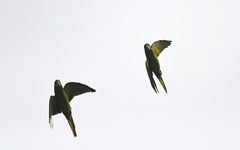
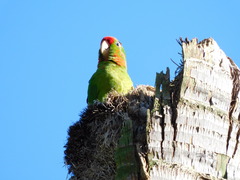
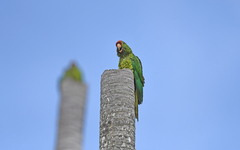
Scarlet-fronted Parakeet

Scarlet-fronted Parakeet

Aratinga wagleri

Silhouette: Myriam_Ramirez · PhyloPic

LCNTNear ThreatenedVUENCR
Daily sighting probability <5% · Rare
at Arequipa

In 3 days ~10%

29 Verified sightings at Arequipa
762 In all 4 parks From 2019 to 2026
April Best month
☀️ Diurnal When it's spotted

About the Scarlet-fronted Parakeet

The scarlet-fronted parakeet (Psittacara wagleri), known in aviculture as the scarlet-fronted conure, red-fronted conure, or Wagler's conure, is a Near Threatened species of bird in subfamily Arinae of the family Psittacidae, the African and New World parrots. It is found in Colombia and Venezuela.

The scarlet-fronted parakeet was for a time placed in the genus Aratinga but from about 2013 has been in its present genus Psittacara. Its taxonomy is otherwise unsettled. The IOC, HBW, and Clements treat them as the two subspecies of the cordilleran parakeet (P. frontatus).

This article follows the two-subspecies model. The scarlet-fronted parakeet is 34 to 40 cm (13 to 16 in) long and weighs 162 to 217 g (5.7 to 7.7 oz). The sexes are alike. Adults are generally green... Wikipedia →

Sounds

Call0:40

Colombia · 2026

© Manuel Sánchez-Nivicela · XC1163909 · CC BY-NC-ND 4.0

Flight call0:18

Colombia · 2019

© David Monroy Rengifo · XC459600 · CC BY-NC-SA 4.0

Song0:08

Colombia · 2017

© Andres Angulo · XC414785 · CC BY-NC-SA 4.0

Global Distribution

Parks Where Found

# Park Country Daily sighting probability
1 Henri Pittier National Park 🇻🇪 Venezuela
~20%
2 Farallones de Cali National Natural Park 🇨🇴 Colombia
~10%
3 Los Nevados National Natural Park 🇨🇴 Colombia
<5%
4 Sierra de la Macarena National Park 🇨🇴 Colombia
<5%

Cities Where Found

# City Country Daily sighting probability
1 Caracas 🇻🇪 Venezuela
~20%
2 Cali 🇨🇴 Colombia
<5%
3 Lima 🇵🇪 Peru
<5%
4 Valencia 🇻🇪 Venezuela
<5%
5 Arequipa 🇵🇪 Peru
<5%
6 Medellín 🇨🇴 Colombia
<5%

Zoos & Centres Where Found

# Zoo / Centre Country
1 Ukumarí Biopark 🇨🇴 Colombia In captivity
2 Aviario Nacional de Colombia 🇨🇴 Colombia In captivity
3 Parque de la Conservación 🇨🇴 Colombia In captivity
4 Parque Zoológico El Pinar 🇻🇪 Venezuela In captivity

Before you go

What are the chances of seeing a Scarlet-fronted Parakeet in Arequipa?

Rare

Under 5% of wildlife watchers report a Scarlet-fronted Parakeet sighting in Arequipa on a given day, based on 29 verified sightings from GBIF citizen-science data. It is the 43rd most-seen of the 61 birds we can rate there. Over three days the chance rises to about 10%, if each day is a fresh chance.

When is the best time to see a Scarlet-fronted Parakeet in Arequipa?

April

In that month about 10% of wildlife watchers report a Scarlet-fronted Parakeet in Arequipa on a given day, against under 5% in May to March, the lowest months. That is one of Arequipa's driest months, with about 5 mm of rain against 45 mm in February.

What time of day is best to see a Scarlet-fronted Parakeet?

Between 7 and 10 am

Across all the parks we cover, that three-hour window holds the most Scarlet-fronted Parakeet sightings with a recorded time, and about 9 in 10 of them come between 6 am and 6 pm: it is a daytime animal.

Is Arequipa the best place to see a Scarlet-fronted Parakeet?

5th of 6

Of the 6 cities where we can rate Scarlet-fronted Parakeet sightings, Arequipa ranks 5th at under 5%. The best odds are in Caracas (Venezuela, about 20%), Cali (Colombia, under 5%) and Lima (Peru, under 5%).

Which relatives of the Scarlet-fronted Parakeet live in Arequipa?

Same genus: Aratinga

The closest relatives of the Scarlet-fronted Parakeet that you can see in Arequipa (genus Aratinga, Aratinga Parakeets) are Red-masked Parakeet (about 20%), Mitred Parakeet (about 10%) and Blue-crowned Parakeet (about 10%), with each one's daily chance of a sighting.

Where does the Scarlet-fronted Parakeet sighting chance come from?

GBIF citizen-science records

It is estimated from how often the Scarlet-fronted Parakeet is recorded against all the birds logged in Arequipa (29 verified sightings), calibrated against known sighting rates. Figures are rounded to the nearest 10% because citizen-science data supports honest approximations, not decimals, and months with records from fewer than five people show "—". How it works.


← Back to Arequipa