


Completed

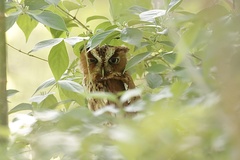
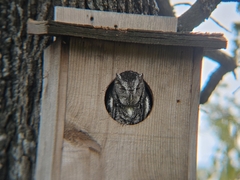
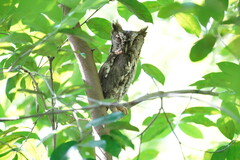
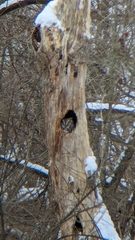

Eastern Screech-Owl
Megascops asio
Silhouette: Jason Dilworth · PhyloPic
- KingdomAnimalia (Animals)
- PhylumChordata (Chordates)
- ClassAves (Birds)
- OrderStrigiformes (Owls)
- FamilyStrigidae (Typical Owls)
- GenusMegascops (Screech-Owls)
- SpeciesMegascops asio (Eastern Screech-Owl)
In 3 days <5%
40 Verified sightings at Baltimore
1,593 In all 8 parks From 2019 to 2026
December Best month
☀️🌙 Day & Night When it's spotted
About the Eastern Screech-Owl
The eastern screech owl (Megascops asio) or eastern screech-owl is a stocky, short-tailed owl that is relatively common in Eastern North America, from Mexico to Canada. Mid-sized for a screech owl, the species resides in most types of woodland habitats across its range and is relatively adaptable to urban and developed areas compared to other owls. Although it often lives in close proximity to humans, the eastern screech owl frequently avoids detection due to its strictly nocturnal habits.
The eastern screech owl was formally described in 1758 by Swedish naturalist Carl Linnaeus in the 10th edition of his Systema Naturae. He placed it with all the other owls in the genus Strix and coined the binomial name Strix asio. Linnaeus based his account on the "little owl" that had been described and illustrated by English naturalist Mark Catesby in his book The Natural History of Carolina, Florida and the Bahama Islands. The specific epithet is the Latin word for a type of eared owl. The eastern screech owl is now one of 22 screech owls placed in the genus Megascops that was introduced in 1848 by the German naturalist Johann Kaup.
Five subspecies are typically recognised for... Wikipedia →
Recent sightings of Eastern Screech-Owl in Baltimore
LIVEiNaturalistGlobal Distribution
Parks Where Found
| # | Park | Country | Daily sighting probability |
|---|---|---|---|
| 1 | Point Pelee National Park | 🇨🇦 Canada | |
| 2 | Everglades National Park | 🇺🇸 United States | |
| 3 | Cumbres de Monterrey National Park | 🇲🇽 Mexico | |
| 4 | Congaree National Park | 🇺🇸 United States | |
| 5 | Great Smoky Mountains National Park | 🇺🇸 United States | |
| 6 | Shenandoah National Park | 🇺🇸 United States | |
| 7 | Merritt Island National Wildlife Refuge | 🇺🇸 United States | |
| 8 | Big Cypress National Preserve | 🇺🇸 United States |
Cities Where Found
| # | City | Country | Daily sighting probability |
|---|---|---|---|
| 1 | Montreal | 🇨🇦 Canada | |
| 2 | Houston | 🇺🇸 United States | |
| 3 | Philadelphia | 🇺🇸 United States | |
| 4 | Miami | 🇺🇸 United States | |
| 5 | Dallas | 🇺🇸 United States | |
| 6 | Toronto | 🇨🇦 Canada | |
| 7 | Detroit | 🇺🇸 United States | |
| 8 | Austin | 🇺🇸 United States | |
| 9 | Boston | 🇺🇸 United States | |
| 10 | New York City | 🇺🇸 United States |
Zoos & Centres Where Found
Closest Relatives at Baltimore











Before you go
What are the chances of seeing an Eastern Screech-Owl in Baltimore?
Rare
Under 5% of wildlife watchers report an Eastern Screech-Owl sighting in Baltimore on a given day, based on 40 verified sightings from GBIF citizen-science data. It is the 232nd most-seen of the 246 birds we can rate there. Over three days the chance rises to under 5%, if each day is a fresh chance.
When is the best time to see an Eastern Screech-Owl in Baltimore?
Any time of year
In every month with enough records, under 5% of wildlife watchers report an Eastern Screech-Owl in Baltimore on a given day, so our monthly data shows no clear season.
What time of day is best to see an Eastern Screech-Owl?
Between 3 and 6 pm
Across all the parks we cover, that three-hour window holds the most Eastern Screech-Owl sightings with a recorded time, and about 6 in 10 of them come between 6 am and 6 pm: it is seen both by day and at night.
Is Baltimore the best place to see an Eastern Screech-Owl?
Among the best
Of the 18 cities where we can rate Eastern Screech-Owl sightings, Baltimore ranks 16th at under 5%, level with the leaders once rounded. The best odds are in Montreal (Canada, under 5%), Houston (United States, under 5%) and Philadelphia (United States, under 5%).
Where does the Eastern Screech-Owl sighting chance come from?
GBIF citizen-science records
It is estimated from how often the Eastern Screech-Owl is recorded against all the birds logged in Baltimore (40 verified sightings), calibrated against known sighting rates. Figures are rounded to the nearest 10% because citizen-science data supports honest approximations, not decimals, and months with records from fewer than five people show "—". How it works.
