Vine Hawkmoth

Vine Hawkmoth

Hippotion celerio

Daily sighting probability <5% · Rare
at Bangkok

In 3 days ~10% in a week ~20%

5 Verified sightings at Bangkok
155 In all 10 parks From 2019 to 2026
July Best month
🌅 Crepuscular When it's spotted

About the Vine Hawkmoth

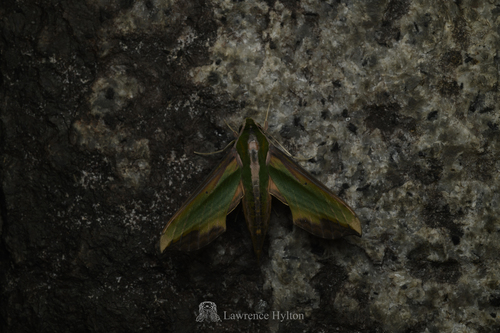
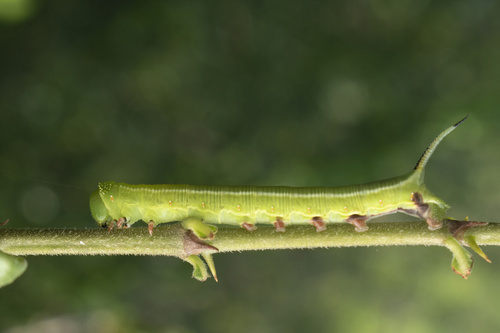
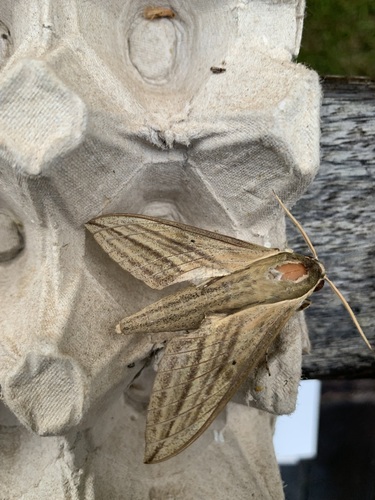
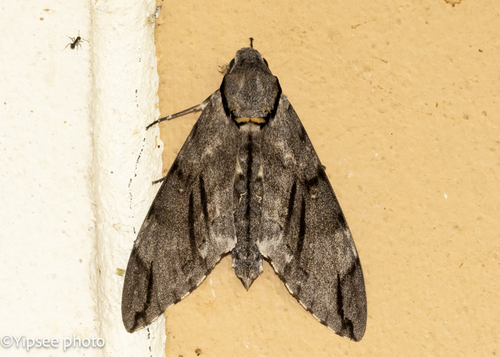
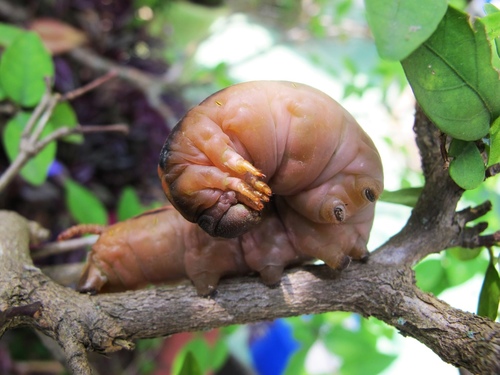
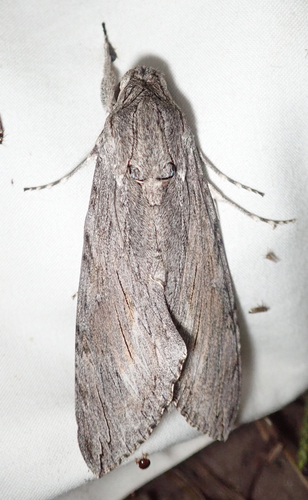
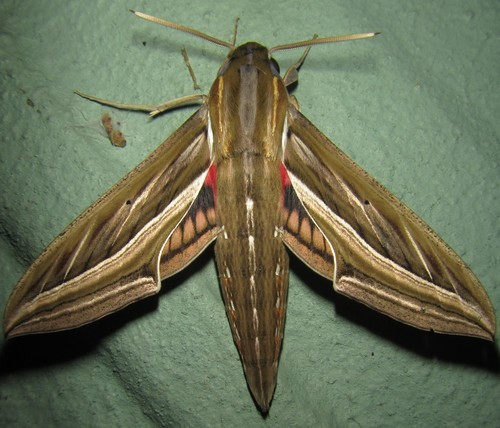
Hippotion celerio, the vine hawk-moth or silver-striped hawk-moth, is a moth of the family Sphingidae. It was described by Carl Linnaeus in his 1758 10th edition of Systema Naturae. It is found in Africa and central and southern Asia of India, Sri Lanka and, as a migrant in southern Europe and Australia.

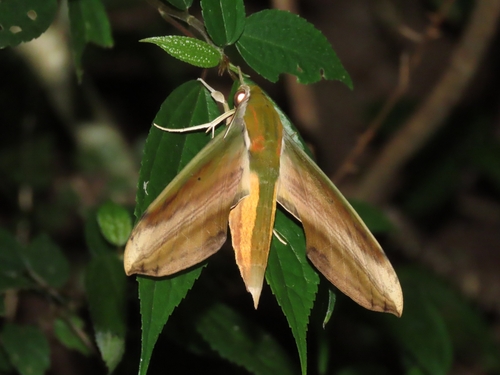
The forewing is typically 28–45 millimetres (1.1–1.8 in) long. The body and forewing of the adult moth are green and ochre. They have silvery white dots and streaks, with a silvery band running obliquely on the forewing. The hindwing is red near its lower angle (tornus) to pinkish over other parts of the wing. It is crossed by a black bar and black veins. There is greater variation. In f. pallida Tutt the ground coloration is a pale terracotta ground; in f. rosea Closs, the wings have a red suffusion; in f. brunnea Tutt, the suffusion is deep brown. In f. augustei Trimoul, the black markings cover the entire wings; in f. luecki Closs, all silver markings are absent and in f. sieberti Closs, the forewing oblique stripe is yellowish, not silver.

Hippotion osiris larger size and lacks the black venation... Wikipedia →
Global Distribution

Parks Where Found

# Park Country Daily sighting probability
1 Aberdare National Park 🇰🇪 Kenya
~30%
2 Ningaloo Marine Park 🇦🇺 Australia
~30%
3 Hwange National Park 🇿🇼 Zimbabwe
~20%
4 Uluru-Kata Tjuta National Park 🇦🇺 Australia
~10%
5 Kruger National Park 🇿🇦 South Africa
~10%
6 Blue Mountains National Park 🇦🇺 Australia
~10%
7 Addo Elephant National Park 🇿🇦 South Africa
~10%
8 Springbrook National Park 🇦🇺 Australia
~10%
9 Garden Route National Park 🇿🇦 South Africa
~10%
10 Table Mountain National Park 🇿🇦 South Africa
<5%

Cities Where Found

# City Country Daily sighting probability
1 Davao City 🇵🇭 Philippines
~20%
2 Manila 🇵🇭 Philippines
~20%
3 Naha 🇯🇵 Japan
~10%
4 Taichung 🇹🇼 Taiwan
~10%
5 Dehradun 🇮🇳 India
~10%
6 Perth 🇦🇺 Australia
~10%
7 Tasikmalaya 🇮🇩 Indonesia
~10%
8 Nairobi 🇰🇪 Kenya
~10%
9 Tainan 🇹🇼 Taiwan
~10%
10 Athens 🇬🇷 Greece
~10%

Before you go

What are the chances of seeing a Vine Hawkmoth in Bangkok?

Rare

Under 5% of wildlife watchers report a Vine Hawkmoth sighting in Bangkok on a given day, based on 5 verified sightings from GBIF citizen-science data. It is the 228th most-seen of the 245 insects we can rate there. Over three days the chance rises to about 10%, and over a week to about 20%, if each day is a fresh chance.

When is the best time to see a Vine Hawkmoth in Bangkok?

Any time of year

In every month with enough records, under 5% of wildlife watchers report a Vine Hawkmoth in Bangkok on a given day, so our monthly data shows no clear season.

What time of day is best to see a Vine Hawkmoth?

Between 7 and 10 am

Across all the parks we cover, that three-hour window holds the most Vine Hawkmoth sightings with a recorded time, and about 6 in 10 of them come between 6 am and 6 pm: it is most active around dawn and dusk.

Is Bangkok the best place to see a Vine Hawkmoth?

32nd of 32

Of the 32 cities where we can rate Vine Hawkmoth sightings, Bangkok ranks 32nd at under 5%. The best odds are in Davao City (Philippines, about 20%), Manila (Philippines, about 20%) and Naha (Japan, about 10%).

Which relatives of the Vine Hawkmoth live in Bangkok?

Same family: Sphingidae

The closest relatives of the Vine Hawkmoth that you can see in Bangkok (family Sphingidae, Sphinx Moths) are Oleander Hawkmoth (about 10%) and Green Pergesa Hawkmoth (about 10%), with each one's daily chance of a sighting.

Where does the Vine Hawkmoth sighting chance come from?

GBIF citizen-science records

It is estimated from how often the Vine Hawkmoth is recorded against all the insects logged in Bangkok (5 verified sightings), calibrated against known sighting rates. Figures are rounded to the nearest 10% because citizen-science data supports honest approximations, not decimals, and months with records from fewer than five people show "—". How it works.

← Back to Bangkok