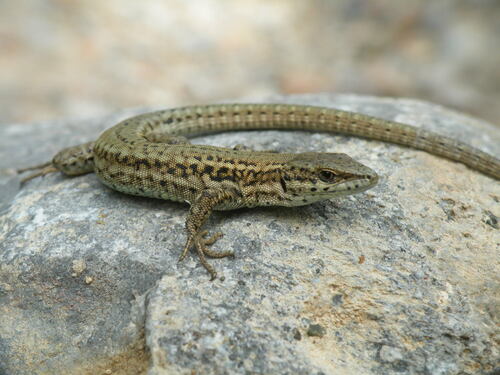
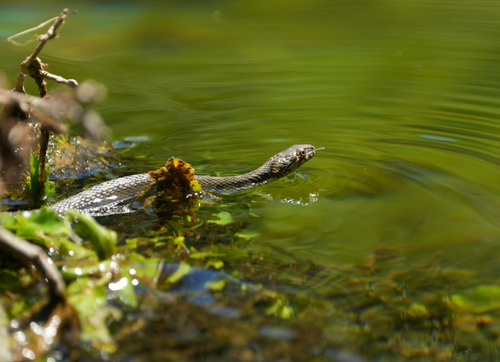
Large Psammodromus

Large Psammodromus

Psammodromus algirus

Silhouette: Gustav Mützel · PhyloPic

LCLeast ConcernNTVUENCR
Daily sighting probability ~10% · With luck
at Barcelona

In 3 days ~30% in a week ~50%

28 Verified sightings at Barcelona
530 In all 5 parks From 2019 to 2026
June Best month
☀️ Diurnal When it's spotted

About the Large Psammodromus

Psammodromus algirus, known commonly as the Algerian psammodromus or the large psammodromus, is a species of lizard in the family Lacertidae. The species is found in southwestern Europe and northwestern Africa. There are four subspecies:Psammodromus algirus algirus (Linnaeus, 1758)

Psammodromus algirus doriae Bedriaga, 1886 Psammodromus algirus nollii Fischer, 1887 Psammodromus algirus ketamensis Galán, 1931 Psammodromus algirus is found in North Africa (Morocco, Algeria, and Tunisia) and in Southwestern Europe (Iberian Peninsula: Portugal, Spain, Andorra, Gibraltar; southernmost France, and Italy near Lampedusa).

The IUCN assessment from 2009 treats Psammodromus algirus nollii and Psammodromus algirus ketamensis as full species and restricts Psammodromus algirus to North Africa. Psammodromus algirus typically occurs in dense bushy vegetation, but it can also venture to more open areas. It can be found at elevations up to 2,600 m (8,500 ft) above sea level, but it is more common at lower elevations.

Psammodromus algirus preys mainly on terrestrial arthropods, specifically Orthoptera, Formicidae, Coleoptera, Hemiptera... Wikipedia →
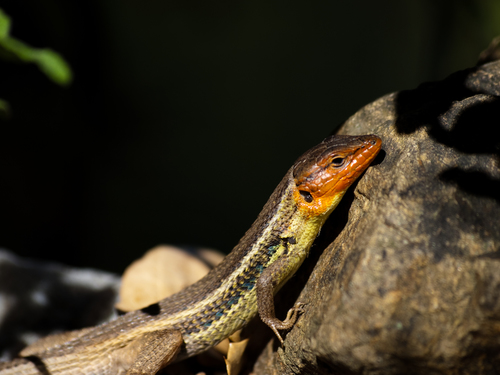
Global Distribution

Parks Where Found

# Park Country Daily sighting probability
1 Sierra Nevada National Park 🇪🇸 Spain
~60%
2 Monfragüe National Park 🇪🇸 Spain
~50%
3 Doñana National Park 🇪🇸 Spain
~40%
4 Sierra de Guadarrama National Park 🇪🇸 Spain
~30%
5 Pyrénées National Park 🇫🇷 France
~10%

Cities Where Found

# City Country Daily sighting probability
1 Algiers 🇩🇿 Algeria
~10%
2 Lisbon 🇵🇹 Portugal
~10%
3 Barcelona 🇪🇸 Spain
~10%
4 Madrid 🇪🇸 Spain
~10%
5 Porto 🇵🇹 Portugal
~10%

Before you go

What are the chances of seeing a Large Psammodromus in Barcelona?

With luck

About 10% of wildlife watchers report a Large Psammodromus sighting in Barcelona on a given day, based on 28 verified sightings from GBIF citizen-science data. It is the 4th most-seen of the 11 reptiles we can rate there. Over three days the chance rises to about 30%, and over a week to about 50%, if each day is a fresh chance.

When is the best time to see a Large Psammodromus in Barcelona?

June–July and September

In those months about 20% of wildlife watchers report a Large Psammodromus in Barcelona on a given day, against under 5% in November to February, the lowest months.

What time of day is best to see a Large Psammodromus?

Between 11 am and 2 pm

Across all the parks we cover, that three-hour window holds the most Large Psammodromus sightings with a recorded time, and about 8 in 10 of them come between 6 am and 6 pm: it is a daytime animal.

Is Barcelona the best place to see a Large Psammodromus?

Among the best

Of the 5 cities where we can rate Large Psammodromus sightings, Barcelona ranks 3rd at about 10%, level with the leaders once rounded. The best odds are in Algiers (Algeria, about 10%) and Lisbon (Portugal, about 10%).

Where does the Large Psammodromus sighting chance come from?

GBIF citizen-science records

It is estimated from how often the Large Psammodromus is recorded against all the reptiles logged in Barcelona (28 verified sightings), calibrated against known sighting rates. Figures are rounded to the nearest 10% because citizen-science data supports honest approximations, not decimals, and months with records from fewer than five people show "—". How it works.

← Back to Barcelona