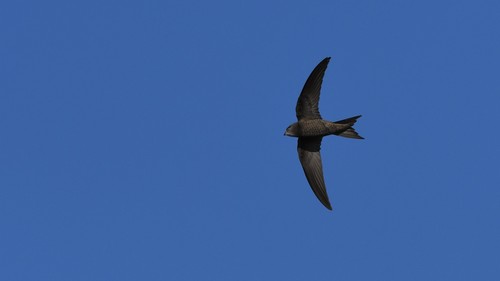
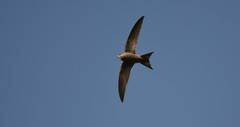
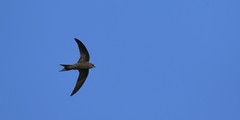
About the Pallid Swift
The pallid swift (Apus pallidus) is a swift (order Apodiformes). Swifts have very short legs which they use only for clinging to vertical surfaces. The genus name Apus is Latin for a swift, thought by the ancients to be a type of swallow with no feet (from Ancient Greek α, a, "without", and πούς, pous, "foot"), and pallidus is Latin for "pale". Like other swifts they never settle voluntarily on the ground, but spend most of their lives in the air, living on the insects they catch in their beaks. They drink on the wing.
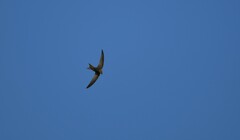
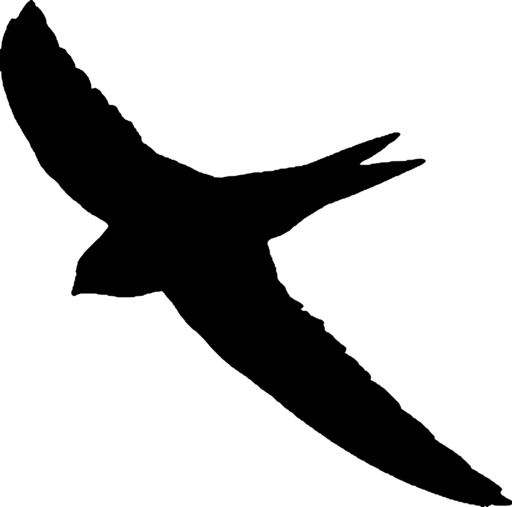
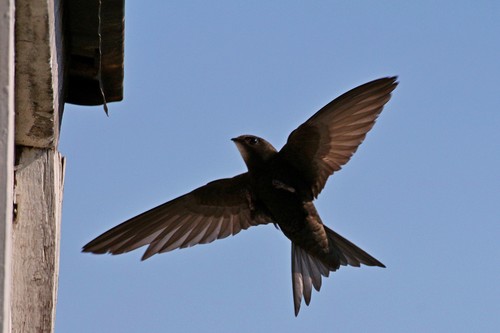
The pallid swift was first described by English naturalist George Ernest Shelley in 1870. This 16–17 cm (6.3–6.7 in) long species is very similar to the common swift, and separation is only possible with good views. Like its relative, it has a short forked tail and very long swept-back wings that resemble a crescent or a boomerang.
It is entirely dark except for a large white throat patch which is frequently visible from a distance. It is chunkier and browner than common swift, and the slightly paler flight feathers, underparts and rump give more contrast than that species. It also has a scalier looking belly and subtly different flight... Wikipedia →