Swan Moth
Daily sighting probability <5% · Rare
at Beijing

In 3 days ~10% in a week ~20%

10 Verified sightings at Beijing
99 In all 5 parks From 2019 to 2026
August Best month
☀️🌙 Day & Night When it's spotted

About the Swan Moth

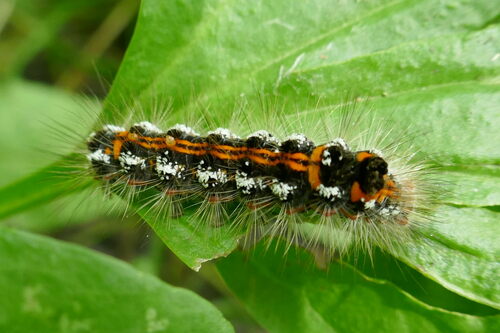
The yellow-tail, goldtail moth or swan moth (Sphrageidus similis) is a moth of the family Erebidae. The species was first described by Johann Kaspar Füssli in 1775, and has commonly been placed within the related genus Euproctis. It is distributed throughout Europe to the Urals, then east across the Palearctic to Siberia and south to India and Sri Lanka.

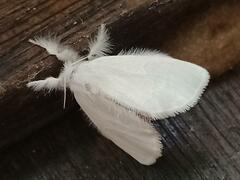
This species has a wingspan of 35–45 mm, the female usually noticeably larger than the male. All parts of the adults are pure white, apart from a bright yellow tip to the abdomen (larger in the female) and a small black or brown tornal mark on the forewing of the male.

White, and very like Euproctis chrysorrhoea, but more pure silky white, anal wool and hairs at the apex of the abdomen of the female golden yellow. Not rarely, especially in the male sex, color forms occur with small dark spots on the forewing: form "auriflua" has three spots at the inner angle, forming an oblique transverse row, and one spot in the basal area near the hindmargin; form "nyctea" has only one spot at the inner angle as well as one in the basal area like "auriflua"; form "trimaculata" is like "nyctea" but has another... Wikipedia →
Global Distribution

Parks Where Found

# Park Country Daily sighting probability
1 Snowdonia National Park 🇬🇧 United Kingdom
~20%
2 Białowieża National Park 🇵🇱 Poland
~10%
3 Wadden Sea National Park 🇩🇪 Germany
~10%
4 Pyrénées National Park 🇫🇷 France
~10%
5 Bavarian Forest National Park 🇩🇪 Germany
<5%

Cities Where Found

# City Country Daily sighting probability
1 Porto 🇵🇹 Portugal
~20%
2 Liverpool 🇬🇧 United Kingdom
~10%
3 Seoul 🇰🇷 South Korea
~10%
4 Helsinki 🇫🇮 Finland
~10%
5 Beijing 🇨🇳 China
<5%
6 London 🇬🇧 United Kingdom
<5%
7 Tokyo 🇯🇵 Japan
<5%

Before you go

What are the chances of seeing a Swan Moth in Beijing?

Rare

Under 5% of wildlife watchers report a Swan Moth sighting in Beijing on a given day, based on 10 verified sightings from GBIF citizen-science data. It is the 260th most-seen of the 401 insects we can rate there. Over three days the chance rises to about 10%, and over a week to about 20%, if each day is a fresh chance.

When is the best time to see a Swan Moth in Beijing?

August

In that month about 10% of wildlife watchers report a Swan Moth in Beijing on a given day, against under 5% in September to July, the lowest months. That is one of Beijing's wettest months, with about 110 mm of rain against almost none in January.

What time of day is best to see a Swan Moth?

Between 8 and 11 am

Across all the parks we cover, that three-hour window holds the most Swan Moth sightings with a recorded time, and about 7 in 10 of them come between 6 am and 6 pm: it is seen both by day and at night.

Is Beijing the best place to see a Swan Moth?

5th of 7

Of the 7 cities where we can rate Swan Moth sightings, Beijing ranks 5th at under 5%. The best odds are in Porto (Portugal, about 20%), Liverpool (United Kingdom, about 10%) and Seoul (South Korea, about 10%).

Where does the Swan Moth sighting chance come from?

GBIF citizen-science records

It is estimated from how often the Swan Moth is recorded against all the insects logged in Beijing (10 verified sightings), calibrated against known sighting rates. Figures are rounded to the nearest 10% because citizen-science data supports honest approximations, not decimals, and months with records from fewer than five people show "—". How it works.

← Back to Beijing