Elm Zigzag Sawfly

Elm Zigzag Sawfly

Aproceros leucopoda

Daily sighting probability <5% · Rare
at Berlin

In 3 days ~10% in a week ~20%

7 Verified sightings at Berlin
October Best month

About the Elm Zigzag Sawfly

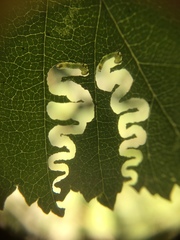
Aproceros leucopoda, the elm zigzag sawfly, is a species of sawfly in the family Argidae native to eastern Asia in China and Japan. It is an invasive species in Europe since 2003, and North America since 2020. The larva is green, around 4 mm long at first, growing to 10 mm long when full grown, and feeds on elm (Ulmus) leaves. At first it eats a very distinctive zig-zag shaped cut into the leaves, from which the species' English name derives. As the larva grows over its 4–7 instars, the feeding trace becomes less regular and less easily distinguished from other elm leaf feeding insects. The larva completes its growth in 2–3 weeks, then produces a transparent lattice-like cocoon on the underside of an elm leaf, in which it pupates. The pupa is also green, around 8 mm long. The adult hatches out after 4–7 days; it is a small black sawfly, 6–10 mm long, with pale legs. There are several generations in a year; the final generation of the autumn produces a thicker, more solid cocoon; this falls with the autumn leaves, with the insect overwintering as a pupa in the leaf litter to emerge as adults the following spring.

As an invasive species, it was first found in Europe in 2003, with the first records in Poland and Hungary; it spread westwards from there, reaching southeastern England in 2017. The first record in North America was in Quebec in 2020, and it has subsequently spread to several states in the United States. It can cause severe defoliation of elms, which can lead to their decline and death, particularly if other diseases are enabled to attack due to the tree's weakened status. Wikipedia →

Global Distribution

Parks Where Found

# Park Country Daily sighting probability

More parks will be added in future updates.

Cities Where Found

# City Country Daily sighting probability
1 London 🇬🇧 United Kingdom
~10%
2 Montreal 🇨🇦 Canada
<5%
3 Minneapolis [Saint Paul] 🇺🇸 United States
<5%
4 Berlin 🇩🇪 Germany
<5%
5 Paris 🇫🇷 France
<5%
6 Vienna 🇦🇹 Austria
<5%

Before you go

What are the chances of seeing an Elm Zigzag Sawfly in Berlin?

Rare

Under 5% of wildlife watchers report an Elm Zigzag Sawfly sighting in Berlin on a given day, based on 7 verified sightings from GBIF citizen-science data. It is the 801st most-seen of the 1065 insects we can rate there. Over three days the chance rises to about 10%, and over a week to about 20%, if each day is a fresh chance.

When is the best time to see an Elm Zigzag Sawfly in Berlin?

October and November

In those months about 10% of wildlife watchers report an Elm Zigzag Sawfly in Berlin on a given day, against under 5% in December to September, the lowest months.

Is Berlin the best place to see an Elm Zigzag Sawfly?

4th of 6

Of the 6 cities where we can rate Elm Zigzag Sawfly sightings, Berlin ranks 4th at under 5%. The best odds are in London (United Kingdom, about 10%), Montreal (Canada, under 5%) and Minneapolis [Saint Paul] (United States, under 5%).

Which relatives of the Elm Zigzag Sawfly live in Berlin?

Same order: Hymenoptera

The closest relatives of the Elm Zigzag Sawfly that you can see in Berlin (order Hymenoptera, Ants, Bees, Wasps, and Sawflies) are Common Carder Bumble Bee (about 30%), European Hornet (about 20%) and German Yellowjacket (about 20%), with each one's daily chance of a sighting.

Where does the Elm Zigzag Sawfly sighting chance come from?

GBIF citizen-science records

It is estimated from how often the Elm Zigzag Sawfly is recorded against all the insects logged in Berlin (7 verified sightings), calibrated against known sighting rates. Figures are rounded to the nearest 10% because citizen-science data supports honest approximations, not decimals, and months with records from fewer than five people show "—". How it works.

← Back to Berlin