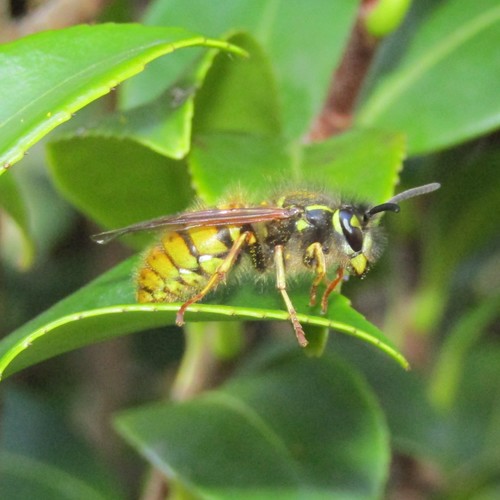
Mexican Grass-Carrying Wasp

Mexican Grass-Carrying Wasp

Isodontia mexicana

Daily sighting probability ~10% · With luck
at Berlin

In 3 days ~40% in a week ~60%

149 Verified sightings at Berlin
21 In all 3 parks From 2019 to 2026
July Best month
☀️ Diurnal When it's spotted

About the Mexican Grass-Carrying Wasp

Isodontia mexicana, the Mexican grass-carrying wasp, is a species of insect belonging to the family Sphecidae. It is mainly found throughout North America, but has become established in Europe, primarily France, Switzerland, Hungary, Italy, Serbia, and Spain.

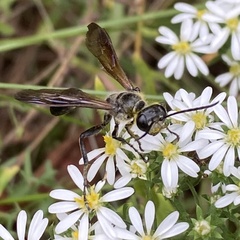
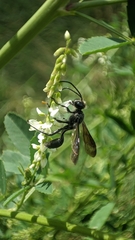
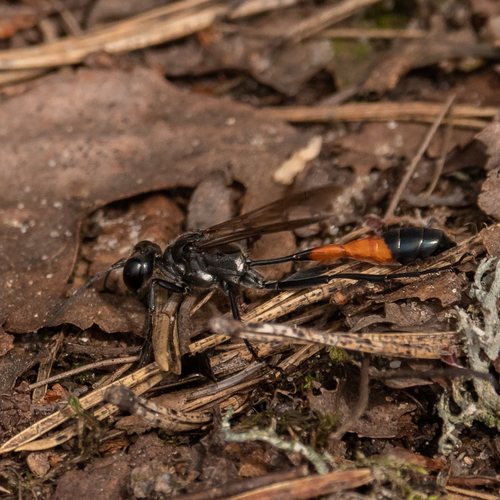
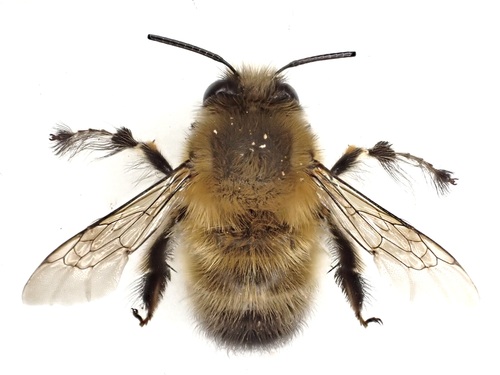
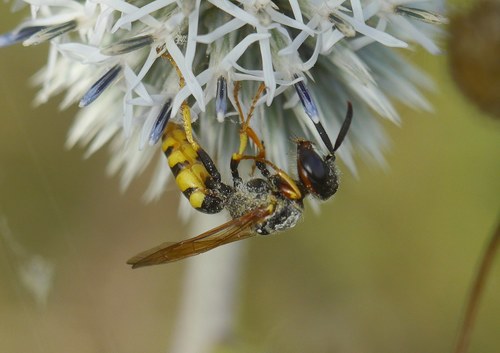
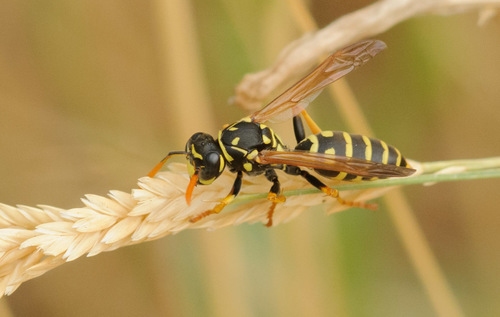
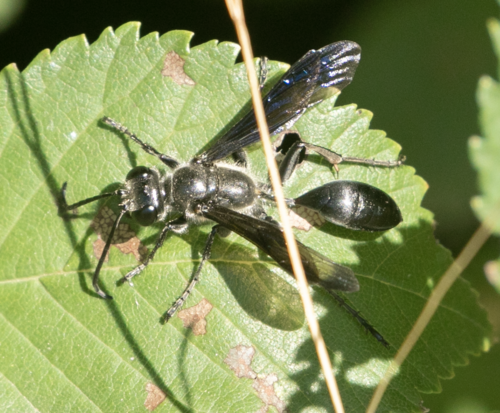
The adults grow up to 18–20 millimetres (0.71–0.79 in) long, the body is completely black, the thorax is quite hairy and the wings have a smoky-brown color. They can be encountered from early summer through September. Females are larger and emerge as adults later in the season than males.

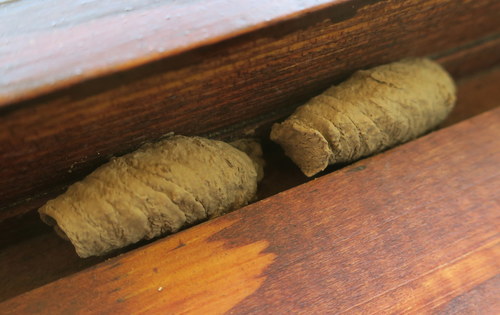
Isodontia mexicana is a typical case of a species arrived accidentally from North America and slowly encroaching on the European continent, probably for the lack of predators or parasites. These wasps build their nests in hollowed branches or in other natural cavities, often reusing the nests of other species. Then they line the inside with grass fragments or other plant fibers (hence the name of 'grass-carrying wasps').

Isodontia mexicana mainly preys on grasshoppers (usually katydids, Tettigoniidae species) or tree crickets (Gryllidae species), choosing the small ones and carrying them to its nest to feed the emerging larvae with the living, but paralyzed Orthoptera. Wikipedia →
Global Distribution

Parks Where Found

# Park Country Daily sighting probability
1 Bavarian Forest National Park 🇩🇪 Germany
~10%
2 Cévennes National Park 🇫🇷 France
<5%
3 Pyrénées National Park 🇫🇷 France
<5%

Cities Where Found

# City Country Daily sighting probability
1 Warsaw 🇵🇱 Poland
~10%
2 Berlin 🇩🇪 Germany
~10%
3 Paris 🇫🇷 France
~10%
4 Munich 🇩🇪 Germany
~10%
5 Cologne 🇩🇪 Germany
~10%
6 Vienna 🇦🇹 Austria
~10%
7 Budapest 🇭🇺 Hungary
~10%
8 Seattle 🇺🇸 United States
~10%
9 Prague 🇨🇿 Czechia
~10%
10 Minneapolis [Saint Paul] 🇺🇸 United States
~10%

Before you go

What are the chances of seeing a Mexican Grass-Carrying Wasp in Berlin?

With luck

About 10% of wildlife watchers report a Mexican Grass-Carrying Wasp sighting in Berlin on a given day, based on 149 verified sightings from GBIF citizen-science data. It is the 44th most-seen of the 1065 insects we can rate there. Over three days the chance rises to about 40%, and over a week to about 60%, if each day is a fresh chance.

When is the best time to see a Mexican Grass-Carrying Wasp in Berlin?

July

In that month about 30% of wildlife watchers report a Mexican Grass-Carrying Wasp in Berlin on a given day, against under 5% in October to May, the lowest months. That is one of Berlin's wettest months, with about 80 mm of rain against 30 mm in April.

What time of day is best to see a Mexican Grass-Carrying Wasp?

Between 3 and 6 pm

Across all the parks we cover, that three-hour window holds the most Mexican Grass-Carrying Wasp sightings with a recorded time, and nearly all of them come between 6 am and 6 pm: it is a daytime animal.

Is Berlin the best place to see a Mexican Grass-Carrying Wasp?

Among the best

Of the 26 cities where we can rate Mexican Grass-Carrying Wasp sightings, Berlin ranks 2nd at about 10%, level with the leaders once rounded. The best odds are in Warsaw (Poland, about 10%).

Which relatives of the Mexican Grass-Carrying Wasp live in Berlin?

Same family: Sphecidae

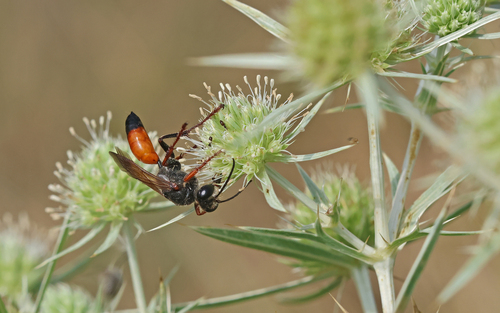
The closest relatives of the Mexican Grass-Carrying Wasp that you can see in Berlin (family Sphecidae, Thread-waisted Wasps) are Asian Mud-Dauber Wasp (about 10%) and Golden Digger Wasp (about 10%), with each one's daily chance of a sighting.

Where does the Mexican Grass-Carrying Wasp sighting chance come from?

GBIF citizen-science records

It is estimated from how often the Mexican Grass-Carrying Wasp is recorded against all the insects logged in Berlin (149 verified sightings), calibrated against known sighting rates. Figures are rounded to the nearest 10% because citizen-science data supports honest approximations, not decimals, and months with records from fewer than five people show "—". How it works.

← Back to Berlin