Snowy Owl

Snowy Owl

Bubo scandiacus

Silhouette: Steven Traver · PhyloPic

LCNTVUVulnerableENCR
Daily sighting probability <5% · Rare
at Boston

In 3 days <5%

15 Verified sightings at Boston
65 In 1 park From 2019 to 2026
December Best month
☀️ Diurnal When it's spotted

About the Snowy Owl

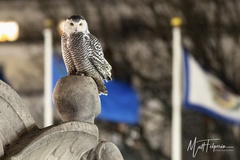
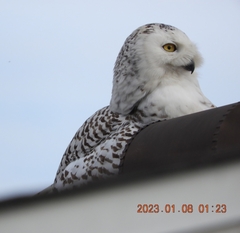
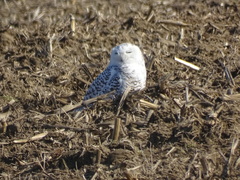
The snowy owl (Bubo scandiacus), also known as the polar owl, the white owl and the Arctic owl, is a large, white owl of the true owl family. Snowy owls are native to the Arctic regions of both North America and the Palearctic, breeding mostly on the tundra. It has a number of unique adaptations to its habitat and lifestyle, which are quite distinct from other extant owls. One of the largest species of owl, it is the only owl with mainly white plumage. Males tend to be a purer white overall while females tend to have more extensive flecks of dark brown. Juvenile male snowy owls have dark markings and may appear similar to females until maturity, at which point they typically turn whiter. The composition of brown markings about the wing, although not foolproof, is the most reliable technique for aging and sexing individual snowy owls.

Most owls sleep during the day and hunt at night, but the snowy owl is often active during the day, especially in the summertime. The snowy owl is both a specialized and generalist hunter. Its breeding efforts and global population are closely tied to the availability of tundra-dwelling lemmings, but in the non-breeding season, and occasionally during breeding, the snowy owl can adapt to almost any available prey – most often other small mammals and northerly water birds, as well as, opportunistically, carrion. Snowy owls typically nest on a small rise on the ground of the tundra. The snowy owl lays a very large clutch of eggs, often from about 5 to 11, with the laying and hatching of eggs considerably staggered. Despite the short Arctic summer, the development of the young takes a relatively long time and independence is sought in autumn.

The snowy owl is a nomadic bird, rarely breeding at the same locations or with the same mates on an annual basis and often not breeding at all if prey is unavailable. A largely migratory bird, snowy owls can wander almost anywhere close to the Arctic, sometimes unpredictably irrupting to the south in large numbers. Given the difficulty of surveying such an unpredictable bird, there was little in-depth knowledge historically about the snowy owl's status; however, 2020s data suggests the species is declining precipitously. Whereas the global population was once estimated at over 200,000 individuals, 2010s–2020s data suggests that there are probably fewer than 100,000 individuals globally and that the number of successful breeding pairs is 28,000 or even considerably less. Wikipedia →

Sounds

Call0:56

Japan · 2021

© Morioka Zoological Park ZOOMO · XC679718 · CC BY-NC-SA 4.0

Recording0:11

United Kingdom · 2021

© Peter Stronach · XC674464 · CC BY-NC-SA 4.0

Song0:09

Finland · 2012

© Tero Linjama · XC343145 · CC BY-NC-SA 4.0

Global Distribution

Parks Where Found

# Park Country Daily sighting probability
1 Acadia National Park 🇺🇸 United States
<5%

More parks will be added in future updates.

Cities Where Found

# City Country Daily sighting probability
1 Seattle 🇺🇸 United States
<5%
2 Washington 🇺🇸 United States
<5%
3 Toronto 🇨🇦 Canada
<5%
4 Los Angeles 🇺🇸 United States
<5%
5 Montreal 🇨🇦 Canada
<5%
6 Chicago 🇺🇸 United States
<5%
7 New York City 🇺🇸 United States
<5%
8 Boston 🇺🇸 United States
<5%
9 Minneapolis [Saint Paul] 🇺🇸 United States
<5%

Zoos & Centres Where Found

# Zoo / Centre Country
1 Chimelong Spaceship 🇨🇳 China In captivity
2 Pairi Daiza 🇧🇪 Belgium In captivity
3 ZooParc de Beauval 🇫🇷 France In captivity
4 Copenhagen Zoo 🇩🇰 Denmark In captivity
5 Dublin Zoo 🇮🇪 Ireland In captivity
6 Lisbon Oceanarium 🇵🇹 Portugal In captivity
7 Cabarceno Natural Park 🇪🇸 Spain In captivity
8 Ostrava Zoo 🇨🇿 Czechia In captivity
9 Chomutov Zoo 🇨🇿 Czechia In captivity
10 Walsrode World Bird Park 🇩🇪 Germany In captivity
11 Parc des oiseaux 🇫🇷 France In captivity
12 Kaliningrad Zoo 🇷🇺 Russia In captivity
13 Ecomuseum Zoo 🇨🇦 Canada In captivity
14 Ranua Wildlife Park 🇫🇮 Finland In captivity
15 Zoo d'Amiens 🇫🇷 France In captivity
16 Le rocher des aigles 🇫🇷 France In captivity
17 Northwest Trek Wildlife Park 🇺🇸 United States In captivity
18 Zoo Sauvage de St-Félicien 🇨🇦 Canada In captivity
19 Espace Rambouillet 🇫🇷 France In captivity
20 Beijing Wildlife Park 🇨🇳 China In captivity
21 African Lion Safari 🇨🇦 Canada In captivity
22 Toronto Zoo 🇨🇦 Canada In captivity
23 World Bird Sanctuary 🇺🇸 United States In captivity
24 Port Lympne Wild Animal Park 🇬🇧 United Kingdom In captivity
25 Bronx Zoo 🇺🇸 United States In captivity
26 Badoca Safari Park 🇵🇹 Portugal In captivity
27 Tallinn Zoo 🇪🇪 Estonia In captivity
28 Bratislava Zoo 🇸🇰 Slovakia In captivity
29 Chimelong Safari Park 🇨🇳 China In captivity
30 Highland Wildlife Park 🇬🇧 United Kingdom In captivity
31 Safari World 🇹🇭 Thailand In captivity
32 Ähtäri Zoo 🇫🇮 Finland In captivity
33 Banham Zoo 🇬🇧 United Kingdom In captivity
34 Cotswold Wildlife Park 🇬🇧 United Kingdom In captivity
35 Zoo de Pescheray 🇫🇷 France In captivity
36 Hillside Animal Sanctuary 🇬🇧 United Kingdom In captivity
37 Tiergarten Am Tiergarten 28 in Nürnberg 🇩🇪 Germany In captivity
38 The Maryland Zoo 🇺🇸 United States In captivity
39 Toledo Zoo 🇺🇸 United States In captivity
40 Tama Zoological Park 🇯🇵 Japan In captivity
41 Wildpark Gangelt 🇩🇪 Germany In captivity
42 Wildgehege Hellenthal 🇩🇪 Germany In captivity
43 Wildpark Leipzig 🇩🇪 Germany In captivity
44 Wildpark Schwarze Berge 🇩🇪 Germany In captivity
45 Louisville Zoo 🇺🇸 United States In captivity
46 Yaroslavl Zoo 🇷🇺 Russia In captivity
47 Bojnice Zoo 🇸🇰 Slovakia In captivity
48 Wildpark Knüll 🇩🇪 Germany In captivity
49 La Torbiera 🇮🇹 Italy In captivity
50 Nasu Animal Kingdom 🇯🇵 Japan In captivity

Before you go

What are the chances of seeing a Snowy Owl in Boston?

Rare

Under 5% of wildlife watchers report a Snowy Owl sighting in Boston on a given day, based on 15 verified sightings from GBIF citizen-science data. It is the 276th most-seen of the 283 birds we can rate there. Over three days the chance rises to under 5%, if each day is a fresh chance.

When is the best time to see a Snowy Owl in Boston?

Any time of year

In every month with enough records, under 5% of wildlife watchers report a Snowy Owl in Boston on a given day, so our monthly data shows no clear season.

What time of day is best to see a Snowy Owl?

Between 2 and 5 pm

Across all the parks we cover, that three-hour window holds the most Snowy Owl sightings with a recorded time, and about 8 in 10 of them come between 6 am and 6 pm: it is a daytime animal.

Is Boston the best place to see a Snowy Owl?

Among the best

Of the 9 cities where we can rate Snowy Owl sightings, Boston ranks 8th at under 5%, level with the leaders once rounded. The best odds are in Seattle (United States, under 5%), Washington (United States, under 5%) and Toronto (Canada, under 5%).

Where does the Snowy Owl sighting chance come from?

GBIF citizen-science records

It is estimated from how often the Snowy Owl is recorded against all the birds logged in Boston (15 verified sightings), calibrated against known sighting rates. Figures are rounded to the nearest 10% because citizen-science data supports honest approximations, not decimals, and months with records from fewer than five people show "—". How it works.

← Back to Boston