Daily sighting probability ~10% · With luck
at Brisbane

In 3 days ~30% in a week ~50%

136 Verified sightings at Brisbane
53 In all 5 parks From 2019 to 2026
February Best month
☀️ Diurnal When it's spotted

About the Great Jay

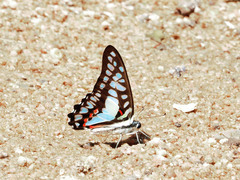
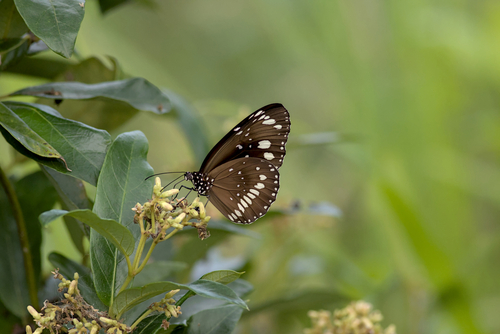
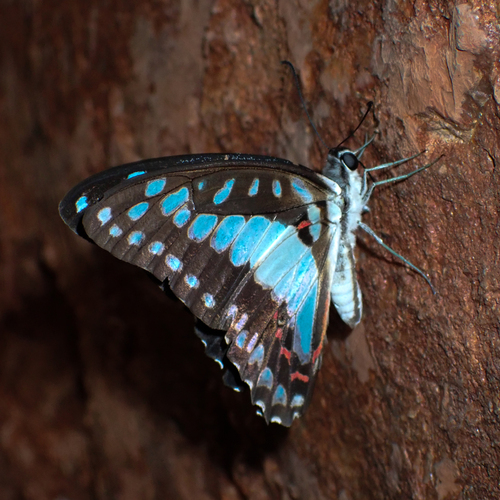
Graphium eurypylus, the great jay or pale green triangle, is a species of tropical butterfly belonging to the family Papilionidae. The specific name eurypylus likely comes from the name Eurypylus, a Thessalian king who lead the Thessalians during the Trojan War.

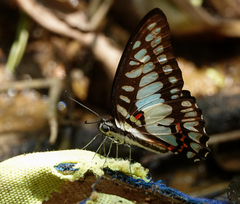
This species can be found in the Australasian realm and in the Indomalayan realm (Northeast India, Southeast Asia and Australia). Graphium eurypylus has a wingspan reaching about 7–8 centimetres (2.8–3.1 in). The basic colour of the uppersides of the wings is black, with a chain of yellowish or greenish spots at the edges. In the middle of the forewings there is a large yellowish or greenish area. The undersides of the wings are similar to the uppersides, but the basic colour is brownish and the spots are paler or whitish. The hindwings have a few red spots.

Subspecies G. e. jason (South India and Sri Lanka) — Males and females. Upperside black. Forewing: three slender, oblique, short pale green streaks in basal half of cell and two irregular small similarly-coloured spots near its apex; a discal band composed of pale green spots that gradually diminish in size anteriorly... Wikipedia →
Global Distribution

Parks Where Found

# Park Country Daily sighting probability
1 Cuc Phuong National Park 🇻🇳 Vietnam
~30%
2 Tangkoko Nature Reserve 🇮🇩 Indonesia
~20%
3 Kakadu National Park 🇦🇺 Australia
~20%
4 Cat Tien National Park 🇻🇳 Vietnam
~10%
5 Lamington National Park 🇦🇺 Australia
~10%

Cities Where Found

# City Country Daily sighting probability
1 Brisbane 🇦🇺 Australia
~10%
2 Sydney 🇦🇺 Australia
<5%

Before you go

What are the chances of seeing a Great Jay in Brisbane?

With luck

About 10% of wildlife watchers report a Great Jay sighting in Brisbane on a given day, based on 136 verified sightings from GBIF citizen-science data. It is the 117th most-seen of the 1083 insects we can rate there. Over three days the chance rises to about 30%, and over a week to about 50%, if each day is a fresh chance.

When is the best time to see a Great Jay in Brisbane?

January and February

In those months about 20% of wildlife watchers report a Great Jay in Brisbane on a given day, against under 5% in April to October, the lowest months. Those are among Brisbane's wettest months, with about 150 mm of rain a month against 40 mm in July.

What time of day is best to see a Great Jay?

Between 10 am and 1 pm

Across all the parks we cover, that three-hour window holds the most Great Jay sightings with a recorded time, and nearly all of them come between 6 am and 6 pm: it is a daytime animal.

Is Brisbane the best place to see a Great Jay?

Yes

Of the 2 cities where we can rate Great Jay sightings, Brisbane has the highest daily chance: about 10%. Next come Sydney (Australia, under 5%).

Which relatives of the Great Jay live in Brisbane?

Same family: Papilionidae

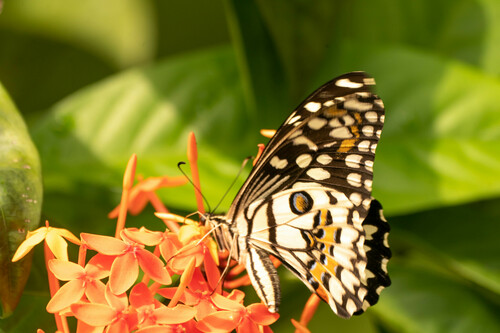
The closest relatives of the Great Jay that you can see in Brisbane (family Papilionidae, Swallowtails and Parnassians) are Orchard Swallowtail (about 30%), Lime Swallowtail (about 10%) and Dainty Swallowtail (about 10%), with each one's daily chance of a sighting.

Where does the Great Jay sighting chance come from?

GBIF citizen-science records

It is estimated from how often the Great Jay is recorded against all the insects logged in Brisbane (136 verified sightings), calibrated against known sighting rates. Figures are rounded to the nearest 10% because citizen-science data supports honest approximations, not decimals, and months with records from fewer than five people show "—". How it works.

← Back to Brisbane