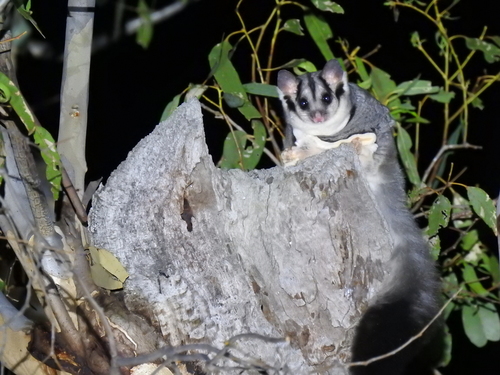
Sugar Glider

Sugar Glider

Petaurus breviceps

Silhouette: Steven Traver · PhyloPic

LCLeast ConcernNTVUENCR Endemic
Daily sighting probability <5% · Rare
at Brisbane

In 3 days ~10% in a week ~20%

9 Verified sightings at Brisbane
52 In all 3 parks From 2019 to 2026
January Best month
🌙 Nocturnal When it's spotted

About the Sugar Glider

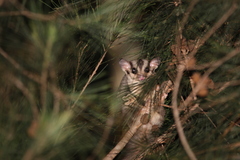
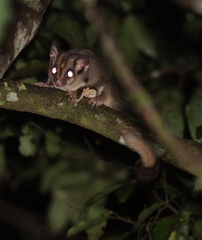
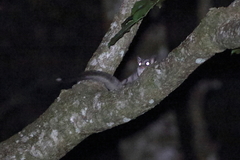
The sugar glider (Petaurus breviceps) is a small, omnivorous, arboreal, and nocturnal gliding possum. The common name refers to its predilection for sugary foods such as sap and nectar and its ability to glide through the air, much like a flying squirrel. They have very similar habits and appearance to the flying squirrel, despite not being closely related—an example of convergent evolution. The scientific name, Petaurus breviceps, translates from Latin as "short-headed rope-dancer", a reference to their canopy acrobatics.

The sugar glider is characterised by its pair of gliding membranes, known as patagia, which extend from its forelegs to its hindlegs. Gliding serves as an efficient means of reaching food and evading predators. The animal is covered in soft, pale grey to light brown fur which is countershaded, being lighter in colour on its underside.

The sugar glider, as strictly defined in a recent analysis, is only native to a small portion of southeastern Australia, corresponding to southern Queensland and most of New South Wales east of the Great Dividing Range; the extended species group, including populations which may or may not belong to P. breviceps, occupies a larger range covering much of coastal eastern and northern Australia, New Guinea, and nearby islands. Members of Petaurus are popular exotic pets. Wikipedia →

Sounds

Call0:31

Australia · 2026

© Marc Anderson · XC1089161 · CC BY-NC-ND 4.0

Recording0:17

Australia · 2022

© Michael Tervo · iNaturalist · CC BY-NC 4.0

Recording0:20

Australia · 2025

© Christine Rand · iNaturalist · CC BY-NC 4.0

Global Distribution

Parks Where Found

# Park Country Daily sighting probability
1 Lamington National Park 🇦🇺 Australia
~10%
2 Royal National Park 🇦🇺 Australia
~10%
3 Blue Mountains National Park 🇦🇺 Australia
~10%

Cities Where Found

# City Country Daily sighting probability
1 Sydney 🇦🇺 Australia
~10%
2 Brisbane 🇦🇺 Australia
<5%

Zoos & Centres Where Found

# Zoo / Centre Country
1 Pairi Daiza 🇧🇪 Belgium In captivity
2 San Diego Zoo Safari Park 🇺🇸 United States In captivity
3 Nehru Zoological Park 🇮🇳 India In captivity
4 Tallinn Zoo 🇪🇪 Estonia In captivity
5 Tama Zoological Park 🇯🇵 Japan In captivity
6 Yaroslavl Zoo 🇷🇺 Russia In captivity
7 Night Safari 🇸🇬 Singapore In captivity
8 Singapore Zoo 🇸🇬 Singapore In captivity
9 Currumbin Wildlife Sanctuary 🇦🇺 Australia In captivity
10 Krakow Zoo 🇵🇱 Poland In captivity
11 Kangaroo Creek Farm 🇨🇦 Canada In captivity
12 Sea Life Sydney Aquarium 🇦🇺 Australia In captivity
13 Wild Life Sydney 🇦🇺 Australia In captivity
14 Aquarium River of Zaragoza 🇪🇸 Spain In captivity
15 Bird Kingdom 🇨🇦 Canada In captivity
16 Nanjing Underwater World 🇨🇳 China In captivity

Before you go

What are the chances of seeing a Sugar Glider in Brisbane?

Rare

Under 5% of wildlife watchers report a Sugar Glider sighting in Brisbane on a given day, based on 9 verified sightings from GBIF citizen-science data. It is the 17th most-seen of the 22 mammals we can rate there. Over three days the chance rises to about 10%, and over a week to about 20%, if each day is a fresh chance.

When is the best time to see a Sugar Glider in Brisbane?

January

In that month about 10% of wildlife watchers report a Sugar Glider in Brisbane on a given day, against under 5% in February to December, the lowest months. That is one of Brisbane's wettest months, with about 140 mm of rain against 40 mm in July.

What time of day is best to see a Sugar Glider?

Between 7 and 10 pm

Across all the parks we cover, that three-hour window holds the most Sugar Glider sightings with a recorded time, and about 9 in 10 of them come between 6 pm and 6 am: it is mostly seen at night.

Is Brisbane the best place to see a Sugar Glider?

2nd of 2

Of the 2 cities where we can rate Sugar Glider sightings, Brisbane ranks 2nd at under 5%. The best odds are in Sydney (Australia, about 10%).

Where does the Sugar Glider sighting chance come from?

GBIF citizen-science records

It is estimated from how often the Sugar Glider is recorded against all the mammals logged in Brisbane (9 verified sightings), calibrated against known sighting rates. Figures are rounded to the nearest 10% because citizen-science data supports honest approximations, not decimals, and months with records from fewer than five people show "—". How it works.

← Back to Brisbane