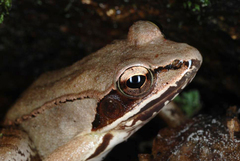
About the Wood Frog
Lithobates sylvaticus or Rana sylvatica, commonly known as the wood frog, is a frog species that has a broad distribution over North America, extending from the boreal forest of the north to the southern Appalachians, with several notable disjunct populations including lowland eastern North Carolina. The wood frog has garnered attention from biologists because of its freeze tolerance, relatively great degree of terrestrialism (for a ranid), interesting habitat associations (peat bogs, vernal pools, uplands), and relatively long-range movements. It is the only North American frog that occurs north of the Arctic Circle.
The ecology and conservation of the wood frog has attracted research attention in recent years because they are often considered "obligate" breeders in ephemeral wetlands (sometimes called "vernal pools"), which are themselves more imperiled than the species that breed in them. The wood frog has been proposed to be the official state amphibian of New York.
Wood frogs range from 51 to 70 mm (2.0 to 2.8 in) in length. Females are larger than males. Adult wood frogs are usually brown, tan, or rust-colored, and usually have a dark eye mask. Individual frogs... Wikipedia →