Aurora House Snake

Aurora House Snake

Lamprophis aurora

Silhouette: SeismicShrimp · PhyloPic

LCLeast ConcernNTVUENCR
Daily sighting probability ~10% · With luck
at Cape Town

In 3 days ~20% in a week ~40%

55 Verified sightings at Cape Town
15 In 1 park From 2019 to 2026
June Best month
☀️🌙 Day & Night When it's spotted

About the Aurora House Snake

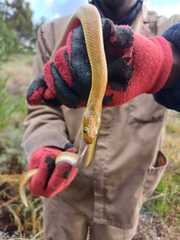
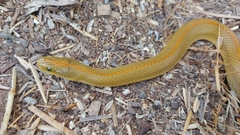
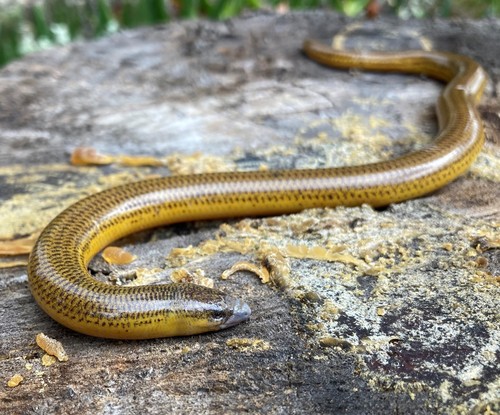
The Aurora house snake, Aurora snake, African house snake, or night snake (Lamprophis aurora) is a non-venomous species of lamprophiid snake. It is endemic to Southern Africa (South Africa, Lesotho, Eswatini, Botswana). This species of house snake is widespread across South Africa, where it is present all provinces (except for most of the Northern Cape). It also occurs in Lesotho, Eswatini and eastern Botswana, although this might represent a translocation.

The snake can achieve a maximum length of 90 cm, but averages 45–60 cm. Colour varies from shiny olive green to dull dark green above. A bright yellow to orange vertebral stripe runs from the top of the head to the tip of the tail.

This species occurs in grassland, fynbos, and moist savanna habitats at elevations up to 1,700 m (5,600 ft) above sea level. They are often found near streams and under rocks, and may occur in old termitaria. It is secretive but can be locally common. It is active at night (nocturnal). The diet consists of rodents, lizards, and frogs. The female lays clutches of up to 12 eggs. It is non-venomous and seldom attempts to bite. Wikipedia →

Global Distribution

Parks Where Found

# Park Country Daily sighting probability
1 Table Mountain National Park 🇿🇦 South Africa
<5%

More parks will be added in future updates.

Cities Where Found

# City Country Daily sighting probability
1 Cape Town 🇿🇦 South Africa
~10%
2 Johannesburg 🇿🇦 South Africa
~10%

Before you go

What are the chances of seeing an Aurora House Snake in Cape Town?

With luck

About 10% of wildlife watchers report an Aurora House Snake sighting in Cape Town on a given day, based on 55 verified sightings from GBIF citizen-science data. It is the 14th most-seen of the 35 reptiles we can rate there. Over three days the chance rises to about 20%, and over a week to about 40%, if each day is a fresh chance.

When is the best time to see an Aurora House Snake in Cape Town?

September to July

In those months about 10% of wildlife watchers report an Aurora House Snake in Cape Town on a given day, against under 5% in August, the lowest month.

What time of day is best to see an Aurora House Snake?

Between 11 am and 2 pm

Across all the parks we cover, that three-hour window holds the most Aurora House Snake sightings with a recorded time, and about 7 in 10 of them come between 6 am and 6 pm: it is seen both by day and at night.

Is Cape Town the best place to see an Aurora House Snake?

Yes

Of the 2 cities where we can rate Aurora House Snake sightings, Cape Town has the highest daily chance: about 10%. Next come Johannesburg (South Africa, about 10%).

Which relatives of the Aurora House Snake live in Cape Town?

Same family: Lamprophiidae

The closest relatives of the Aurora House Snake that you can see in Cape Town (family Lamprophiidae, Lamprophiid Snakes) are Common Brown Water Snake (about 20%) and Brown House Snake (about 10%), with each one's daily chance of a sighting.

Where does the Aurora House Snake sighting chance come from?

GBIF citizen-science records

It is estimated from how often the Aurora House Snake is recorded against all the reptiles logged in Cape Town (55 verified sightings), calibrated against known sighting rates. Figures are rounded to the nearest 10% because citizen-science data supports honest approximations, not decimals, and months with records from fewer than five people show "—". How it works.

← Back to Cape Town